The 2026 Refrigerant Cliff: Why Your Next Unit Isn’t Just ‘Another AC’
I was standing in a crawlspace in Savannah last August, the kind where the humidity is so thick you feel like you’re breathing through a wet wool blanket. I’d been called in to follow up on a ‘Sales Tech’—one of those guys who wears a crisp white shirt and hasn’t touched a manifold gauge in five years. He’d told the homeowner, a retired shop teacher who knew a thing or two about mechanics, that his entire system was ‘terminal’ and needed a $17,000 replacement because of a minor refrigerant leak. The kicker? He was trying to push a leftover R-410A unit just weeks before the hard phase-out. I found the leak in a Schrader valve—a five-cent fix—but the conversation we had that day is one every homeowner needs to hear before 2026. The HVAC industry is currently walking off a regulatory cliff, and if you aren’t paying attention to the specific Thermal Expansion Valve (TXV) in your 2026 AC installation, you’re buying a dinosaur.
The Death of R-410A and the Rise of A2L
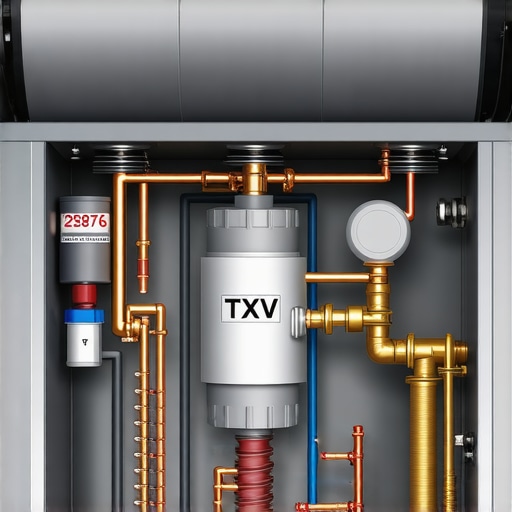
We are currently witnessing the end of the R-410A era. For twenty years, that ‘juice’ has been the standard, but as of 2025 and 2026, the EPA has slammed the door shut on high-GWP (Global Warming Potential) refrigerants. We’re moving to A2L refrigerants—specifically R-454B and R-32. Now, don’t let the ‘mildly flammable’ label scare you; your hairspray is more dangerous. But from a physics perspective, these new gases behave differently. They have a different ‘glide’—that’s the temperature range where the refrigerant boils and condenses. This is why the TXV, the component that meters the flow of refrigerant into your evaporator coil, is more critical now than it was in the 1990s. If you’re getting a heating service or a new AC installation in 2026, an old-school mechanical TXV might not cut it. You need an Electronic Expansion Valve (EEV) or a high-precision A2L-optimized TXV.
“The most expensive equipment in the world cannot overcome a bad duct system.” – Industry Axiom
Thermodynamic Zooming: Why the TXV is the Brain of Your System
Let’s talk shop. In a humid climate like the Southeast, your AC has two jobs: sensible cooling (dropping the temperature) and latent cooling (removing moisture). When the refrigerant enters the evaporator coil, it needs to be at the exact right pressure to drop the coil temperature below the dew point. If your TXV is ‘hunting’—opening and closing erratically—your coil temperature fluctuates. When it stays too warm, you aren’t pulling water out of the air. You end up with a house that’s 72 degrees but 70% humidity—a cold swamp. The new A2L refrigerants require a valve that can respond to the load in milliseconds, not minutes. This is why a mini-split often outperforms a traditional central air system; they use EEVs that talk directly to the inverter compressor to maintain a perfect 1-degree superheat. If your AC installation tech isn’t talking about subcooling and superheat targets for the specific refrigerant glide of R-454B, kick them off your property.
The Trap: Why Buying ‘Cheap’ in 2026 Will Cost You $10k
There’s a temptation to find a contractor who has a ‘new-old-stock’ R-410A unit sitting in his warehouse. He’ll offer it to you for a ‘steal.’ Here is the trap: R-410A production is being slashed by 40%, then 70%, then 85%. By the time that unit needs a furnace repair or a simple recharge in five years, the cost of the gas will be higher than the value of the unit. Furthermore, the heat exchangers in 2026-compliant systems are designed for the higher efficiencies required by the new SEER2 ratings. Using an outdated metering device on a modern coil is like putting a carburetor on a Tesla. It’s inefficient, it’s noisy, and it leads to liquid slugging—where liquid refrigerant makes it back to the compressor and destroys the bearings. You’ll hear that ‘death rattle’—a metallic screech that means your $3,000 compressor just turned into a boat anchor.
“Design and installation of residential systems shall be in accordance with ACCA Manual J and Manual S.” – ASHRAE Standard 15.2
Static Pressure and the ‘Tin Knocker’s’ Revenge
You can buy the fanciest R-454B unit with a digital TXV, but if your ductwork is junk, the system is junk. I see it every day: a homeowner spends $12,000 on a high-end unit, but they have a return air drop that’s half the size it needs to be. The system can’t breathe. It’s like trying to run a marathon while breathing through a cocktail straw. This is where the ‘Tin Knocker’ (the ductwork specialist) earns his keep. In 2026, these new systems are hypersensitive to static pressure. If the pressure is too high, the variable speed blower motor will ramp up to 100% capacity to compensate, burning itself out and doubling your electric bill. I always tell my apprentices: ‘Pookie’ is your best friend. Mastic sealant—we call it Pookie—is the difference between a system that actually delivers 2 tons of cooling and one that leaks half its capacity into your attic. If you see your installer using silver tape instead of mastic, they’re cutting corners.
The Verdict: Trane, Carrier, or Goodman?
People always ask me, ‘What’s the best brand?’ In 2026, the brand matters less than the guy holding the torch. However, since the A2L transition, some manufacturers have leaned harder into EEV technology. Trane and Carrier are leading the charge on integrated sensors that can detect a refrigerant leak—a safety requirement for A2L—and adjust the TXV to prevent the coil from freezing. If you are looking at a mini-split, brands like Mitsubishi have been using these ‘mildly flammable’ gases globally for years; they have the tech down to a science. Whether you need a heating service update or a full system swap, ensure your technician is EPA Section 608 certified for A2L refrigerants. If they call it ‘freon,’ they’re 20 years behind the times. It’s refrigerant, and in 2026, it’s a whole new ballgame.“,