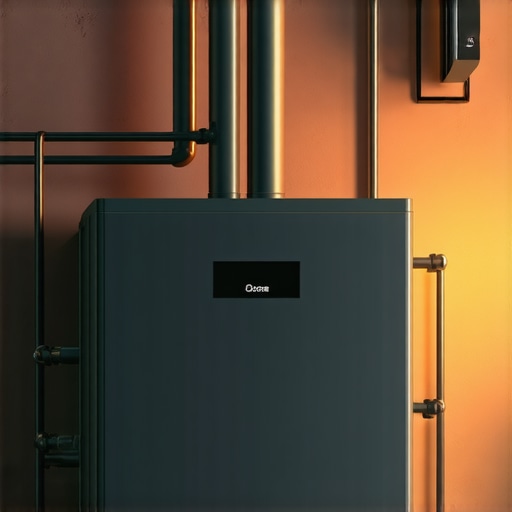
The Metallic Tang of Trouble: Why Your Furnace Smells Like a Thunderstorm
When you walk into a house in the dead of a Michigan February and the air smells like a lightning strike just happened in the living room, my gut usually clenches. That sharp, metallic, almost bleach-like scent is ozone. In thirty years of crawling through crawlspaces and dragging my tool bag across frozen rooftops, I’ve learned that ozone isn’t just a ‘weird smell’—it’s the scent of chemistry happening where it shouldn’t. Most homeowners mistake it for ‘freshness’ because of those cheap ionizers sold on late-night TV, but in a forced-air system, it’s often the signature of a component that’s currently eating itself alive. If you’re smelling it, your heating service needs aren’t just about comfort anymore; they’re about preventing a structural fire or a total system meltdown.
The Sales Tech Scam: A $9,000 Dust Bunny
I remember following a ‘Sales Tech’—one of those guys who gets a commission for every unit he condemns—to a bungalow in the suburbs. The previous guy told the homeowner, a retired schoolteacher, that her furnace was ‘leaking raw electricity’ and producing ozone because the heat exchanger had disintegrated. He quoted her $9,000 for a new AC installation and furnace combo. When I pulled the door off that cabinet, I didn’t see a cracked heat exchanger. I saw a twenty-year-old Electronic Air Cleaner (EAC) that hadn’t been washed since the Clinton administration. The collector plates were so caked with conductive dust that the high-voltage transformer was constantly arcing, creating a miniature lightning storm inside the return air. I spent twenty minutes cleaning the cells in her utility sink, and the ‘ozone’ smell vanished. She didn’t need a new system; she needed a technician who wasn’t a shark. That’s why I tell people: airflow and maintenance are the only things that keep the ‘juice’ where it belongs.
“The most expensive equipment in the world cannot overcome a bad duct system or a lack of basic maintenance.” – Industry Axiom
1. The Arcing Blower Motor: Commutators in Crisis
The most common source of an ozone smell in a 2026-era furnace is the blower motor. If you have an older Permanent Split Capacitor (PSC) motor or even an early ECM (Electronically Commutated Motor), the internal components can fail. Specifically, when the brushes or the windings begin to short out, they create micro-arcs. This electricity jumps the gap between components, ionizing the oxygen in the air and creating O3—ozone. You’ll usually hear a faint ‘tick-tick-tick’ or a high-pitched screech from a failing bearing alongside the smell. If the motor is struggling to push air through a filthy, restrictive filter, it draws more amperage, generates more heat, and eventually, the insulation on the copper windings starts to cook. That’s when the ‘ozone’ turns into the acrid, sour stench of a winding burnout. A proper furnace repair involves checking the static pressure to ensure the motor isn’t working itself to death.
2. Electronic Air Cleaners: When Good Tech Goes Bad
Many high-end systems are paired with electronic air cleaners. These units use high-voltage wires to give dust particles a charge, which then stick to collector plates. It’s a great way to keep the air clean, but if the voltage regulator fails or if the wires are snapped, they start ‘nuisance arcing.’ This is a primary producer of ozone. In the North, where we keep the windows sealed tight for six months, that ozone concentration can reach levels that irritate the lungs. If you smell it, check your EAC. If it’s ‘snapping’ constantly like popcorn, you’ve got a short. Sometimes, a mini-split system in a bedroom can exhibit similar smells if the plasma ionizer is malfunctioning, though those are much lower voltage than a central furnace.
“Ventilation systems shall be designed to prevent the re-entrainment of contaminants and maintain indoor air quality levels as prescribed by local codes.” – ASHRAE Standard 62.1
3. The Control Board ‘Fried’ Circuitry
Modern furnaces are basically computers that burn gas. The integrated furnace control (IFC) board manages everything from the igniter to the inducer motor. If a relay on that board starts to fail, it can chatter. This rapid opening and closing of electrical contacts creates heat and ozone. I’ve seen boards where the ‘Sparky’ (the electrician) didn’t tighten the lugs properly, leading to high-resistance connections. The plastic coating on the wires begins to off-gas a chemical smell that mimics ozone. This is a critical safety fix because a chattering relay is a precursor to a board fire. During a heating service, I always look for those brown ‘toast’ marks on the green circuit board. If I see them, that board is a ticking time bomb.
4. Cracked Heat Exchangers and Flame Rollout
While a cracked heat exchanger usually produces Carbon Monoxide (which is odorless), the resulting ‘flame rollout’ can burn internal wiring or plastic grommets. When the heat exchanger loses integrity, the blower motor’s air pressure can push the burner flame back toward the cabinet. This singes the wiring harness. The smell of melting wire insulation is often confused with ozone by homeowners. This is why a combustion analysis is non-negotiable. If your furnace is over 15 years old and you smell ‘electricity’ when the burners kick on, you need to shut it down immediately. We don’t play games with cracked heat exchangers; that’s a ‘red tag’ situation every single time. 2026 safety standards are stricter than ever regarding these leaks, and for good reason.
The Thermodynamic Reality of 2026 Fixes
We are moving into an era of A2L refrigerants and higher-efficiency furnaces. Whether you’re dealing with a standard gas furnace or a heat pump/mini-split hybrid, the physics of airflow remains the king. Ozone is a symptom of electrical stress or ionization. Don’t let a ‘Sales Tech’ convince you that a smell means you need a whole new AC installation unless they can show you the failure with a multimeter or a camera. Most of the time, the fix is in the details—cleaning the ‘Pookie’ (mastic) off a sensor, replacing a $50 capacitor, or scrubbing the collector cells of an air cleaner. Keep your filters clean, keep your ‘tin knocker’ (duct specialist) on speed dial for annual checkups, and never ignore the smell of a thunderstorm in your basement.