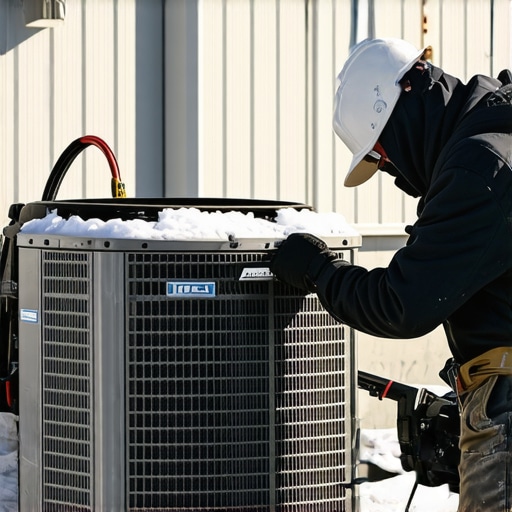
The Sound of a Choking Machine
You wake up at 3 AM in a house that feels like a meat locker, and instead of the gentle hum of your high-efficiency mini-split, you hear it: a rhythmic, metallic thump-shriek-thump. It is the sound of an ice-bound blower wheel trying to chew through a solid block of frost. As an HVAC veteran who has spent more time in crawlspaces than in my own living room, I can tell you that a frozen mini-split is not just a nuisance; it is a cry for help from the laws of thermodynamics. By 2026, we are dealing with a new breed of equipment using A2L refrigerants, and the old tricks for a standard furnace repair or a legacy AC installation don’t always apply to these complex inverter-driven beasts.
“The design of the air distribution system shall be based on the heating and cooling loads as determined by the calculations in Manual J.” – ACCA Manual S
The Physics Lesson: You Can’t Heat What You Can’t Move
My old mentor, a man who smelled perpetually of PVC glue and stale coffee, used to scream at me every time I reached for my gauges too fast: ‘You can’t heat what you can’t touch!’ He was talking about airflow. In a mini-split, the evaporator coil (or the condenser in heating mode) is a heat exchanger. If the air isn’t moving across those fins at the precise velocity the engineers intended, the ‘juice’—that’s the refrigerant—doesn’t have a place to dump its thermal energy. In the winter, your outdoor unit is trying to find heat in the freezing air to bring inside. When the physics fail, the coil temperature drops below the dew point, moisture flashes into frost, and before you know it, you’ve got a 200-pound popsicle hanging off the side of your house.
The 2026 Reality: Why Your New Unit is Acting Up
We are in the era of the A2L transition. If you had a heating service call recently, you might have noticed the new sensors on your 2026-spec unit. These systems are designed to be safer and more efficient, but they are also more sensitive to static pressure. If your mini-split is icing up, the culprit is rarely a mystery; it’s usually a violation of basic psychrometrics. Here are the five fast fixes to get the heat back on before the compressor starts ‘slugging’ liquid and kills itself.
1. The ‘Biofilm’ Barrier: Beyond the Plastic Mesh
Most homeowners think they’re doing a great job by rinsing the plastic mesh filters every six months. Wrong. Those filters are just ‘rock catchers.’ Inside the indoor head, the blower wheel is a magnet for skin cells, pet dander, and cooking grease. This creates a biofilm that narrows the gaps between the blades. This reduces the CFMs (Cubic Feet per Minute) to a crawl. When the air slows down, the coil temperature plummets. I’ve seen ‘Sales Techs’ tell people they need a whole new AC installation because of a dirty blower wheel. Don’t fall for it. If that wheel isn’t ‘beer can cold’ in the summer or ‘hot to the touch’ in the winter, it’s usually just choked with muck. Get a pressurized cleaning bag and blow the gunk out.
2. The Defrost Logic Check
Your mini-split is supposed to go into a defrost cycle—essentially reversing itself to heat up the outdoor coil and melt the ice. If you see your outdoor unit encased in a glacier, the ‘brain’ isn’t talking to the sensors. By 2026, most units use a thermistor clamped to the u-bend of the coil. If that sensor has slipped or the resistance has drifted, the board thinks the coil is 40°F when it’s actually 10°F. No defrost means total ice-over. A real tech will check the Ohms on that thermistor before trying to sell you a new compressor.
“A heat pump must be equipped with a defrost control system that automatically prevents the accumulation of ice on the outdoor coil.” – ASHRAE Standard 15
3. The Refrigerant Trap (The ‘Gas’ Problem)
Low refrigerant is the most common reason a coil ices up in the cooling mode, and it’s a major factor in heating too. Because the system is ‘undercharged,’ the remaining liquid flashes off into a gas too early in the coil, creating a localized ‘cold spot’ that is far below freezing. This starts a chain reaction of ice. But listen to me: it’s a sealed system. If you are low on ‘gas,’ you have a leak. If a guy wants to ‘top it off’ every year, he’s a thief. You need to find the leak—likely at the flare fittings, which is where most ‘tin knockers’ get lazy during the initial mini-split setup.
4. The Drainage Freeze-Back
In cold climates (like our Northern zones), the water that melts during a defrost cycle has to go somewhere. If your drain line is buried in snow or hasn’t been pitched correctly, that water stays in the bottom pan and freezes solid. Eventually, the ice builds up from the bottom until it hits the fan blades. I’ve seen this ‘ice-up’ destroy a perfectly good fan motor in a single night. Ensure your outdoor unit is elevated at least 6 to 12 inches off the ground on ‘snow feet’ to let that water escape.
5. The Vane Obstruction
Mini-splits use motorized vanes to direct air. If you’ve tucked your unit behind a decorative soffit or if you have furniture too close, you’re creating ‘short-cycling.’ The air leaves the unit, hits an object, and bounces right back into the intake. The unit ‘thinks’ the room is warm, slows down the compressor, and the lack of airflow causes the coil to drop into the freezing range. This is the ‘Sparky’ special—I’ve seen electricians mount these things in closets. Give the machine room to breathe.
The Forensic Diagnosis: Repair or Replace?
If you’re staring at a frozen unit, don’t just turn it off and wait. If the ice is thick, it can warp the aluminum fins. Switch it to ‘Fan Only’ mode to help it thaw naturally. If you keep running a frozen unit, you risk liquid refrigerant returning to the compressor. Compressors are designed to compress gas, not liquid. You try to compress a liquid, and you’ll snap a connecting rod faster than a ‘Sales Tech’ can pull out a financing contract. When the cost of the furnace repair or the leak search exceeds 50% of the cost of a new AC installation, that’s when you pull the plug—but not a second before. HVAC is not magic; it is a battle against the Second Law of Thermodynamics. And in my experience, the physics always win in the end.