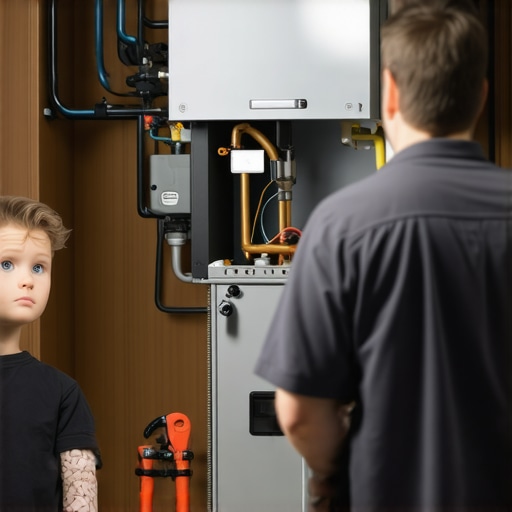
The Death of the ‘Handyman Special’ and the 2026 Regulatory Cliff
If you think the current price of a heating service call is steep, wait until you see the bill for a voided warranty in 2026. We are currently standing on a regulatory cliff. With the industry-wide transition to A2L refrigerants and the tightening of AFUE (Annual Fuel Utilization Efficiency) standards, manufacturers like Carrier, Trane, and Lennox are looking for any excuse to deny a claim. I’ve spent 30 years crawling through crawlspaces and dragging manifolds across icy roofs, and I’ve seen the ‘Sales Techs’—those guys who look more like used-car salesmen than mechanics—screw over homeowners by cutting corners that seem harmless today but are catastrophic for your 2026 warranty status. The era of ‘just making it work’ is over; if the physics of the install isn’t perfect, the manufacturer’s lawyers will be the first to tell you ‘no.’
The Narrative of the Jumped Pressure Switch
I followed a ‘tech-in-a-truck’ last November to a job in a drafty split-level during a 10°F cold snap. The homeowner had paid a guy $100 to ‘fix’ her two-year-old condensing furnace. When I arrived, the house smelled of scorched dust and something worse: faint, acidic combustion gases. I pulled the panel and found a yellow jumper wire bypassing the pressure switch. The original tech couldn’t figure out why the inducer motor wasn’t pulling enough vacuum, so he just cheated the safety circuit to get the burners to fire. He told her she saved $4,000 on a new inducer assembly. In reality, he had allowed the furnace to run with a partially blocked flue. When that furnace eventually took a dive three weeks later, the manufacturer’s rep saw the tool marks on the switch terminals and the soot buildup on the secondary heat exchanger. They didn’t just deny the repair; they blacklisted the serial number. A $100 ‘fix’ cost that family an entire furnace repair and eventually a full AC installation replacement because the coil was toasted by the excess heat. That’s the reality of modern HVAC: the equipment is smarter than the people fixing it.
“The most expensive equipment in the world cannot overcome a bad duct system or improper field modifications.” – Industry Axiom
Thermodynamic Zooming: Why Airflow is King
To understand why these mistakes void warranties, you have to understand the physics of a high-efficiency furnace. We aren’t just burning gas; we are managing a precise stoichiometric ratio. In a 96% AFUE furnace, we use a secondary heat exchanger to extract latent heat from the combustion process. This is where the water vapor in the exhaust turns back into liquid. If your heating service tech doesn’t check the static pressure, that heat exchanger becomes a ticking time bomb. High static pressure—caused by undersized ducts or those ‘filter-of-the-month’ 1-inch pleated filters that have the breathability of a brick—slows down the airflow. When airflow slows, the temperature rise across the heat exchanger exceeds the manufacturer’s limit. This causes the metal to expand and contract violently, leading to microscopic cracks. In 2026, manufacturers will require digital logs of static pressure readings for any major component claim. If your tech isn’t using a manometer, they are voiding your warranty in real-time.
Mistake 1: The Non-Certified Component Swap (The A2L Trap)
By 2026, we will be fully immersed in the R-454B and R-32 transition. Many homeowners are opting for dual-fuel systems—a mini-split or heat pump paired with a gas furnace. The mistake? Using ‘universal’ parts or third-party coils that aren’t certified for the specific flammability ratings of the new ‘gas’ (refrigerant). If a Sparky or a cut-rate tech installs a contactor or a motor that isn’t spark-proof in a system designed for A2L refrigerants, you haven’t just voided the warranty; you’ve built a localized hazard. Manufacturers are now embedding sensors that track ‘unauthorized’ voltage spikes or resistance changes. If you don’t use OEM (Original Equipment Manufacturer) parts, the control board logs the discrepancy. When that ‘Juice’ leaks or the compressor fails, the manufacturer pulls the board data and sees you used a ‘Will-Fit’ part. Claim denied.
Mistake 2: Ignoring the Condensate Chemistry
In the North, where furnace repair is a winter blood sport, the condensate drain is the most overlooked component. High-efficiency furnaces produce acidic water. I’ve seen tin knockers and plumbers run that condensate through copper pipes or let it pool near the heat exchanger. That acid will eat through a secondary heat exchanger from the outside in. If your tech doesn’t install a neutralizer kit or ensure the ‘Pookie’ (mastic) isn’t blocking the internal drain ports, the furnace will eventually ‘slug’ the inducer. When the manufacturer sees signs of internal corrosion caused by improper drainage, they won’t cover the heat exchanger. They’ll argue—rightfully so—that the install didn’t meet the mechanical code or their specific installation manual instructions.
“Design of the distribution system shall be in accordance with ACCA Manual D to ensure proper airflow and pressure balance.” – ACCA Manual J Standards
Mistake 3: Over-Sizing and the ‘Short-Cycle’ Sin
The ‘Sales Tech’ loves to sell you a 100,000 BTU beast when your house only needs 60,000 BTUs. Why? Because it’s more expensive. But in the 2026 regulatory environment, an oversized furnace is a warranty liability. Oversized units ‘short-cycle’—they turn on, blast the house with heat, and shut off before the heat exchanger reaches a stable operating temperature. This prevents the unit from ever clearing the ‘corrosive’ condensate from the secondary heat exchanger. It’s like driving a car only two blocks at a time; the engine never gets hot enough to burn off the moisture. If your AC installation or furnace tech doesn’t perform a Manual J load calculation, the unit will fail prematurely. Manufacturers are now demanding the Manual J documentation before they ship a replacement heat exchanger. No math, no motor.
The Verdict: Physics Doesn’t Lie
When you hear the screech of a failing bearing or the ‘huffing’ of a dirty burner, don’t call the guy who promises the lowest price. Call the guy who brings a manometer, a combustion analyzer, and a laptop. The ‘Beer can cold’ era of checking mini-split charges or furnace gas pressure by ‘ear’ is dead. If your tech isn’t talking about microns, inches of water column, and Delta-T, they are a liability to your wallet. You want a system that lasts until 2040? Treat it like the high-performance thermodynamic engine it is. Keep the ‘Pookie’ off the sensors, keep the ‘Gas’ in the lines, and never, ever let a tech jump out a safety switch. Your 2026 warranty depends on it.