The $4,000 Communication Error: A Story of Sales Tech Greed
I walked into a house last Tuesday in the middle of a 112-degree Las Vegas heatwave. The homeowner was white as a ghost, clutching a quote for a full system replacement. A ‘Sales Tech’—one of those guys with a shiny uniform and zero grease under his fingernails—had told him his 2026-model mini-split was ‘fried’ because the indoor head wouldn’t talk to the remote. He quoted him four grand for a new evaporator head and ‘re-commissioning.’ I took one look at the digital readout on the indoor unit. It wasn’t ‘fried.’ The leak detection sensor—a new requirement for these 2026 A2L refrigerant systems—had tripped because of a minor flare nut weep, locking out the communication board for safety. A twenty-minute repair and a sensor reset saved that man thousands. That is the reality of the 2026 HVAC landscape: it is smarter, safer, and infinitely more annoying for the average homeowner.
The Regulatory Cliff: Why Your 2026 Mini-Split is Different
If you bought a system recently, you’ve likely heard about the death of R-410A. The industry has moved to A2L refrigerants like R-454B or R-32. These are ‘mildly flammable,’ which sounds terrifying but really just means we have to be smarter about how we install them. To satisfy the safety bureaucrats, manufacturers have packed these units with ‘Mitigation Boards’ and leak sensors. When your remote stops communicating, it’s rarely a dead battery. It’s often the logic board inside the head unit refusing to execute a ‘call for cool’ because it detects a change in the air-to-refrigerant ratio. In the dry Southwest, where the heat cooks the juice (refrigerant) at high head pressures, these sensors are the first thing to go haywire.
“The presence of a leak detection system is mandatory for all A2L systems exceeding specific charge thresholds to ensure safety in occupied spaces.” – ASHRAE Standard 15
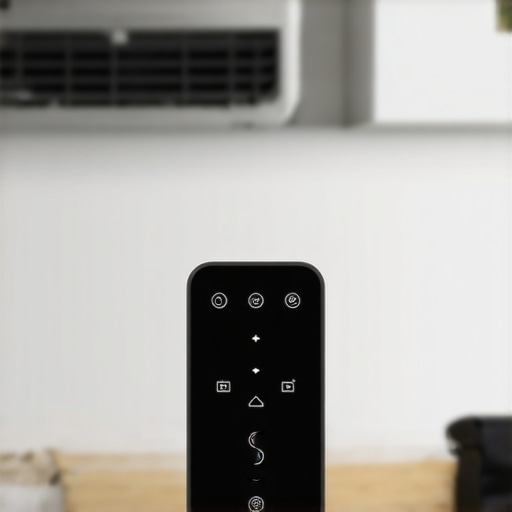
When you press that button on your remote, you aren’t just sending a signal to ‘turn on.’ You are initiating a complex handshake between the handheld IR or RF transmitter, the indoor control board, the mitigation sensor, and the outdoor inverter. If any link in that chain feels a ‘stubbed toe,’ the whole system shuts down. This isn’t your grandfather’s heating service where you just jump two wires at the thermostat. This is high-level data communication.
Thermodynamic Zooming: The Physics of the ‘Comm Error’
In a place like Nevada or Arizona, we deal with sensible heat. The goal is to drop the temperature of the air, but the 2026 mini-splits are designed to be hyper-efficient. They use electronic expansion valves (EEVs) that move in increments smaller than a human hair. To make this work, the remote has to constantly relay the ‘I-Feel’ temperature data back to the unit. If the remote is blocked by a curtain, or if the 2.4GHz interference from your new mesh router is screaming louder than the remote, the inverter loses its mind. It doesn’t know whether to ramp the compressor to 100% or 10%. When the ‘brain’ gets confused, it defaults to an error code—usually a flashing LED that leaves you sweating in the dark.
The indoor coil is designed to drop below the dew point to wring out whatever moisture we have during the monsoon season. If the remote isn’t communicating, the EEV might stay wide open, flooding the evaporator with liquid refrigerant. This can cause the coil to freeze solid. Once that ice block forms, the sensor detects a massive drop in airflow and kills the communication to prevent the compressor from ‘slugging’—which is a fancy way of saying the compressor tries to compress liquid, and the internal valves explode like a cheap watch.
The Anatomy of a Failed Handshake
If your remote is showing a ‘signal’ icon but the unit is ignoring you, we look at the ‘Mechanical Anatomy’ of the communication loop. First, check for IR ‘washout.’ In brightly lit rooms with high-output LED lighting, the infrared signal from a cheap remote can get lost in the noise. Second, look at the sensor. The 2026 models have an A2L sensor located near the bottom of the indoor chassis. If that sensor fails its self-test during startup, it will disable the wireless receiver to prevent any operation. It’s a fail-safe that turns your expensive mini-split into a very heavy wall ornament.
Third, we have to talk about the Sparky (electrician) and the ‘Tin Knocker’ (duct guy). Even though mini-splits don’t use traditional ducts, the way they are mounted matters. If the unit is vibrating because it wasn’t leveled, those vibrations can loosen the tiny communication wire (the ‘S’ terminal) that links the indoor and outdoor sections. If that wire has a nick in it, the ‘talk’ between the boards gets garbled. It’s like trying to have a conversation over a cell phone with one bar of service while standing next to a jet engine.
Repair vs. Replace: The 2026 Dilemma
We are in a transitional era. If you have an older R-410A system that needs a furnace repair or a new coil, you are looking at skyrocketing prices for the old gas. But the 2026 units, while efficient, are complex. A communication error on a new unit shouldn’t mean a replacement. If a tech tells you that a two-year-old system needs to be scrapped because the remote isn’t ‘syncing,’ they are likely a ‘Sales Tech’ looking for a commission. Most communication issues are solved by:
- Firmware updates (yes, your AC now needs software updates).
- Sensor recalibration.
- Checking the shielded 14/4 communication wire for electromagnetic interference.
“The most expensive equipment in the world cannot overcome a bad installation or improper sensor calibration.” – Industry Axiom
Brand Science: Trane, Carrier, and the A2L Shift
Not all 2026 units are built the same. Trane and American Standard have leaned heavily into R-454B, using robust sensors that seem to handle the Southwest heat a bit better. Carrier and Bryant have integrated sophisticated ‘Ecobee’ style logic directly into their mini-split heads. While this makes for a great user interface, it adds another layer of potential communication failure. If your home Wi-Fi goes down, does your AC installation still work? In 2026, the answer is ‘sometimes.’ You want a system that has a ‘hard-wired’ bypass for when the fancy remote decides to stop talking to the mothership.
If you are looking at a new heating service or AC setup, do not buy the cheapest unit on the pallet. The low-end brands use bottom-tier A2L sensors that are notorious for ‘false positives.’ A false positive leak detection will shut your air off at 2 PM on a Saturday, and you won’t get a tech out until Monday. Spend the extra money on a brand with a proven track record of ‘sensor stability.’
The Airflow Manifesto: Why Physics Always Wins
At the end of the day, your remote is just a messenger. The real work is done by the delta-T (the temperature difference across the coil). If your filters are dirty, or if you’ve used Pookie (mastic) to seal up every crack but haven’t accounted for return air, the system will struggle. The 2026 logic boards monitor the return air temperature vs. the supply air temperature. If they don’t like the ‘spread,’ they might ignore the remote’s request for a lower setpoint as a protective measure. It’s not broken; it’s protecting itself from your neglect.
Keep your coils washed. In the desert, dust is the silent killer. It coats the fins, raises the head pressure, and makes the compressor work twice as hard to move the same amount of heat. When the compressor gets hot, the oil thins out, the bearings start to screech, and eventually, the acid buildup from the heat will eat the motor windings from the inside out. That ‘sour’ smell of a burnout is something no 2026 sensor can truly prevent once the damage is done.
Conclusion: Professional Diagnosis Over Panic
If your 2026 mini-split remote is giving you the silent treatment, don’t let a salesman talk you into a new system. It is a machine of physics and logic. Check your batteries, check your line-of-sight, and then call a tech who knows how to use a multimeter, not just a iPad for financing. Comfort isn’t a luxury in the heat; it’s a matter of survival, and understanding the ‘why’ behind the ‘error code’ is the first step to staying cool.