The 2026 Regulatory Cliff: Why Your Next Unit Is a High-Stakes Investment
I’ve spent the last thirty years dragging my tool bag across oyster-shell driveways and crawling through crawlspaces so humid they felt like a Turkish bath. I’ve seen the industry transition from the bulletproof R-22 ‘green gas’ to R-410A, and now we are staring down the barrel of the 2025/2026 A2L refrigerant mandate. If you think your daddy’s 1990 Trane XE1200—which probably lasted 25 years despite a complete lack of maintenance—is what you’re buying today, you’re in for a expensive wake-up call. The newer systems, specifically those hitting the market for a 2026 AC installation, are built with thinner fins and complex sensors to handle mildly flammable refrigerants like R-454B. In a high-salt or high-humidity environment, these machines will dissolve faster than a sugar cube in a cup of coffee if you don’t treat them right. We aren’t just fighting heat anymore; we’re fighting chemistry.
The Sales Tech Mirage: A Cautionary Tale
Last August, I followed a ‘Comfort Advisor’—that’s trade-speak for a sales tech who couldn’t find a blown fuse with a map and a flashlight—to a job in a coastal neighborhood. He’d quoted a retired schoolteacher $18,000 for a full heating service and cooling replacement because he saw surface oxidation on the cabinet. He told her the ‘rust had compromised the thermodynamic integrity’ of the system. What a load of hot air. I opened the panel and found the evaporator coil was pristine, but the Schrader valve was leaking juice. A fifty-cent part and a bit of Pookie (mastic) on the plenum would have fixed it. But this highlights the problem: rust is used as a scare tactic, yet it is a legitimate killer of efficiency if it hits the coils. By the time 2026 rolls around, the cost of these A2L-compliant units will be 30% higher due to new leak-detection sensors and spark-proof components. You cannot afford to let salt air eat a $15,000 investment in five years.
“Equipment shall be protected from physical damage and the effects of corrosion in coastal environments.” — ASHRAE Standard 15-2022
Step 1: Demand Factory-Applied Phenolic Coatings
When you’re looking at a new mini-split or a central split system, the standard aluminum fins are a buffet for salt air. Most ‘Sales Techs’ will try to sell you an aftermarket spray-on coating. Don’t fall for it. You want a factory-applied phenolic coating, like Bronz-Glow or Blygold. These aren’t just paint; they are molecularly bonded barriers that prevent the ‘white rust’ (aluminum oxide) from insulating the fins. Remember, we are dealing with sensible heat—the temperature you see on the thermostat—and latent heat—the humidity. If your fins are corroded, they can’t reach the dew point efficiently. The suction line should be beer can cold, but if those fins are pitted, your compressor will ramp up head pressure, overheat the oil, and turn that sour, acidic smell of a burnout into a reality.
Step 2: The Art of Thermodynamic Placement
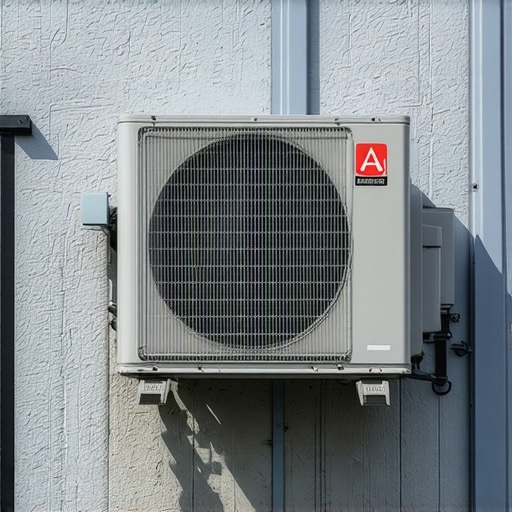
Most tin knockers and installers just want to drop the condenser where the old one was. That’s a mistake. For a 2026 installation, you need to account for prevailing wind patterns. If your unit is on the windward side of a coastal home, it’s acting like a giant salt-air filter. We need to use the building’s structure as a shield or install a vented baffle. But be careful: you can’t choke the airflow. If you restrict the discharge air, you’re killing the subcooling. I’ve seen ‘Sparkies’ (electricians) wire up beautiful units only for the homeowner to hide them behind a solid fence, causing the unit to recirculate its own hot air. You’ll be calling for a furnace repair or AC fix within two seasons because the high-limit switches are tripping.
Step 3: Cathodic Protection and Sacrificial Anodes
This is where we get into the real grit of HVAC physics. Just like a water heater or a boat motor, your AC condenser can benefit from sacrificial anodes. Zinc sticks bolted to the frame will corrode before the copper or aluminum does. This is basic electrolysis. In 2026, with the thinner microchannel coils becoming standard to meet SEER2 requirements, there is less metal to lose. A microchannel coil is essentially a series of tiny flat tubes; if one pits through, the whole coil is junk. You can’t patch those like the old round-tube-plate-fin coils. This isn’t magic; it’s protecting the metals that are lower on the galvanic scale.
“The most expensive equipment in the world cannot overcome a bad duct system or a corrosive atmosphere.” — Industry Axiom
Step 4: Managing the Condensate and the ‘Pookie’ Seal
Rust doesn’t just happen outside; it happens in the evaporator cabinet. In humid zones, your AC is a giant dehumidifier. If the installer doesn’t pitch the drain pan correctly, you have standing water. That water becomes acidic as it mixes with household dust and VOCs. For your 2026 setup, ensure they use high-grade mastic (Pookie) on all seams to prevent unconditioned, humid air from being sucked into the negative pressure side of the blower. If you’re pulling in 90-degree attic air, your heating service or cooling cycle will never satisfy the thermostat, leading to short-cycling. Short-cycling is the silent killer—it prevents the oil from circulating and keeps the coils wet longer, accelerating the rust cycle.
The Verdict: Physics Over Features
In the end, comfort is a matter of physics, not a brand name on a box. Whether you are installing a high-efficiency furnace repair replacement or a 2026-spec cooling system, the enemy remains the same: oxidation and poor airflow. Don’t let a sales guy talk you into a ‘smart’ thermostat to fix a rust problem. You protect the metal, you protect the juice, and you protect your wallet. Stick to the basics of thermodynamics, and you might actually get twenty years out of that 2026 unit.
This post offers some essential insights, especially the emphasis on factory-applied phenolic coatings and proper placement to combat salt air corrosion. I’ve seen firsthand how neglecting these details can drastically shorten the lifespan of coastal HVAC systems. The point about sacrificial zinc anodes is particularly interesting because many contractors overlook electrolysis issues entirely. In my experience, consistent maintenance of condensate drain pans and sealing seams with high-grade mastic like Pookie really does make a difference in preventing internal rust. I’ve also noticed that some newer units are more sensitive to airflow restrictions, so proper thermodynamic placement isn’t just an optimization but a necessity to prevent short-cycling and rust acceleration. What strategies have others found effective in balancing aesthetics and proper airflow in salty environments? Sometimes, homeowners want units hidden away, but that can lead to recirculating hot, humid air and rusting out the coils faster. Open to hearing other tips on maximizing the longevity of these high-tech, coastal-specific systems.