The Invisible Constraint: Why Your New Unit is Choking
You just dropped ten grand on a high-efficiency 2026-compliant AC installation. The shiny white cabinet looks beautiful in the basement, and the Sparky just finished wiring the disconnect. But when the blower kicks on, it sounds like a jet engine taking off in your hallway, and the master bedroom is still five degrees warmer than the kitchen. Most homeowners think they bought a lemon. As someone who has spent three decades dragging a tool bag through fiberglass-filled attics, I can tell you the truth: your equipment isn’t the problem. Your ductwork is a straw trying to handle the breath of a giant.
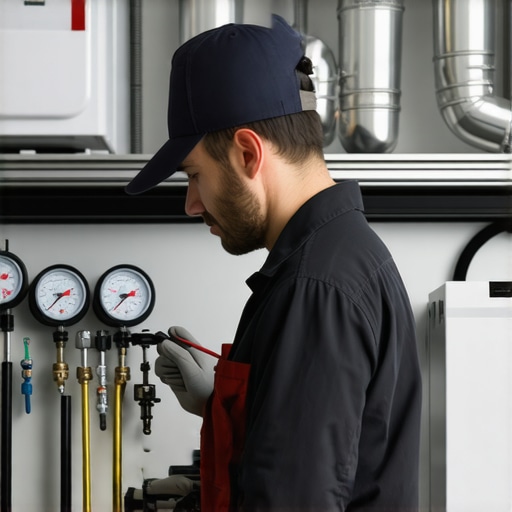
My old mentor, a man who could diagnose a bad TXV just by the vibration of the suction line, used to tell me, ‘You aren’t in the business of moving machines; you’re in the business of moving molecules.’ He would take a manometer—a tool most ‘Sales Techs’ couldn’t find in their own truck—and show me the pressure differential. This is the Static Pressure Test. If you don’t have one performed during your next AC installation or furnace repair, you are effectively buying a Ferrari engine and hooking it up to a golf cart exhaust pipe.
“The most expensive equipment in the world cannot overcome a bad duct system. Proper airflow is the fundamental requirement for thermodynamic exchange.” – ACCA Manual D Philosophy
Thermodynamic Zooming: The Physics of Resistance
Static pressure is the resistance to airflow within your HVAC system. Think of it like blood pressure. If it’s too high, the heart (your blower motor) has to work twice as hard to move the same amount of juice. In the old days of permanent split capacitor (PSC) motors, the fan would just slow down, the evaporator coil would freeze into a block of ice, and you’d call for a heating service or cooling repair. But today’s high-efficiency ECM motors are smarter—and more fragile. They will ramp up their RPMs to ‘hunt’ for the programmed CFM (Cubic Feet per Minute). They will fight against that restrictive ductwork until the motor bearings scream or the control board fries.
When we talk about mini-split systems, we avoid some of these issues because they are ductless, but for central air, the 2026 standards for A2L refrigerants like R-454B mean our coils are denser. Denser coils mean more resistance. If your tin knocker didn’t upsize your return air drop, your system is essentially suffocating. This isn’t just about comfort; it’s about the latent heat removal. If the air moves too fast because the static pressure is skewed, it doesn’t spend enough time on the evaporator coil to reach the dew point. You end up with ‘sensible cooling’ (the temperature drops) but no dehumidification. You’re left in a cold, clammy tomb because the physics of the heating service and cooling cycle were ignored.
“Standard 62.2 requires specific ventilation rates, but without verified static pressure, delivered airflow remains a theoretical guess rather than a mechanical reality.” – ASHRAE Standards
The 2026 Regulatory Cliff and Airflow Reality
The transition to mildly flammable refrigerants in 2025 and 2026 has changed the game. These systems require precise charge weights and even more precise airflow to ensure the safety sensors don’t trip. If your tech doesn’t pull out a pitot tube to measure the Total External Static Pressure (TESP), they are guessing. And in this trade, a guess is just a slow-motion warranty claim. I’ve seen brand-new 18-SEER units fail in three years because the high static pressure caused the compressor to run at temperatures that turned the oil into an acidic sludge. That acidic smell of a burnout is something you never forget—it smells like wasted money.
Proper furnace repair often involves more than just swapping a cracked heat exchanger; it involves checking if the supply plenum is leaking air into the attic. We use Pookie (mastic) to seal those joints because tape fails, but sealing a system without checking static pressure can actually make things worse. If you seal a leaky, undersized duct system, you increase the pressure even further. It’s a delicate balance of fluid dynamics that most companies skip because it takes an extra 30 minutes and a brain. If you want your 2026 system to last twenty years instead of seven, demand the manometer. Don’t let them tell you the ‘factory settings’ are enough. Physics doesn’t care about factory settings.
How to Ensure Your System Isn’t Choking
Verifying Your Installation Quality
1. The TESP Measurement: Ask the technician to show you the TESP reading on their dual-port manometer. For most residential systems, you want to see something below 0.5 inches of water column (wc). If it’s hitting 0.8 or 0.9, your system is redlining.
2. The Return Air Ratio: Ensure your return ducting is large enough. A 4-ton AC needs significantly more ‘lung capacity’ than a 2-ton unit. Most AC installation failures stem from trying to put a 5-ton unit on a 3-ton return.
3. Filter Selection: Those high-MERV ‘hepa-like’ filters you buy at the big box store? They are static pressure nightmares. Unless your system was specifically designed for them, you might be killing your blower motor for the sake of ‘clean’ air that isn’t even moving.