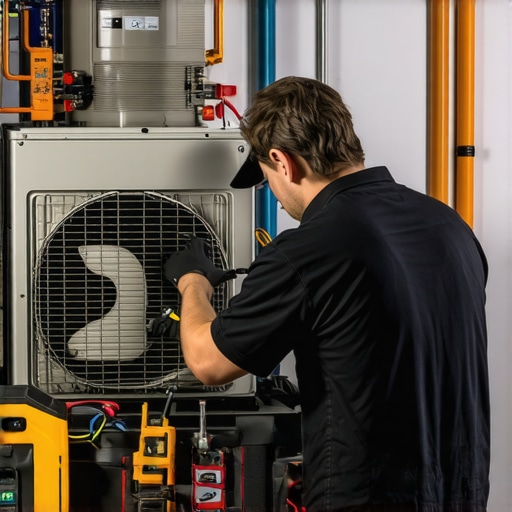
The Ghost in the Ductwork: Why 2026 Changes Everything
You hear that? That high-pitched whistle coming from your return grille? Most folks ignore it. A ‘Sales Tech’—those guys who wear white shirts and never have grease under their fingernails—will tell you it’s just ‘powerful airflow.’ They’re lying to you. That sound is your blower motor screaming for help because it’s trying to suck air through a straw. In thirty years of crawling through blown-in insulation and dodging black widows, I’ve learned one thing: airflow is the physics of comfort, and most installers are failing the class.
My old mentor, a man we called ‘Iron-Lung’ Larry, used to shove a lit match near a supply register. If the flame didn’t dance exactly forty-five degrees, he’d rip the whole plenum out. ‘You can’t cool what you can’t touch!’ he’d bark. He was right. You can buy the most expensive 25-SEER2 variable-speed inverter on the market in 2026, but if your static pressure is out of whack, you’ve just bought a Ferrari with a clogged exhaust pipe. As we transition to R-454B and other A2L refrigerants, the margin for error has evaporated. These systems are smarter, more sensitive, and frankly, more temperamental than the old ‘sluggers’ we installed in the 90s.
“The most expensive equipment in the world cannot overcome a bad duct system. Total external static pressure is the blood pressure of the HVAC system.” – ACCA Manual D
Thermodynamic Zooming: The Physics of the Coil
When we talk about AC installation, we aren’t just ‘swapping boxes.’ We are managing a phase change. Inside your evaporator coil, the liquid refrigerant—the ‘juice’—is forced through a metering device where it flashes into a low-pressure saturated vapor. This drops the coil temperature below the dew point of your home’s air. As the blower pushes warm, humid air across those aluminum fins, sensible heat is absorbed by the refrigerant, and latent heat is removed as water drips into the condensate pan. If your static pressure is too high, the air moves too slow or too fast. Too slow, and the coil freezes into a block of ice, potentially slugging the compressor with liquid refrigerant. Too fast, and the air doesn’t spend enough ‘dwell time’ on the coil to drop its moisture. In a 2026 mini-split or central system, this imbalance triggers a fault code, and your ‘smart’ unit shuts down to save itself, leaving you sweating in 105°F heat.
The 2026 Regulatory Cliff: A2L Refrigerants
Why is 2026 different? The EPA has mandated the phase-out of R-410A. The new kids on the block, like R-454B, are classified as ‘mildly flammable.’ To manage this, manufacturers have packed these units with leak sensors and mitigation boards. If you have a restricted duct system that causes the evaporator coil to vibrate or undergo extreme pressure spikes, you risk a micro-leak. A micro-leak in 2026 doesn’t just mean ‘topping off the gas’ (which is illegal anyway—it’s a sealed system, find the leak!). It means the sensors might lock out the system or even trigger a high-speed ventilation mode. This makes a Static Pressure Test not just a ‘good idea,’ but a mandatory part of any legitimate heating service or cooling setup.
The Manometer Doesn’t Lie: What is Static Pressure?
Static pressure is the resistance to airflow. Think of it like your blood pressure. If it’s too high, your heart (the blower motor) has to work harder. We measure this in ‘inches of water column’ (w.c.) using a digital manometer. We poke two small holes: one before the filter and one after the coil. Most residential blowers are rated for a total external static pressure of 0.5″ w.c. I’ve walked into jobs where the ‘Sparky’ did the wiring but the Tin Knocker undersized the return, and the manometer read 0.9″ w.c. That motor is consuming 30% more electricity and will burn out in five years instead of fifteen.
“Airflow through the cooling coil shall be within the manufacturer’s specified range, typically 350 to 450 CFM per ton of cooling capacity.” – ASHRAE Standard 62.2
The Southwest Struggle: High Head Pressure and Sensible Loads
In dry climates like Nevada or Arizona, we fight Sensible Heat. When it’s 115°F outside, the AC installation must be perfect because the temperature differential (Delta T) across the condenser is massive. High static pressure on the indoor side causes the compressor’s head pressure to skyrocket. When that happens, the ‘Gas’ can’t reject heat to the outdoors effectively. I’ve seen ‘Sales Techs’ try to fix this by adding more refrigerant. That is a crime against physics. Overcharging a system to overcome bad airflow is like trying to fix a broken leg by putting on a larger shoe. It doesn’t work, and it’ll kill the compressor’s valves.
The Furnace Repair Connection
Airflow isn’t just for cooling. During a furnace repair call in the winter, high static pressure is the number one killer of heat exchangers. If the air can’t move across the heat exchanger fast enough, the metal gets too hot, expands, and eventually cracks. A cracked heat exchanger leaks carbon monoxide into your home. If your installer doesn’t check the static pressure on your new 2026 furnace, they aren’t an HVAC tech; they’re an equipment mover. You need the pookie (mastic) to be sealed tight on every joint to ensure that pressure is used to move air into the rooms, not into the attic.
Conclusion: Don’t Settle for a Box Swap
When you’re looking at a quote for a new 2026 system, look for the words ‘Static Pressure Profile.’ If the tech doesn’t own a manometer, show them the door. A real pro will check your return air drop, inspect the ‘Suction Line’ (it should be beer-can cold, but not freezing), and ensure the ductwork can handle the CFM of the new blower. Comfort isn’t magic; it’s a calculation. If you want a system that lasts until 2040, you start by measuring the pressure today.