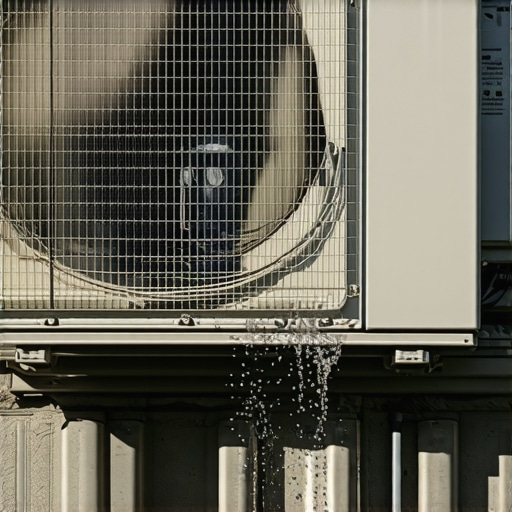
The Invisible Cost of 2026 AC Installation: Don’t Let a $50 Drip Tray Ruin Your System
I’ve spent thirty years crawling through humid attics and cramped crawlspaces, and if there is one thing I’ve learned, it’s that the smallest component is usually what causes the biggest catastrophe. We are entering a new era of HVAC. The EPA has slammed the door on R-410A, and as we pivot toward A2L refrigerants like R-454B in 2026, the stakes for a proper AC installation have never been higher. Yet, I’m still seeing ‘Sales Techs’—those guys who wear pristine white shirts and carry iPads but couldn’t tell a capacitor from a contactor—skip the basics. Specifically, they are skipping the secondary drip tray. It’s a fifty-dollar piece of plastic or galvanized metal that stands between you and a ten-thousand-dollar mold remediation bill.
The Sales Tech Scam: A Case Study in Negligence
I recently followed a ‘System Designer’—that is the fancy name they give sales guys these days—who had quoted a homeowner in a swampy coastal climate nearly $18,000 for a full mini-split and central air overhaul. He told her the furnace repair was impossible because the heat exchanger was ‘probably’ cracked and the AC was ‘leaking juice like a sieve.’ When I got there, I didn’t see a puddle of refrigerant. I saw a primary condensate drain plugged with ‘white slime’—a nasty bacterial growth common in high-humidity zones. Because the original installer was a ‘blow-and-go’ artist who didn’t install a secondary drip tray or a float switch, the water had been backing up directly into the emergency pan, which had rusted through, and then into the floor joists. The unit wasn’t dead; it was just drowning. A $20 clearing of the line and a $50 tray would have saved that lady five years of structural rot. But the Sales Tech didn’t want a fix; he wanted a commission.
Thermodynamic Zooming: Why Water is the Enemy
In a humid climate, your AC is a giant dehumidifier. As the evaporator coil drops below the dew point, it pulls latent heat out of the air. This is physics, not magic. This moisture—condensate—has to go somewhere. If your AC installation doesn’t account for the massive volume of water produced during a 95-degree afternoon with 80% humidity, you’re asking for trouble.
“The removal of latent heat is as critical as the reduction of sensible temperature in humid climates to maintain indoor air quality and structural integrity.” – ASHRAE Fundamentals Handbook
When the ‘gas’ (refrigerant) expands into the coil, it creates a freezing surface that grabs every molecule of water it can. If that tray isn’t there to catch the inevitable overflow when the primary line clogs, that water isn’t just a puddle; it’s a structural solvent.
The 2026 A2L Transition: Why the Tray Matters More Now
As we move to A2L refrigerants, the sensors are the new kings of the system. These ‘mildly flammable’ refrigerants require leak detection sensors inside the cabinetry and often near the coil. If your installer doesn’t use a proper secondary pan, and moisture begins to pool around the base of the new 2026 air handlers, you can end up with ghost codes and sensor failures. The ‘Tin Knockers’—the guys who actually build the ductwork—know that static pressure and moisture management go hand-in-hand. A missing tray often means the unit isn’t level, which means the ‘Pookie’ (mastic sealant) around the plenum is going to fail as the metal expands and contracts against standing water. It’s a chain reaction of failure.
The Anatomy of a Proper Installation
A real heating service or AC installation in 2026 should look like a laboratory, not a junk pile. First, you need that secondary tray. Second, you need a ‘SS2’ float switch. This is a tiny device that shuts the system down the moment water hits the secondary level. I’d rather you be hot for an hour because the system tripped than have you wake up to a ceiling caving in. Third, let’s talk about the ‘Suction Line.’ It should be ‘beer can cold’ and insulated with closed-cell foam all the way to the service valve. If I see bare copper, I see a technician who gave up at 4 PM.
“Condensate disposal systems shall be provided for equipment and appliances that produce condensate in order to prevent damage to the structure or other contents of the building.” – International Mechanical Code (IMC) Section 307
Furnace Repair vs. Total Replacement
When you’re looking at a furnace repair in conjunction with a new AC, the Sales Tech will always tell you to ‘match the set.’ While there’s some truth to AFUE ratings and blower motor compatibility, don’t let them scare you into a $15k purchase if your heat exchanger is solid. The real ‘sparky’ (electrician) work and the ‘tin knocker’ work are where the quality is hidden. If they aren’t checking the static pressure of your ductwork, they aren’t doing an installation; they’re just dropping a box. High static pressure is the silent killer of those fancy new variable-speed motors. It’s like trying to breathe through a cocktail straw while running a marathon.
Conclusion: Don’t Step Over a Dollar to Save a Dime
If your contractor scoffs at the idea of an emergency drain pan, a secondary float switch, or a dedicated dehumidification cycle, kick them off the property. They are looking for a quick ‘flip,’ not a thirty-year solution. Demand the $50 drip tray. Demand that they use ‘Pookie’ on every joint, not just silver tape that will peel off in three seasons. HVAC is a game of inches and ounces. If you miss the small stuff in 2026, the new high-tech systems will punish you with repair bills that make the old R-22 days look like a bargain. Keep your coils clean, your filters changed, and for heaven’s sake, make sure that water has a clear path out of your house.