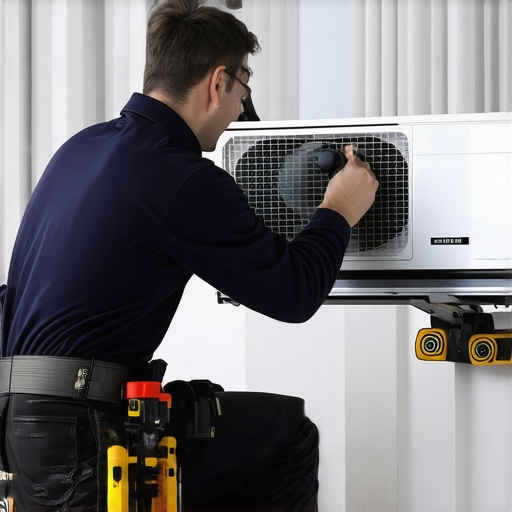
The Siren Song of a Struggling Inverter: Why Your Mini-Split is Screaming
There is a specific sound that haunts the dreams of a seasoned tech. It is not the boom of a cracked heat exchanger or the rhythmic thumping of an unbalanced blower wheel in a 1990s furnace repair call. It is a high-pitched, tea-kettle whistle coming from a sleek, modern mini-split. If you are hearing this in 2026, you are likely dealing with the new generation of high-static inverter units that are moving more air through smaller apertures than ever before. This sound is not just an annoyance; it is the sound of physics complaining. When air is forced through a restricted orifice at high velocity, it creates a vortex shedding frequency—basically, your AC is playing itself like a flute. Before you call for an AC installation quote or an expensive heating service, you need to understand the ‘Bernoulli Trap’ that these units fall into.
The Physics Lesson: Sarge and the Straw
My old mentor, a man we called ‘Sarge’ because he treated every attic like a combat zone, used to scream at me, ‘You can’t cool what you can’t touch!’ I was twenty years old, sweating through my shirt in a crawlspace, and he was holding a drinking straw. He made me blow through it, then pinched the end. The sound went from a low huff to a sharp whistle. ‘That whistle, kid,’ he said, ‘is the sound of the motor working three times harder to move half the air.’ He was right. In the world of HVAC, velocity is not the same as volume. A mini-split whistling is usually a sign that the static pressure has spiked, forcing the ECM motor to ramp up to its maximum RPM to maintain the CFM (cubic feet per minute) required to keep the evaporator coil from freezing over. If that coil drops below the 32°F mark, the latent heat—that’s the moisture in the air—stops being removed as a liquid and starts turning into a block of ice. Once that happens, your airflow is dead, and your compressor is probably going to take a ‘slug’ of liquid juice (refrigerant) and die a painful, expensive death.
“The most expensive equipment in the world cannot overcome a bad duct system or restricted airflow path.” – Industry Axiom
The 2026 Reality: A2L Refrigerants and Tighter Coils
By 2026, we’ve fully transitioned to A2L refrigerants like R-454B. These gases are efficient, but they require tighter tolerances in the evaporator fins to maximize heat transfer. When you have more fins per inch, you have more resistance. If your mini-split is whistling, it’s often because the intake path is obstructed by something as simple as a warped filter frame or a microscopic layer of ‘bio-slime’ on the blower wheel. Unlike a traditional heating service on a gas furnace where you might have a massive 20×25 filter, these mini-splits rely on thin plastic mesh. If that mesh isn’t seated perfectly—and I mean within a millimeter—the air bypasses the filter, hits the blower wheel, and creates a ‘whistle’ at the point of bypass. This is where the ‘Tin Knockers’ and the service techs differ. A tin knocker wants to build a bigger box; a service tech knows it’s usually a gasket issue.
The Forensic Diagnosis: Anatomy of the Whistle
To fix the whistle, you have to perform a mechanical anatomy check. First, understand that your mini-split is a heat pump. In the winter, it’s absorbing heat from the freezing outside air (yes, even at -5°F, there is heat to be found) and moving it inside. In the summer, it’s doing the opposite. The whistling usually occurs during the ‘ramp up’ phase.
“Designers shall ensure that air velocities in the occupied zone do not exceed the limits specified to prevent localized discomfort and acoustic interference.” – ASHRAE Standard 62.1
When the unit detects a large ‘Delta T’ (the difference between the room temperature and your set point), it pushes the inverter compressor to 100%. This increases the refrigerant flow. If the indoor fan can’t keep up because of a tiny air leak in the plastic housing, you get the whistle. It’s like a ‘Sparky’ (electrician) trying to push 100 amps through a 14-gauge wire; something is going to get hot, and in our case, something is going to get loud.
The 2-Minute Fix: The ‘Gasket Reset’
Here is the fix that the sales techs don’t want you to know. They want to sell you a whole new AC installation for $15,000 because ‘the motor is failing.’ Most of the time, the whistle is caused by the Filter Gate Bypass. 1. Turn off the unit. 2. Open the front panel. 3. Remove the mesh filters. 4. Look at the plastic tracks where the filter sits. Over time, the heat from the heating cycle can slightly warp this plastic. 5. Take a small strip of 1/8-inch foam weatherstripping (the soft stuff, not the dense rubber) and apply it to the underside of the filter’s leading edge. This creates a seal that prevents air from whistling through the gap. 6. Check the louvers. If a ‘Tin Knocker’ or a previous tech didn’t snap the horizontal vane back into its motor drive perfectly, it will vibrate at high frequencies. Give it a firm ‘click’ into the seat. 7. Restart the unit. If the whistle is gone, you just saved a $300 diagnostic fee. If it’s still there, you might have a ‘Dirty Sock’ issue—mold on the blower wheel creating an uneven weight distribution, making the motor whine.
Thermodynamic Zooming: Why You Can’t Ignore It
Why do I care so much about a little whistle? Because of the Compression Ratio. When airflow is restricted, the heat exchange is inefficient. In cooling mode, the ‘Suction Line’—the big copper pipe that should be ‘beer can cold’—starts to get too cold. This leads to liquid refrigerant returning to the compressor. Compressors are designed to squeeze gas, not liquid. Trying to compress a liquid is like trying to squeeze a rock; something has to break. Usually, it’s the internal valves. Then you’re looking at a ‘burnout.’ If you’ve ever smelled a compressor burnout, you’ll never forget it. It’s an acidic, sour stench that tells you your system is now a giant, expensive paperweight. A little ‘Pookie’ (mastic) or a foam strip is a lot cheaper than a new compressor and a system flush to get the acid out of the lines. Whether you are dealing with a furnace repair or a mini-split, airflow is the king of the mountain. Don’t let a 2-cent air leak ruin a 5-thousand-dollar investment.