The Ghost in the Machine: Why 72 Degrees Feels Like 80
You’re staring at that plastic wand in your hand, the LCD screen clearly reading 68 degrees, yet you’re peeling your shirt off your back. You think the unit is broken. You call for a heating service or a furnace repair guy out of habit, but the truth is far more clinical. You are a victim of the ‘Vertical Gradient,’ and your mini-split is essentially flying blind. As an HVAC veteran who has spent more time in 140-degree attics than in my own living room, I can tell you that the number on your remote is a suggestion, not a fact.
My old mentor, a grizzly ‘Tin Knocker’ named Dutch who could sniff out a refrigerant leak from the curb, used to scream at me during my apprenticeship: ‘You can’t cool what you can’t touch!’ He’d point his beat-up infrared thermometer at the ceiling and then at the floor. ‘The molecule doesn’t care about your thermostat, kid. It cares about the physics of the room.’ This is the cornerstone of the Airflow Manifesto. We aren’t just ‘installing AC’; we are managing a fluid dynamic environment where air is the medium and your comfort is the casualty of poor planning.
“Airflow is the lifeblood of any HVAC system; without proper distribution, the thermostat is merely a decorative wall hanging.” – Industry Axiom
The Thermodynamic Zoom: Latent Heat vs. Sensible Heat
To understand why your room feels like a swamp despite the AC installation being brand new, we have to look at the evaporator coil. This slab of aluminum and copper inside your wall unit is designed to drop below the dew point of your indoor air. When the warm, humid air hits those fins, the water vapor undergoes a phase change into liquid. This is removing ‘latent heat.’ If your mini-split is oversized—a common sin committed by ‘Sales Techs’ looking for a commission—it will satisfy the ‘sensible heat’ (the temperature you see on the remote) so fast that it never has time to pull the moisture out. You end up with a room that is 68 degrees and 70% humidity. It’s cold, it’s clammy, and it’s miserable.
[IMAGE_PLACEHOLDER]
The Airflow Manifesto: Why Placement is Everything
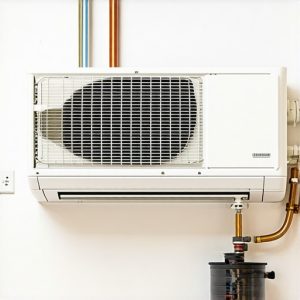
Mini-splits rely on the ‘Coanda Effect’—the tendency of a fluid jet to stay attached to a convex surface. In a proper AC installation, the air should hug the ceiling and slowly drop down as it loses velocity, mixing the room’s air thoroughly. However, most units are slapped onto the wall wherever it’s easiest to run the ‘Line Set’ (the copper pipes carrying the ‘Juice’ or refrigerant). If that unit is tucked into a corner or hovering too close to a curtain, the air short-cycles. The cold air comes out, hits an obstruction, and is immediately sucked back into the return air intake on top of the unit. The internal thermistor (the sensor) thinks the room is 68 degrees because it just breathed in its own exhaust, while you’re sitting in a pocket of stagnant, hot air six feet away.
The ‘I Feel’ Feature and the Sparky’s Nightmare
Modern remotes often have a button labeled ‘I Feel’ or ‘Follow Me.’ This tech attempts to solve the stratification issue by turning the remote itself into the thermostat. But here is the catch: if you leave that remote on a marble countertop or near a drafty window, the unit will ramp up the ‘Gas’ (refrigerant flow) and blast you out of the room. It’s a band-aid for a bad ductless design. Furthermore, if the ‘Sparky’ (electrician) didn’t provide a clean, dedicated circuit, or if the communication wire is picking up interference, the inverter board can start acting like a glitchy laptop. Suddenly, your high-tech mini-split is behaving like a window unit from 1985.
“Proper sizing and airflow management are not optional; they are the fundamental requirements of ASHRAE Standard 62.1 for indoor air quality and comfort.” – ASHRAE Standards
The Solution: Physics, Not Magic
If you want real comfort, stop looking at the remote and start looking at your filters and vanes. If those filters are choked with dust, the static pressure increases, the fan slows down, and the ‘Suction Line’ (the big copper pipe that should be ‘beer can cold’) starts to freeze up. Once that ice forms, you’re done. No amount of clicking the remote will fix a frozen block of aluminum. You need a real heating service professional who understands the psychrometric chart, not someone trying to sell you a whole new system because a capacitor blew. We use ‘Pookie’ (mastic) and proper sealing to ensure the air goes where it’s told. Comfort is about the movement of energy, and in this trade, if you aren’t measuring the airflow, you’re just guessing.