The Sound of a Wet Disaster
There is a specific sound that makes a seasoned HVAC tech’s skin crawl more than the screech of a dying bearing. It’s a rhythmic, dull thud-drip hitting high-end laminate flooring or, worse, the silent saturation of expensive drywall. I’ve spent thirty years in attics where the temperature hits 130 degrees, and I’ve seen more mini-split units destroyed—not by electrical surges or compressor failures—but by the very water they pull out of the air. When you invest in a mini-split or a full-scale AC installation, you’re buying a piece of high-precision machinery. But if that machine isn’t breathing right, or if its waste-water isn’t managed with the respect physics demands, you’re just buying a very expensive indoor waterfall.
“Condensate piping shall be trapped as required by the manufacturer’s instructions, and the piping shall maintain a minimum horizontal slope in the direction of discharge of not less than one-eighth unit vertical in 12 units horizontal.” – International Mechanical Code (IMC) Section 307.2.1
My old mentor, a guy we called ‘Iron Lung’ Dave because he could sniff out a refrigerant leak from three rooms away, used to scream at me every time I picked up a level. ‘You can’t cool what you can’t touch, and you can’t drain what you don’t respect!’ he’d yell. This is why airflow matters more than horsepower. If the air doesn’t move across that evaporator coil correctly, or if the water resulting from that heat exchange has nowhere to go, the system fails. He taught me that thermodynamics isn’t a suggestion; it’s a law. In the humid South, where the air is so thick you can almost chew it, a mini-split is doing double duty. It’s not just lowering the sensible heat (the temperature you see on the thermostat); it’s battling latent heat. That’s the moisture. When that moist air hits a coil that is ‘beer can cold,’ it reaches the dew point instantly. That water has to go somewhere, and if your drain is air-locked or slimed up, that somewhere is your living room wall.
The Forensic Diagnosis: Why Your Wall is Rotting
Let’s look at the mechanical anatomy of this disaster. Inside your indoor head unit sits the evaporator coil. When the heating service side of the unit flips over to cooling, it pumps juice (refrigerant) through that coil, making it incredibly cold. As the blower fan pulls warm, humid air through the fins, the moisture clings to the metal, drips into a plastic tray, and heads for the exit. But here is the catch: mini-splits use a very shallow, gravity-fed tray. Unlike a traditional furnace repair scenario where you might have a deep secondary pan, the mini-split has zero margin for error. If the unit is off-level by even a quarter-inch, the water pools. If the tin knocker who installed your ductless system didn’t account for the ‘p-trap’ effect or the surface tension of water in a small-diameter pipe, you’re in trouble.
The real enemy in a humid climate is the ‘Bio-Slime.’ It’s a sour-smelling, jelly-like substance—essentially an airborne bacteria buffet that grows in the dark, damp environment of your drain line. Once that slime builds up, it creates a dam. Because the mini-split head is mounted high on the wall, the water backs up behind the unit, saturating the drywall. By the time you see the bubble in the paint, the studs are already growing mushrooms. You don’t need a heating service call yet; you need a physics-based intervention. Repairing a ruined wall can cost you $1,500 easily, whereas the hack I’m about to show you costs about twenty bucks in PVC fittings and a little ‘pookie’ (mastic).
“The most expensive equipment in the world cannot overcome a bad condensate management system.” – HVAC Industry Axiom
The Simple Drain Hack: The Vacuum-Break Tee
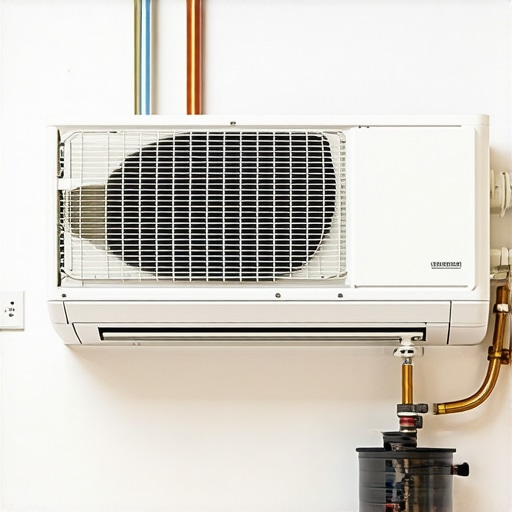
The ‘hack’ isn’t some ‘Sales Tech’ magic trick; it’s actual engineering that most installers skip because they’re in a hurry to get to the next job. Most mini-split drains are a solid piece of corrugated hose or PVC. When the water tries to flow out, it can create a vacuum—think of it like holding your thumb over the end of a straw. The water stays in the straw until you let the air in. We’re going to give the drain air. By installing a ‘Vent Tee’ or a vacuum break just outside the wall where the line leaves the head unit, you break the air-lock. This allows the water to fall freely under the power of gravity, regardless of the humidity levels or how hard the blower is sucking air through the chassis.
To do this right, you need to find the point where the condensate line exits the back of the indoor unit. You’ll cut the line and insert a PVC Tee-fitting. The top of the Tee stays open to the atmosphere (but pointed down or capped with a loose, screened vent to keep bugs out), and the bottom continues to your discharge point. This simple break in the line ensures that even if the end of the pipe gets dipped in a puddle or blocked by a bird’s nest, the unit won’t back up into the house. It’s the difference between a system that works for five years and one that works for twenty. During a standard AC installation, I always insist on this. If a sparky or a general contractor tells you it isn’t necessary, they’ve never had to replace a customer’s custom wallpaper because of a $2 PVC fitting.
The Math: Repair vs. Preventive Maintenance
Let’s talk numbers, because that’s what usually gets people to listen. A standard service call for a leaking mini-split usually starts at $150 just to get a tech to the door. If they have to use a CO2 blow-out tool to clear the slime, you’re looking at $300. If the water has hit the control board—which it often does because of how these units are packed—you’re looking at a $800 repair. Contrast that with the $20 in parts for a vacuum-break tee and a bottle of algae-killing tabs. It’s the same logic we use in furnace repair: a $20 capacitor is a lot cheaper than an $800 blower motor. When you ignore the small stuff in HVAC, the big stuff comes for your wallet. I despise ‘Sales Techs’ who try to sell a whole new system just because a drain is clogged. They’ll tell you the ‘coil is porous’ or some other nonsense. It’s usually just physics and a lack of maintenance.