The Aesthetics vs. Physics War: Why Your Backyard Makeover Might Kill Your Compressor
Everyone wants the comfort of a high-efficiency mini-split, but nobody wants to look at the ‘luggage’ hanging on the side of their house. As a tech who has spent three decades dragging gauges through crawlspaces and burning my knuckles on discharge lines, I get it. You spent $20,000 on a cedar deck and a stone patio; the last thing you want is a gray metal box humming like a disturbed hornet’s nest in the corner of your sanctuary. But here is the cold, hard truth that most ‘Sales Techs’ won’t tell you while they are busy fluffing their commission: If you choke that condenser, you are essentially setting your money on fire.
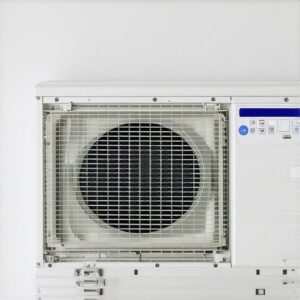
My old mentor, a man we called ‘Iron Mike’ because he could bend 1-inch conduit over his knee, used to scream at me every time I got lazy with a clearance check. ‘You can’t move heat if you can’t move air!’ he’d bark. He wasn’t just being a cranky old man. He understood the fundamental law of thermodynamics that governs every AC installation and heating service call I’ve ever run. A mini-split doesn’t ‘create’ cold. It removes heat. It’s a transport system. The outdoor unit—the condenser—is where that heat is dumped. If you build a solid box around it because you saw a pretty picture on Pinterest, you are forcing that unit to breathe its own exhaust. The head pressure spikes, the juice (refrigerant) stays hot, and the compressor eventually cooks itself in its own acidic oil.
Thermodynamic Zooming: The Secret Life of the Condenser Coil
To understand why hiding a unit is dangerous, we have to look at the physics of heat rejection. Inside that condenser, the compressor is pumping high-pressure, superheated vapor through the coils. The fan’s job is to pull ambient air across those aluminum fins to drop the temperature of the refrigerant until it condenses into a liquid. This is sensible heat exchange. In a humid climate like ours, the efficiency of this process determines whether your indoor evaporator coil can drop below the dew point to handle the latent heat (the moisture that makes your skin feel like wet wool). If the outdoor unit is recycled hot air because it’s trapped behind a solid fence, the refrigerant doesn’t cool down enough. The result? A house that stays at 75 degrees but feels like a swamp because the unit never gets cold enough to dehumidify.
“Equipment shall be installed in accordance with the manufacturer’s instructions and the requirements of this code.” – ACCA Manual S
When we talk about airflow, we are talking about static pressure. Even a decorative lattice can create enough resistance to drop the CFM (Cubic Feet per Minute) of air moving across the coil. This is why I always roll my eyes when a tin knocker or a landscaper builds a tight enclosure without consulting a tech. You need a clear ‘path of least resistance’ for both the intake and the discharge. Most mini-splits discharge air horizontally from the front. If that air hits a solid wall three feet away, it bounces back and gets sucked right back into the intake fins on the rear and side. It’s a short-circuit of the thermal cycle.
The ‘Forensic’ Approach to Hiding Your Unit
If you must hide the unit, you have to do it with the soul of an engineer and the eyes of a designer. I remember a job last summer where a homeowner had hidden three mini-split condensers inside what looked like a solid garden shed. By the time I got there for the ‘AC not cooling’ call, the ambient temperature inside that shed was 145°F. The units were tripping on high-limit switches faster than a sparky on a Friday afternoon. We had to tear down the front of his shed and replace it with high-flow louvered panels. Here is how you avoid that disaster.
1. The 70% Rule for Screen Porosity
If you are building a fence or a screen, the material needs to be mostly air. If you use lattice, ensure it has at least 70% open area. Think of it like breathing through a straw vs. breathing through a snorkel. Your unit needs the snorkel. Avoid solid horizontal slats. Instead, use vertical louvers angled away from the unit’s discharge fan. This directs the ‘waste’ heat out and away from the intake side.
2. The Minimum Clearance Manifesto
Most manufacturers demand 12 inches of clearance from the back (the intake) and at least 24 to 40 inches from the front (the discharge). I tell my clients to double that if they are putting a roof over the unit. Heat rises. If you put a lid on your condenser housing, you are creating a heat trap. Always leave the top open, or use a mesh screen that won’t catch falling leaves and pine needles, which are the silent killers of AC installation longevity.
3. Vegetation: The Living Filter Problem
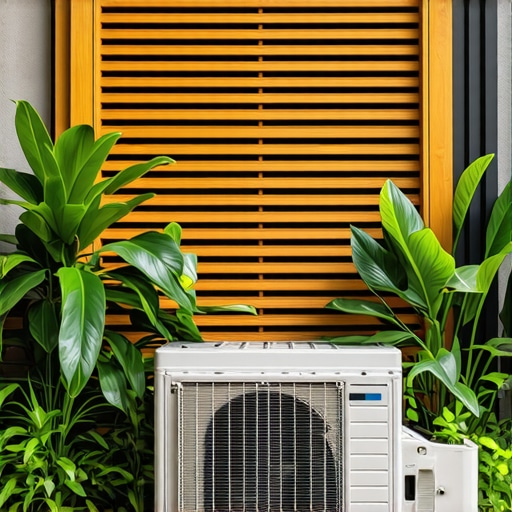
I’ve seen ‘heating service’ pros suggest planting bushes to hide the unit. This is a nightmare. Plants grow. They drop leaves. They release pollen. All of that garbage gets sucked into the condenser fins, creating a thick mat of ‘fur’ that acts like an insulator. If you want to use greenery, keep it three feet back and choose species that don’t shed excessively. If I have to spend two hours with a coil brush and a hose just to see the metal, you’re paying for a lot of labor that could have been avoided with a bit of ‘Pookie’ (mastic) and better planning.
The 2025 Reality: Why Efficiency Matters More Now
With the transition to new refrigerants like R-454B and the phase-out of R-410A, the equipment is getting more sensitive, not less. The new ‘mildly flammable’ A2L refrigerants operate at different pressures and require precise thermal management. A system that is ‘choked’ by a bad enclosure will see its SEER2 rating plummet. You might have paid for a 22-SEER ultra-high-efficiency system, but if it’s trapped in a hot box, it’s performing like a 10-SEER relic from the 1990s. This is why proper furnace repair and AC maintenance starts with the environment around the unit, not just the parts inside it.
“The most expensive equipment in the world cannot overcome a bad duct system—or a restricted condenser.” – Industry Axiom
In the end, comfort is a matter of physics, not magic. You can have a beautiful backyard and a cold house, but you have to respect the airflow. If you treat your condenser like a piece of furniture instead of a breathing mechanical lung, you’ll be seeing me for an expensive compressor replacement long before you should. Keep it clean, keep it clear, and let the juice flow.