The Sound of Physics Screaming: Why Your Commercial Airflow is Whistling
If you are sitting in a commercial office or a retail space and you start hearing a high-pitched, tea-kettle whistle coming from the ceiling at 3:00 PM, you aren’t hearing ghosts. You are hearing the sound of physics being violated. As a tech who has spent three decades dragging a tool bag through return air plenums and burning my retinas on rooftop units (RTUs), I can tell you exactly what that sound is: it’s high static pressure. Your system is trying to shove 2,000 CFM (Cubic Feet per Minute) through a duct designed for 1,200. It’s a literal scream for help from your blower motor.
“The most expensive equipment in the world cannot overcome a bad duct system.” – Industry Axiom
The Physics Lesson: Why Airflow Matters More Than Horsepower
My old mentor, a man who smelled perpetually of PVC glue and stale coffee, used to scream at me, ‘You can’t cool what you can’t touch!’ This was his way of teaching me the fundamental law of thermodynamics in HVAC. If the air can’t pass over the evaporator coil at the correct velocity, the heat exchange fails. In a commercial setting, peak hours mean your thermostat is calling for maximum stage-two cooling or heating. The variable speed blower ramps up to its highest RPM, and suddenly, every pinhole leak, every unsealed joint, and every undersized branch duct becomes a whistle. We call this the ‘straw effect.’ Try blowing through a coffee stirrer as hard as you can; you get a whistle and a headache. That’s exactly what your AC installation is feeling right now.
The Anatomy of the Whistle: Static Pressure and Latent Heat
In our climate zone, where we transition from needing a heavy-duty furnace repair in the winter to a massive heating service check-up in the spring, the ductwork takes a beating. During peak summer hours, we aren’t just fighting sensible heat (the temperature you see on the thermometer). We are fighting latent heat (the moisture in the air). When the air velocity is too high because of restricted ducts, the air passes over the coil so fast it doesn’t have time to drop below the dew point. This means you aren’t removing humidity. You end up with a building that is 72 degrees but feels like a Louisiana swamp. That whistling is the sound of your system failing to dehumidify because the ‘Tin Knockers’ who built the place twenty years ago didn’t account for the modern internal heat loads of servers and LED lights.
The ‘Pookie’ Factor and The Sales Tech Scam
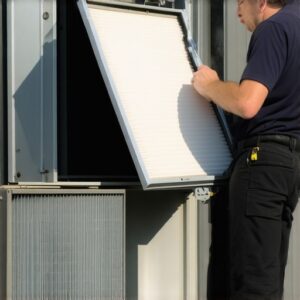
I’ve followed behind plenty of ‘Sales Techs’—those guys in crisp white shirts who couldn’t find a TXV (Thermal Expansion Valve) if it was taped to their forehead. They see a whistling duct and tell the building owner they need a whole new AC installation for $50,000. It’s a predatory joke. Most of the time, the whistle is caused by a loose piece of dampener hardware or a failed seal that needs a good slathering of ‘Pookie’ (mastic duct sealant). Or, heaven forbid, someone actually changed the filters and put in a MERV 16 ‘hospital grade’ filter in a system designed for a MERV 8. You might as well put a piece of plywood over the return air. That furnace repair you thought you needed? It might just be that your blower is starving for air and the primary heat exchanger is tripping the high-limit switch because it’s literally suffocating.
“Airflow shall be within 10 percent of the design CFM for the specific equipment application.” – ACCA Manual J Standards
Static Pressure: The Silent Killer of Compressors
When your ducts whistle, your blower motor is working against a high ‘Total External Static Pressure’ (TESP). This causes the motor to draw more amps, which generates heat, which eventually fries the windings. But it’s worse for the compressor. If the airflow is restricted during a heating service or cooling cycle, the ‘Juice’ (refrigerant) doesn’t fully evaporate. You start sending liquid refrigerant back to the compressor—a process we call ‘slugging.’ Since you can’t compress a liquid, the internal valves of the compressor shatter. That sour, acidic smell of a burnout? That’s the smell of a $5,000 mistake that started with a simple whistle.
The Mini-Split Solution and Modern Retrofits
Sometimes, the whistling is simply because the original building design was flawed. You have a ‘hot spot’ in a corner office, and the system is over-compensating. Instead of tearing out the drywall to resize the ducts, a mini-split installation is often the surgical strike needed. It handles the localized load without stressing the main trunk line. This prevents the main blower from having to ramp up to those ‘whistling’ RPMs just to satisfy one stubborn thermostat. It’s about working with physics, not against it.
2025 and the Regulatory Cliff: Why You Should Fix it Now
We are entering the era of A2L refrigerants like R-454B. The new units are going to be more sensitive than ever to airflow issues because of the mildly flammable nature of the new ‘gas.’ If you have a whistling duct now, a new system installation next year is going to be a nightmare of sensor trips and safety shutdowns. You need a real technician—a ‘Sparky’ for the electrical and a seasoned ‘Tin Knocker’ for the air—to balance your system. Don’t let a Sales Tech sell you a new box when your current box just needs to breathe. Check your static pressure, seal your joints with Pookie, and make sure your return air drop is ‘beer can cold’ and quiet.