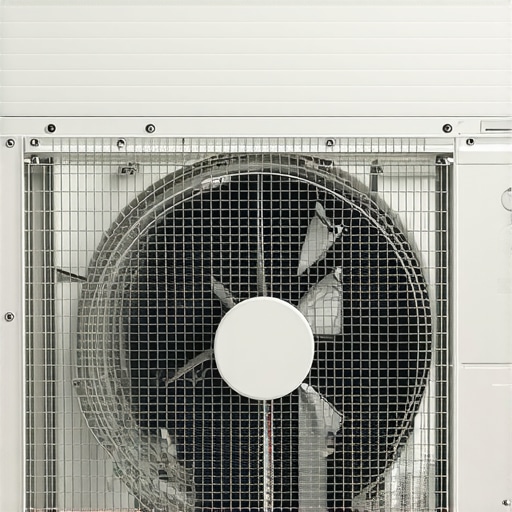
The Death Rattle of a Ductless Wonder
You hear it before you feel it. That rhythmic, irritating thwack-thwack-thwack coming from the wall-mounted head of your mini-split. It’s 2026, and while the industry has pivoted hard toward the new A2L refrigerants like R-454B, the physics of a spinning blower wheel hasn’t changed a lick since the first tin knocker hung a piece of galvanized pipe. That wobble isn’t just a nuisance; it’s a sign that your system’s centrifugal balance is screaming for mercy. As a veteran who’s spent three decades smelling burnt windings and crawling through blown-in insulation, I can tell you: a wobbling fan is often the precursor to a shattered bearing or a fried motor controller.
The Sales Tech Scam: A $4,000 Set Screw
I followed a ‘Sales Tech’ last month—one of those guys who wears a shirt so white it blinds you and carries a tablet instead of a manifold gauge set. He’d quoted a young couple in a drafty Victorian three grand to replace the entire indoor head of their multi-zone system. He told them the ‘internal gyroscopic stabilizer’ was shot. Pure fiction. I walked in, pulled the filters, and saw a build-up of gray, fuzzy gunk on the leading edge of the cross-flow fan. I took a stiff brush and a vacuum, cleared the debris, and tightened the 3mm hex set screw on the blower hub. Total time: 15 minutes. Total cost: A fraction of his ‘replacement’ fee. He wanted to sell a new AC installation; I wanted to fix the damn machine. That’s the difference between a technician and a salesman.
“The most expensive equipment in the world cannot overcome a bad duct system or poor mechanical maintenance.” – Industry Axiom
Thermodynamic Zooming: Why Balance Matters
To understand the wobble, you have to understand the evaporator’s job. It’s not just about ‘blowing cold.’ The cross-flow fan pulls warm, humid air across the aluminum fins of the evaporator coil. As that air temperature drops below the dew point, latent heat is removed—turning water vapor into liquid condensate. If that fan is wobbling, the airflow becomes turbulent. Instead of a steady laminar flow, you get dead spots on the coil. This leads to uneven cooling, or worse, the coil freezing into a block of ice because the heat exchange rate has plummeted. In the 2026 era of ultra-high-efficiency heat pumps, even a 10% reduction in airflow can send the inverter compressor into a tailspin, trying to compensate for a problem that’s purely mechanical.
Fix 1: The Debris Imbalance (The ‘Biofilm’ Problem)
Mini-split fans are precision-weighted. In humid environments, the moist environment inside the head unit becomes a breeding ground for biological growth. This ‘gunk’ sticks to the blades of the blower wheel. Because the wheel is long and narrow, even a few grams of weight on one side creates a massive centrifugal imbalance. If your unit is used for heating service in the winter and cooling in the summer, this stuff bakes onto the plastic. The Fix: Disconnect the power at the Sparky’s disconnect box. Open the louvers and use a flashlight to inspect the wheel. If it looks like it’s growing a beard, it needs a deep clean. Don’t just spray it with canned air; you’ll just push the dirt into the bearings.
Fix 2: The Perishing Rubber Bushing
On the left side of most mini-split heads (opposite the motor), the blower wheel sits in a rubber bushing. Over time, especially in high-heat zones or during intense furnace repair seasons where the indoor air is bone-dry, that rubber becomes brittle. It loses its elasticity and starts to ‘egg out.’ When the hole is no longer perfectly round, the shaft bounces. The Fix: This requires a bit of ‘tin knocker’ finesse. You have to partially disassemble the casing to reach the bushing. A dab of high-quality silicone grease can sometimes buy you a season, but usually, that $10 piece of rubber just needs to be swapped out.
Fix 3: The ‘Pookie’ and the Plate
Sometimes the wobble isn’t the fan at all—it’s the mounting plate. If the original installer didn’t hit studs and used cheap plastic anchors, the weight of the unit and the vibration of the motor will eventually loosen the plate from the sheetrock. The entire chassis starts to resonate. The Fix: Gently push against the bottom of the unit while it’s running. If the noise stops, your mount is loose. You might need to move the plate or use heavy-duty toggle bolts to secure the ‘gas’ lines and the head unit firmly to the structure.
“Proper airflow is the fundamental requirement for all psychrometric processes in HVAC systems.” – ACCA Manual J Section 1
The Cold Truth
Whether you’re dealing with a legacy R-410A system or the latest 2026 A2L model, physics doesn’t take a day off. A wobbling fan is a cry for help from your equipment. Ignoring it will eventually kill the motor, and then you’re looking at a bill that will make your eyes water. Keep your coils clean, keep your ‘juice’ levels checked by a pro who actually knows how to use a subcool calculator, and don’t let a sales tech talk you into a new system when a hex wrench and some elbow grease will do the trick.