The Anatomy of a Service Call: When ‘Low Gas’ is a High-Stakes Lie
I remember following a ‘Comfort Advisor’—that is trade-speak for a salesman wearing a company polo who wouldn’t know a manifold gauge set from a toaster—into a brick ranch house last August. The customer was a schoolteacher, terrified because her house was 82 degrees and the salesman had already written up a $14,000 quote for a full AC installation. He told her the compressor was ‘bleeding juice’ and the system was obsolete. I walked straight to the mechanical closet, pulled out a filter that looked like it had been used to vacuum a wool rug, and checked the static pressure. Total cost to fix her ‘broken’ unit? Six dollars and ten minutes of my time. This is the reality of the HVAC industry: 90% of cooling failures are actually airflow crimes disguised as mechanical deaths.
The Thermodynamic Zoom: Why Airflow is King
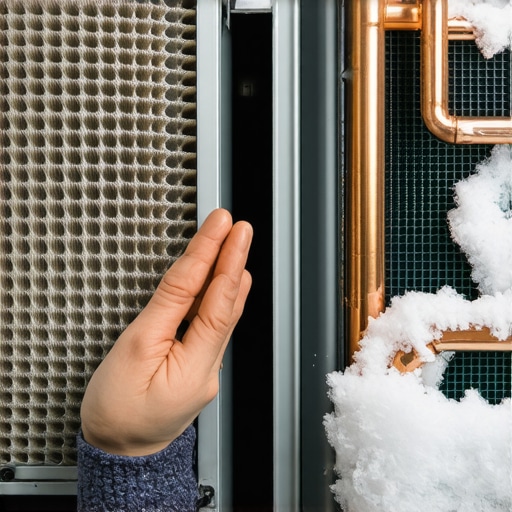
To understand why your unit isn’t cooling, you have to stop thinking about ‘blowing cold air’ and start thinking about heat transfer. Your evaporator coil—that A-shaped hunk of copper and aluminum inside your air handler—is a heat exchanger. When your system is running correctly, the suction line should be ‘beer can cold.’ The refrigerant enters that coil as a low-pressure liquid-vapor mix, roughly 40°F. As the warm, humid air from your living room passes over those fins, the refrigerant absorbs that heat. This causes the refrigerant to ‘boil’ into a gas. This is latent heat removal. If the air is humid, the coil drops below the dew point, and moisture wrings out of the air like a sponge, dripping into the condensate pan. But if you restrict that air with a filthy filter or a botched heating service duct job, the physics break. Without enough warm air to boil the refrigerant, the coil temperature plummets. It doesn’t just get cold; it turns into a block of ice. Once that happens, the heat transfer stops entirely, and you’re just blowing warm air through an ice cube.
“The most expensive equipment in the world cannot overcome a bad duct system.” – ACCA Manual J Standards
Forensic Diagnosis: The Filter vs. The Leak
How do you, the homeowner, tell the difference before calling out a furnace repair specialist or a ‘tin knocker’ for ductwork? First, look at the suction line—the larger, insulated copper pipe. If it’s covered in ice all the way back to the outdoor compressor, you have a massive airflow restriction or a severe charge issue. Here is the trick: turn the system off but keep the fan ‘On.’ If the air starts moving better after an hour of thawing, your problem is almost certainly a restricted filter or a failing blower motor, not a leak. A system low on ‘gas’ (refrigerant) won’t typically freeze the entire line instantly; it starts by freezing just the top of the evaporator coil because there isn’t enough refrigerant to fill the whole circuit. If your filter is clean and the coil is still freezing, you likely have a leak. And remember, as per EPA Section 608 regulations, we don’t just ‘top off’ a system. It’s a sealed loop. If it’s low, there is a hole. Period.
“Refrigerant does not wear out or get ‘used up’ during normal operation. Any loss of refrigerant is indicative of a leak that should be repaired.” – EPA Section 608 Guidelines
The Mini-Split Myth and Modern Efficiency
We see this often with mini-split systems. These high-efficiency units are incredibly sensitive to ‘static pressure.’ Because they use variable-speed fans, a slightly dirty filter can cause the onboard computer to ramp up the compressor, trying to compensate for the lack of heat exchange. This leads to ‘slugging’—where liquid refrigerant makes it back to the compressor because it didn’t have enough air to boil off. This is a compressor killer. Whether it’s a traditional split system or a high-tech heat pump, the law of physics remains: you can’t cool what you can’t touch. If the air can’t touch the fins, the heat stays in your house. If you’re considering a new AC installation, don’t just look at the SEER2 rating. Ask the tech about the return air drop. If they don’t use Pookie (mastic) to seal the joints, they aren’t finishing the job. Leaky ducts in an attic can suck in 140°F air, making even a perfectly charged system feel like it’s failing. Before you let a salesman talk you into a five-figure debt, check your return grills. If they’re whistling, your system is gasping for breath, not ‘low on gas.’