The Sound of a Dying Summer: The Hum-Buzz-Click
You hear it before you feel it. It is 5:30 PM in the middle of a Mojave heatwave. The thermostat says 78, but the air coming out of the vents is lukewarm at best. You walk outside, and instead of the reassuring roar of the condenser fan and the deep thrum of the compressor, you hear a pathetic hummmmmm… click. That click is the internal overload on your compressor screaming for help because it is trying to start against 400 pounds of head pressure without its electrical crutch. As an HVAC vet who has spent thirty years pulling 140-degree shifts in attics, I can tell you that sound is usually a $40 fix or a $10,000 mistake. You are looking at a failed run capacitor, the most common casualty of the desert sun. This little silver cylinder is essentially a temporary battery that provides the phase-shift torque required to get that motor spinning. Without it, the motor just sits there, drawing Locked Rotor Amps (LRA) until it cooks itself from the inside out. If you call the wrong company, they will tell you the ‘juice’ is gone or the compressor is grounded. Don’t believe them until you check the ‘cap’.
The Narrative Matrix: The Case of the $15,000 Dust Bunny
I remember following a ‘Sales Tech’ from a big-box franchise out to a rental property in Henderson last August. The tenant was a young guy, completely at the mercy of the triple-digit heat. The previous tech—let’s call him a ‘Part-Changer’—had spent ten minutes on-site and handed over a quote for a full AC installation, claiming the compressor was ‘mechanically seized.’ He quoted $15,000 for a new 16-SEER system. I walked up to the unit, saw the top of the capacitor was flared out like a muffin top—a classic sign of internal pressure relief—and pulled out my multimeter. I replaced the 45+5 microfarad (µF) dual-run capacitor, scrubbed the desert silt off the condenser coils, and that ‘seized’ compressor kicked on so hard the suction line was ‘beer can cold’ in minutes. The total bill was under $300. That’s the difference between a technician and a salesman. Whether you are dealing with a standard split system or a high-efficiency mini-split, understanding the physics of the start-cycle saves you from the ‘Sales Tech’ scam.
“The most expensive equipment in the world cannot overcome a bad duct system or a technician who doesn’t understand electrical theory.” – Industry Axiom
Thermodynamic Zooming: Why Capacitors Die in the Heat
In the Southwest, we deal with sensible heat that would make a furnace repair guy in Chicago weep. When the ambient temperature hits 110°F, the head pressure in your system skyrockets. The compressor has to work significantly harder to move that refrigerant vapor into the condenser and reject heat. This increased load means more current, and more current means more heat inside the capacitor. Capacitors are rated in microfarads and voltage. Most residential units use a dual-run capacitor, which serves both the compressor and the fan motor. When the dielectric fluid inside the capacitor breaks down due to heat, it can no longer provide the ‘kick’ (the phase angle shift) needed to start the motor. The motor stalls, heats up, and eventually, the windings fail. If you ignore a weak capacitor, you aren’t just losing cooling; you are actively killing the most expensive component in your home. This is why regular heating service and AC maintenance involve checking these ratings under load—not just looking for the ‘bulge.’
Blueprint A: The Forensic Diagnosis and Replacement
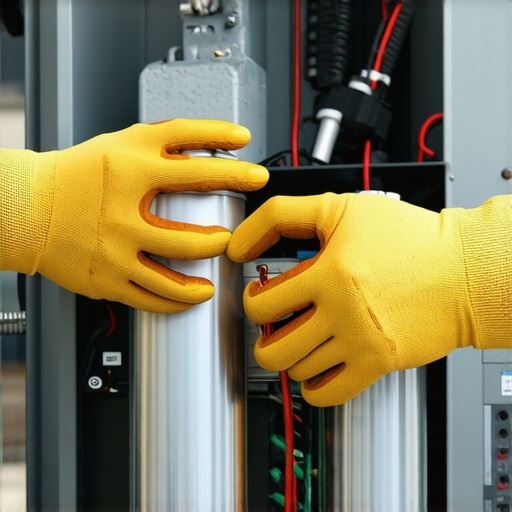
Before you even touch a screwdriver, you need to understand that a capacitor is ‘lightning in a can.’ It stores a charge even when the power is off. If you touch the terminals without discharging them, it will put you on your back faster than a sparky on a Friday afternoon. Step 1: Kill the Power. Pull the disconnect at the outdoor unit. Do not just trust the thermostat. Step 2: The Discharge. Using an insulated screwdriver, bridge the ‘Herm’ terminal to the ‘Common’ terminal, and the ‘Fan’ terminal to ‘Common.’ You might see a spark; that’s the capacitor’s way of saying ‘I would have killed you.’ Step 3: The Identification. Look at the label. You need to match the µF (microfarad) rating exactly. If it says 35/5, you need a 35/5. The voltage rating (usually 370V or 440V) can be higher than the original, but never lower. Think of voltage like a bridge’s weight limit—higher is fine, lower is a collapse. Step 4: The Swap. Use your needle-nose pliers to move the wires one by one. Don’t be a tin knocker and just rip them all off at once. Move the wires from ‘Herm’ (compressor) to ‘Herm,’ ‘Fan’ to ‘Fan,’ and ‘C’ (common) to ‘C.’ If your wires are burnt or ‘crispy,’ you need to strip them back and crimp on new heat-shrink terminals. Poor connections create resistance, and resistance is the father of heat.
“Properly functioning capacitors are critical for maintaining the Power Factor of the HVAC system, ensuring the motor operates within its designed temperature rise.” – ASHRAE Fundamentals Handbook
The Southwest Factor: Hard Start Kits and High Head Pressure
In dry, high-heat climates, a standard capacitor often isn’t enough. Many veterans will install a ‘Hard Start Kit’ (a potential relay and a start capacitor). This gives the compressor an extra 300% starting torque for a fraction of a second. It’s like giving a car a jump-start every time it turns on. If you live in a place where the sun turns your ‘pookie’ (mastic) into brittle crackers, a hard start kit is the best insurance policy you can buy. It reduces the ‘inrush current,’ which keeps your lights from flickering when the AC kicks on and prevents the compressor windings from vibrating themselves to death. When I perform a heating service check in the winter, I’m still looking at that AC capacitor because the heat of the previous summer likely started the degradation process. Don’t wait for the sound of silence; if the top of your cap isn’t perfectly flat, it’s a ticking time bomb.