The Sound of a Failing System: Why Your Wall is Crying
There is a specific sound that makes every veteran tech’s skin crawl at 3 AM: the rhythmic, wet tink-tink-tink of water hitting a hardwood floor. You didn’t buy a high-efficiency ductless system to turn your living room into a swamp, yet here we are. When a mini-split starts vomiting water down your drywall, most homeowners panic and call the first ‘Sales Tech’ they find on Google. That guy will walk in, barely touch his gauges, and tell you the coil is ‘pitted’ and you need a $5,000 AC installation. He’s lying. Or he’s lazy. Probably both.
I remember walking into a high-end boutique in the middle of a humid July. The owner was frantic; her $3,000 silk rugs were being ruined by a dripping indoor head. The previous tech—a kid who looked like he hadn’t even finished his EPA 608 certification—had quoted her a full system replacement because of a ‘cracked drain pan.’ I took one look at the blower wheel, saw it was choked with dust, and realized the unit wasn’t draining because it couldn’t breathe. I spent twenty minutes cleaning the ‘slime’ out of the 3/4-inch PVC and charged her a standard service fee. She didn’t need a new unit; she needed someone who understood the thermodynamics of latent heat.
“The removal of sensible heat is only half the battle; if the system fails to manage latent heat through proper condensate drainage, the indoor environment is compromised.” – Modern Refrigeration and Air Conditioning
Thermodynamic Zooming: How Your Wall Becomes a Waterfall
To understand the leak, you have to understand the evaporator coil. When your mini-split is in cooling mode, that coil is screaming cold—usually somewhere around 40°F to 45°F. The warm, humid air in your room is pulled across those fins. Because the coil temperature is well below the dew point of the room air, the water vapor (latent heat) undergoes a phase change. It turns from a gas into a liquid. This is exactly what happens on the side of a ‘beer can cold’ suction line.
In a perfect world, that water drips into a plastic tray (the condensate pan) and gravity carries it outside through a hole in your wall. But we don’t live in a perfect world. We live in a world of dust, skin cells, and microbial growth. When your mini-split isn’t maintained, that water sits. It gets warm. It starts growing what we in the trade call ‘white slime’ or ‘jelly.’ This biological gunk acts like a dam. Once the pan is full, the water has nowhere to go but over the edge of the plastic and down your expensive paint job. This isn’t a furnace repair issue; this is a failure of fluid dynamics.
The Anatomy of the Leak: Forensic Diagnosis
If your unit is dripping, we have to look at the ‘Mechanical Anatomy’ of the drainage system. First, check the level. These indoor heads are designed with a very specific pitch. If the tin knocker or the installer who put it in didn’t use a level—or if the house has settled—the water will pool at the wrong end of the pan. Even a quarter-inch of ‘back-pitch’ is enough to cause a flood.
Second, we look at the condensate pump. Not every mini-split uses gravity. If your unit is on an interior wall, it likely has a tiny, vibrating pump hidden in the casing. These things are notorious for failing. When the ‘Sparky’ (electrician) wired the unit, if he didn’t set up the safety overflow switch, that pump will die, and the unit will keep making ice and water until you’re swimming in it.
“Condensate piping shall be sloped not less than one-eighth unit vertical in 12 units horizontal (1-percent slope) and shall be a minimum of 3/4-inch nominal pipe size.” – International Mechanical Code (IMC) Section 307.2.1
The Humidity Trap: Why South/Humid Climates Suffer
In high-humidity zones like Houston or Miami, the latent heat load is massive. A 12,000 BTU mini-split can pull gallons of water out of the air in a single day. If your unit was oversized by a salesman looking for a higher commission, it will ‘short cycle.’ This means it hits the temperature setpoint so fast that it doesn’t have time to actually move the water out of the pan. The coil stays wet, the humidity stays high, and you end up with a ‘cold swamp’ feel. This eventually leads to ice formation. If you see ice on the front of your mini-split, don’t call for a heating service—turn it off. You’ve likely got a restricted filter or you’re low on gas (refrigerant), causing the coil to drop below 32°F and freeze that condensate into a block of ice that eventually melts all at once.
The ‘Scam’ Tune-Up vs. Real Maintenance
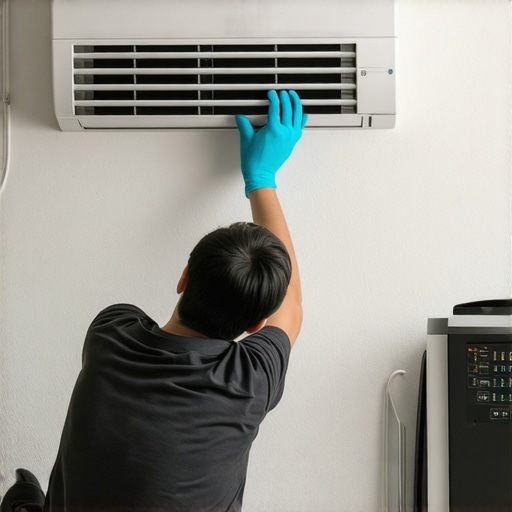
Most companies offer a ‘$59 Tune-up.’ Stay away. They are just there to find a reason to sell you a new AC installation. A real technician is going to pull the cover off that mini-split, check the static pressure, and use a pressurized nitrogen blast to clear the drain line. We also use ‘Pookie’ (mastic) or specialized insulation to wrap the connections. If the suction line isn’t insulated all the way to the cabinet, it will ‘sweat’ behind the unit, and you’ll see water damage on the wall without ever seeing a drip from the front. This is ‘ghost leaking,’ and it’s the hallmark of a lazy installation.
How to Fix it Before Calling Me
Before you pay me $150 to show up, do three things. First, check your filters. If they are ‘clogged with fur,’ the air can’t move, the coil gets too cold, and the water won’t flow. Second, go outside and find the 1-inch white pipe sticking out of your wall. Put a shop-vac to the end of it for 30 seconds. You’d be surprised how much ‘jelly’ you can suck out of there. Third, check the ‘swing’ of the vanes. If they are pointed straight down, they can sometimes cause cold air to blow back onto the plastic housing, creating ‘sensible’ condensation on the outside of the unit itself.