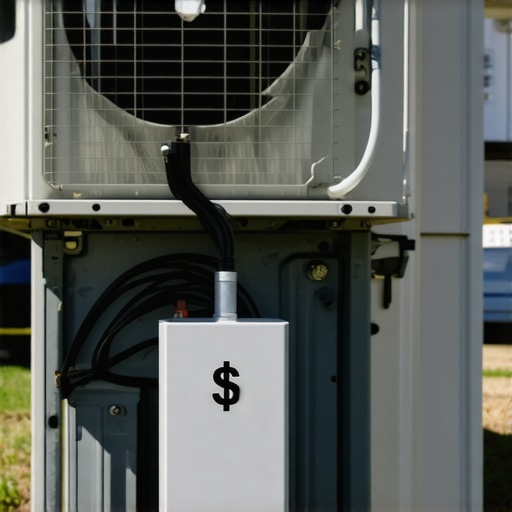
The Sound of a $12,000 Paperweight
The smell of a fried control board is something you never forget—it’s a cloying, metallic stench that tells me exactly how much a homeowner is about to regret their choices. Last August, during a record-breaking heatwave where the ambient temperature on a Scottsdale rooftop hit 118°F, I stood over a high-efficiency inverter unit that was less than six months old. The homeowner was frantic; their AC installation was supposed to be the gold standard. But as I pulled the panel, I saw the blackened traces on the inverter drive. A single micro-surge from the grid had bypassed the cheap disconnect and cooked the ‘brains’ of the system. This wasn’t a mechanical failure; it was a protection failure. A simple $120 Surge Protective Device (SPD) would have saved that board, but the ‘Sales Tech’ who installed it was too busy hitting his commission target to mention a part that doesn’t pad his pocket. That is the reality of the 2026 HVAC landscape: we are installing literal supercomputers outside your house and then leaving them defenseless against the grid.
The A2L Transition: Why Your New System is More Sensitive Than Ever
By now, you’ve probably heard the rumors about the great refrigerant shift. We’ve moved away from R-410A into the era of A2L refrigerants like R-454B and R-32. While the Sparkies and Tin Knockers are arguing about flammability, the real issue for you is the complexity. To manage these ‘mildly flammable’ gases safely, manufacturers have packed these units with more sensors, leak detection modules, and variable-speed logic than a Tesla. These components don’t just ‘run’ on electricity; they feast on clean, stable power. In the Southwest, where sensible heat dominates the load, these boards are already working under extreme thermal stress. When the power fluctuates—as it always does during a monsoon—the voltage spikes can degrade the semi-conductors inside your mini-split or central air handler. You might not see the failure today, but you’re shortening the life of the equipment every time the lights flicker.
“The most expensive equipment in the world cannot overcome a bad duct system, nor can it survive unstable electrical input without dedicated protection.” – Industry Axiom (Modified for the Digital Age)
Thermodynamic Zooming: Sensible Heat and Electronic Vulnerability
In a dry climate, our primary enemy is Sensible Heat—the heat you can actually feel on your skin. When your unit is struggling to reject heat at high head pressures, the compressor draws more ‘juice.’ This increased amperage generates internal heat within the windings and the control circuits. If you don’t have a hard start kit or a surge protector, you’re essentially red-lining your engine without an oil filter. Your heating service technician might check your heat exchanger in the winter, but in the summer, the focus must be on electrical integrity. I’ve seen furnace repair calls turn into full system replacements because a surge traveled through the low-voltage wiring and fried the communicating thermostat and the furnace control board simultaneously. We call this ‘cascading failure,’ and it’s 100% preventable.
The Surge Kit: A $120 Insurance Policy
What exactly is this ‘Surge Kit’? It’s a Type 2 Surge Protective Device, usually mounted at the outdoor disconnect or the main panel. Its job is to shunt excess voltage to the ground before it reaches the sensitive DC inverters. Think of it as a lightning rod for your AC installation. Many ‘trunk-slammers’ and sales-heavy companies skip this because it adds twenty minutes to the job and requires them to actually understand the National Electrical Code (NEC) 240.67 or 230.67 requirements. They’d rather sell you a ‘UV light’ with a 400% markup than a surge protector that actually keeps your house cool during a brownout. If your quote for a new unit doesn’t have a line item for ‘SPD’ or ‘Surge Protection,’ you are being set up for a multi-thousand-dollar repair four years down the road.
“All electrical equipment shall be provided with a short-circuit current rating not less than the maximum available fault current.” – NEC Section 110.10
The Physics of Airflow: Why the ‘Juice’ Matters
You can have the best refrigerant charge in the world—’suction line beer-can cold’ as the old-timers say—but if your blower motor’s ECM (Electronically Commutated Motor) board dies from a power spike, that cold air stays trapped in the coil until it turns into a block of ice. I’ve spent thirty years crawling through attics covered in pookie (mastic) and fiberglass, and I’ve learned one thing: the mechanical parts of an HVAC system are surprisingly hardy. It’s the electronics that are fragile. Whether you’re looking at a mini-split for a garage or a full 5-ton split system, the electronic boards are the heart of the operation. Without a surge kit, you’re basically leaving that heart exposed during a bypass surgery. Don’t let a ‘Sales Tech’ convince you that your manufacturer warranty will cover a ‘surge event.’ Most of the time, they’ll point to the ‘Act of God’ clause and leave you holding the bill for the labor and the $1,200 board. Insist on the kit. Protect the investment. Keep the air moving.
{“@context”:”https://schema.org”,”@type”:”HowTo”,”name”:”How to Verify Surge Protection on Your AC Installation”,”step”:[{“@type”:”HowToStep”,”text”:”Locate the electrical disconnect box near your outdoor condenser unit.”},{“@type”:”HowToStep”,”text”:”Check for a small secondary device with LED indicator lights (usually green) wired into the box.”},{“@type”:”HowToStep”,”text”:”If no such device is present, contact a qualified technician to install a Type 2 Surge Protective Device.”}]}