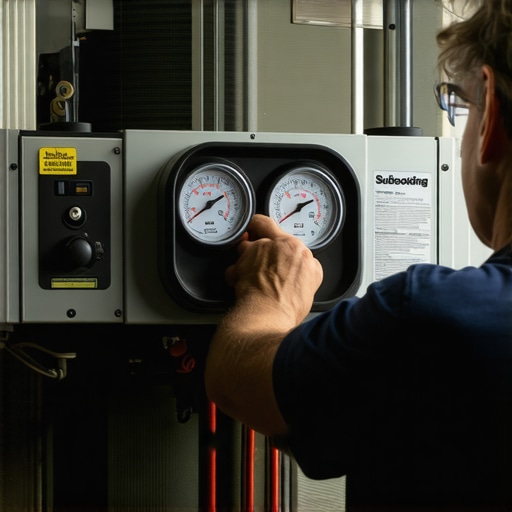
The 130-Degree Attic Truth
I remember a Labor Day weekend back in ’98. The ambient temp was pushing 105, and I was shoulder-deep in a fiberglass-filled crawlspace that smelled like wet dogs and ozone. A frantic homeowner had called because her ‘brand new’ system was blowing 70-degree air. I hauled my gauges out, hooked up to the liquid line, and saw the problem immediately. The previous tech—likely some ‘Sales Tech’ in a starched shirt—had simply dumped juice into the system until the suction line felt ‘beer can cold’ and skipped. He didn’t bother checking the subcooling. He didn’t realize that in our humid climate, that system was drowning in latent heat it couldn’t shed. That ‘free’ installation adjustment ended up costing the lady a compressor two years later. Now, as we stare down the 2026 regulatory barrel, the scams are getting even more sophisticated.
The Regulatory Cliff: R-410A is Dead, Long Live A2L
If you are looking at an AC installation or mini-split setup today, you are caught in the biggest shift since we killed R-22. By 2025 and into 2026, the industry is transitioning to A2L refrigerants like R-454B and R-32. These aren’t just new types of gas; they are ‘mildly flammable.’ That means your new evaporator coil now requires leak sensors and mitigation boards that didn’t exist three years ago. This is where the ‘hidden charges’ start creeping in. A ‘Subcooling Charge’ is often buried in the fine print. While subcooling is a critical thermodynamic measurement—the amount of heat removed from the liquid refrigerant after it has condensed—it is a standard part of a professional commissioning process. If a contractor is line-iteming a ‘Precision Subcooling Calibration’ for $200, they are charging you extra to do their basic job.
“The most expensive equipment in the world cannot overcome a bad duct system.” – Industry Axiom
Thermodynamic Zooming: Why Subcooling Matters
Let’s talk physics. Your AC doesn’t ‘create cold.’ It moves heat. The evaporator coil inside your house drops the temperature of the copper below the dew point. As air passes over it, moisture (latent heat) condenses on the fins and runs down the drain. If your subcooling isn’t dialed in—meaning the refrigerant isn’t properly cooled in the outdoor condenser—the expansion valve won’t get a solid column of liquid. You’ll get ‘flash gas,’ and your efficiency will tank. In our region, where a furnace repair is just as likely as an AC breakdown, getting this balance right is the difference between a 20-year lifespan and a 5-year burnout. A tin knocker can build the best boxes in the world, but if the juice isn’t measured to the gram using a digital scale and a psychrometric chart, it’s all for naught.
The ‘Sales Tech’ Scam and the $200 Line Item
I recently followed a guy who quoted a family $18,000 for a full heating service and cooling replacement. He told them their subcooling was ‘dangerously low’ and they needed a proprietary 2026-compliant ‘balancing charge.’ It was a load of hot air. The unit was just low on airflow because the homeowner hadn’t changed a 4-inch media filter in eighteen months. Once I swapped the filter and cleaned the pookie off the secondary drain pan, the pressures stabilized perfectly.
“The transition to A2L refrigerants requires specialized leak detection systems integrated into the indoor coil assembly.” – ASHRAE Standard 15
Blueprint for a 2026 Installation
When you are shopping for a new system, don’t just look at the SEER2 rating. Ask about the refrigerant type. If it’s R-410A, you’re buying a dinosaur. If it’s R-454B, ensure the tech is EPA Section 608 certified for A2Ls. A real pro won’t charge you a ‘subcooling fee’; they will provide a commissioning report showing the target vs. actual subcooling, the static pressure of your ducts, and the temp drop across the coil. If they can’t show you the math, they are just a parts changer in a fancy van. Remember, airflow is king. If your furnace repair tech doesn’t check your return air static pressure, they aren’t finishing the job. Physics doesn’t care about your warranty; it only cares about thermodynamics.