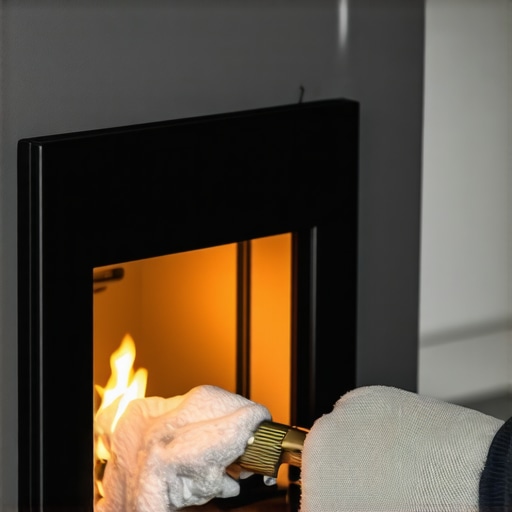
The 3 AM Click of Death: Why Your Furnace is Short-Cycling
It is 3:00 AM in the middle of a January polar vortex, and the silence in your house is heavy. You hear the inducer motor kick on—that familiar mechanical whir. Then, the click-click-click of the igniter. For a second, you hear the roar of the burners. It feels like relief. But five seconds later? Silence. The flame vanishes, the blower never kicks on, and the house stays freezing. You do not need a $15,000 furnace replacement, and you do not need a ‘Sales Tech’ telling you your heat exchanger is cracked when they haven’t even pulled the burner door. Most likely, you are dealing with a dirty flame sensor—a simple metal rod that costs more in labor to find than it does in material to fix.
The Physics Lesson: You Can’t Heat What You Can’t Prove
My old mentor, a guy who had been turning wrenches since the R-12 days, used to scream at me in frozen crawlspaces,
‘The most expensive equipment in the world cannot overcome a bad duct system.’ – Industry Axiom
He would follow that up with his favorite rule for troubleshooting: ‘You can’t cool what you can’t touch, and you can’t heat what you can’t prove is burning!’ He was talking about flame rectification. This is the core physics of your furnace. The flame sensor is not a thermometer; it is a probe that uses the flame itself as a conductor. The furnace control board sends an AC voltage to the sensor. When the flame hits that rod, the ions in the flame conduct electricity, but they only allow it to flow in one direction. This converts the AC to a tiny DC signal—measured in microamps. If that rod is covered in microscopic soot or silica, the ‘gas’ (our trade talk for fuel) burns, but the board never sees the signal. No signal means the board thinks the gas valve is open without a fire, so it shuts everything down to prevent you from turning your basement into a bomb.
Sign #1: The Five-Second Flame Out
The most common sign that your 2026 high-efficiency furnace is throwing a fit is the consistent five-second shutdown. In these modern units, the logic boards are faster than ever. If the flame sensor does not report a minimum of 0.5 to 5.0 microamps within a heartbeat of the gas valve opening, the system goes into lockout. This is the forensic diagnosis of a dirty sensor. Unlike a bad inducer motor or a tripped limit switch (which usually prevents the burners from lighting at all), a dirty sensor allows the fire to start, then kills it. If you see the glow of the igniter and the blue of the flame, but it dies almost instantly, the sensor is the prime suspect. It is often just a thin layer of oxidation—essentially ‘rust’ from the combustion process—insulating the metal rod from the flame’s plasma.
The Hidden Enemy: Atmospheric Contaminants
Why does it happen? In modern tight-built homes, we see a lot of ‘Sialic’ buildup. If you have been doing renovations and there is drywall dust in the air, or even if you use a lot of scented candles or laundry soap near the mechanical room, those chemicals get pulled into the combustion air. When they hit the 1,200-degree flame, they turn into a glass-like coating on the sensor. This is why heating service professionals always check the combustion air intake. If your furnace is gasping for air or sucking in ‘trash’ from the air, that $10 rod is going to fail every season. You can spend $10,000 on a fancy AC installation or a mini-split, but if the fundamental physics of the combustion environment are off, the equipment will fail.
Sign #2: Visual Carbon Crusting and Silica ‘Frost’
If you are brave enough to pull the burner cover (after killing the power, of course—don’t be a hero), look at the rod sitting in front of the furthest burner from the igniter. A healthy sensor looks like a dull piece of stainless steel. A failing sensor looks like it has been dipped in white powder or has black, flaky soot on it. This is where the ‘Sales Tech’ earns his commission by scaring you. He will point at that soot and tell you it is proof of an ‘incomplete burn’ and that your furnace repair is actually a ‘total system replacement’ due to a compromised heat exchanger. Do not fall for it.
‘A flame sensor must provide a steady signal of 0.5 to 10 microamps to the integrated furnace control to maintain the gas valve circuit.’ – HVAC Service Standards
Often, all that is needed is a bit of light abrasive—I use a dollar bill or a very fine Scotch-Brite pad—to rub that oxidation off. You are not trying to sand it down to a toothpick; you just want to see shiny metal again.
The Thermodynamic Zoom: Why 2026 Models Are Pickier
As we move into 2026, furnace manufacturers are pushing for higher AFUE (Annual Fuel Utilization Efficiency) ratings. To get that extra 1% of efficiency, they have narrowed the tolerances on the control boards. Where an old ‘tin knocker’ special from 1995 might have stayed lit with a 0.2-microamp signal, these new units will lockout if the signal even wavers. This is especially true in cold climates like Chicago or the Northeast, where the ‘Polar Vortex’ puts a massive load on the system. The higher the heat demand, the more the sensor is subjected to thermal stress, accelerating the oxidation process. If your static pressure is too high because you haven’t changed your filter, the heat in the burner box rises, baking that soot onto the sensor even faster.
Sign #3: The Multi-Attempt Lockout (Error Code 3 or 34)
Most modern furnaces have a ‘brain’ that talks to you through an LED light on the control board. If you peer through the little sight glass on the blower door and see a blinking red or amber light, you are looking at a diagnostic code. A common code for a flame sensor issue is ‘Ignition Failure’ or ‘Flame Sense Out of Sequence.’ If the furnace tries to light three times and fails each time due to the sensor, it will go into a ‘Hard Lockout’ for three hours. This is the furnace’s way of saying, ‘I don’t trust you, and I’m not going to keep pumping gas into a chamber I can’t prove is lit.’ If you see these codes, it is time to call for a professional heating service, but specifically ask them to ‘check the microamps on the flame sensor’ before they start talking about a new unit. A real tech will have a multimeter out, not a sales brochure.
Repair vs. Replace: The $10 Math
Let’s talk about the ‘Sparky’ side of things. A new flame sensor costs about $10 to $50 depending on the brand (Trane, Carrier, or Goodman). The labor to install it is where the cost comes in. However, a cleaning takes ten minutes. If you are being quoted $800 for a furnace repair that only involves one small rod, you are being taken for a ride. But if the tech shows you that your heat exchanger has actual metallurgical failure (cracks), that is a different story. In the North, carbon monoxide is the silent killer. A dirty flame sensor is an annoyance; a cracked heat exchanger is a death warrant. This is why annual maintenance isn’t a ‘scam’—it’s a safety check. We check the ‘juice’ (refrigerant) in the summer for your AC installation, and we check the combustion chemistry in the winter. It’s all about the physics of the home.
The Airflow Manifesto: Beyond the Sensor
At the end of the day, a flame sensor is just a symptom-bearer. If your furnace is constantly fouling its sensor, you have an airflow or a combustion air problem. Maybe your ‘pookie’ (mastic) is leaking at the return air drop, pulling in dust from the basement floor. Maybe your ‘tin knocker’ didn’t size the return vents correctly, causing the burners to run too hot and ‘cook’ the sensor. Comfort isn’t magic; it is thermodynamic physics. If you want your 2026 furnace to last until 2046, you have to treat it like a living thing that needs to breathe. Clean your sensor, yes, but more importantly, clean your air.