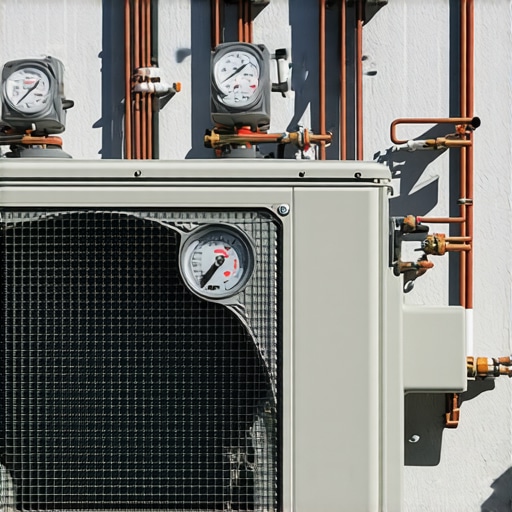
The 2026 Refrigerant Shakeup: Why Your Quote Just Got Weird
I’ve spent the last thirty years crawling through blown-in fiberglass and baking on black shingle roofs, and I’ve seen every trick in the book. But what we’re seeing in 2026 is a different breed of nonsense. The industry is currently sweating through the R-410A phase-out, transitionally pivoting to A2L refrigerants like R-454B and R-32. If you’re looking at a quote for a new AC installation or even a furnace repair that involves a coil swap, you might see a line item that looks like ‘System Subcooling Optimization’ or ‘Digital Refrigerant Alignment.’ Usually, there’s a $200 price tag attached to it. Let me be clear: that’s a ‘Sales Tech’ tax, and it’s absolute garbage.
The Forensic Diagnosis: I Caught a ‘Tech-Bro’ in the Act
Last month, I was called out to second-guess a quote for a homeowner in Phoenix. A ‘Sales Tech’—you know the type, clean fingernails, brand-new wrapped van, spends more time on his iPad than his manifold gauges—told this guy his two-year-old mini-split needed a $1,400 ‘Refrigerant Re-balancing’ because the subcooling was ‘out of factory spec.’ I climbed up there and found the real culprit. The tin knocker who installed the ductwork had kinked the liquid line, and the condenser was choked with three years of desert silt. It wasn’t a ‘balance’ issue; it was a physics issue. I washed the coil, fixed the restriction, and the subcooling snapped right back to 10 degrees. The Sales Tech was trying to charge him for a ‘service’ that was actually just a cover-up for a bad install. This is the ‘Subcooling Charge’ trap of 2026.
“The most expensive equipment in the world cannot overcome a bad duct system.” – Industry Axiom
Thermodynamic Zooming: The Physics of the Subcooling Scam
To understand why they’re charging you for subcooling, you have to understand what it actually is. In the heating service world, we deal with sensible heat, but in cooling, we’re fighting two fronts: sensible and latent. Subcooling is the amount of heat removed from the liquid refrigerant after it has completely condensed in the outdoor unit. If your liquid gas isn’t cooled enough before it hits the TXV (Thermal Expansion Valve), it starts to ‘flash’ into a vapor too early. This starves the evaporator coil. When that coil isn’t cold enough to drop below the dew point, it can’t pull the latent heat (humidity) out of the air. In the Southwest, where the ambient temp hits 115°F, high head pressure is the enemy. Without proper subcooling, your compressor is essentially trying to pump a liquid-vapor sludge, which is a one-way ticket to a sour-smelling compressor burnout.
The A2L Transition: Why Prices are Skyrocketing
We are now in the era of ‘Mildly Flammable’ refrigerants. The new 2026 systems require leak sensors in the evaporator cabinets and specialized brass fittings to prevent ‘Sparky’ from accidentally igniting the line set with a stray wire. Because of these safety mandates, the cost of a basic AC installation has jumped 30% overnight. Shady companies are adding ‘subcooling calibration’ fees to make up for the fact that they don’t know how to properly braze with nitrogen yet. They’re treating basic startup procedures like they’re NASA-level rocket science. If a tech tells you that charging the system to the manufacturer’s slide rule is an ‘extra’ cost, tell them to get off your property. That is literally Step 1 of a professional install.
“Design of the air distribution system shall be in accordance with ACCA Manual D and the equipment manufacturer’s instructions.” – ANSI/ACCA 5 QI – 2015
The Southwest Strategy: Fighting Sensible Heat
In dry climates like Nevada or Arizona, we don’t care as much about latent heat—we care about high-side pressure. When the sun is cooking your condenser, your subcooling is the only thing keeping that compressor from tripping on thermal overload. A ‘Sales Tech’ will try to sell you a hard start kit or a fancy ‘2026-compliant’ refrigerant additive. Don’t buy it. What you actually need is a clean coil and a tin knocker who knows how to size a return air drop. If your return is too small, your static pressure goes through the roof, your blower motor screams like a banshee, and your subcooling numbers will look like a heart attack on a gauge. Furnace repair isn’t just about the firebox; it’s about the airflow that passes over the cooling coil in the summer. If you have a ‘cold swamp’ feel in your house, your unit is likely oversized and short-cycling, meaning it never stays on long enough to actually dehumidify.
Brand Science: Trane, Goodman, and the 2026 Reality
People ask me all the time, ‘Which brand should I buy?’ In 2026, the brand matters less than the guy holding the torch. A Goodman installed with proper vacuum procedures and Pookie (mastic) on every joint will outperform a Trane installed by a hack. The ‘Subcooling Charge’ is often used by companies selling ‘Value Brands’ to make the invoice look more ‘Professional.’ They use the technical jargon to mask the fact that they’re using 24-gauge scrap metal for your transitions. Look for a tech who talks about ‘Beer Can Cold’ suction lines but backs it up with a digital manifold reading. If they aren’t checking the static pressure of your mini-split or central air, they aren’t doing the job.
Final Verdict: Don’t Pay for Physics
Your 2026 AC unit comes with a charging chart on the inside of the service panel. That chart tells the tech exactly what the subcooling should be based on the outdoor temperature. It takes five minutes to read. Charging $200 for that is like a mechanic charging you extra to check the oil level after an oil change. If you’re getting a quote for a heating service or a new cooling system, look for the ‘Total System Startup’ line. If subcooling is listed separately, they’re trying to huff your wallet. Stay cool, keep your filters clean, and never trust a tech who doesn’t have a little bit of Pookie on his work pants.