The Sound of a Stuck Cycle: When Your Heat Pump Refuses to Flip
There is a specific, agonizing sound a heat pump makes when it is trying to do its job but the physics just won’t cooperate. It’s a dull hum followed by the metallic ‘thwack’ of a reversing valve that’s lost its mind. I remember my old mentor, a man who had more refrigerant in his veins than blood, used to scream at me in the middle of a 95-degree afternoon: ‘You can’t cool what you can’t touch, and you can’t move heat if you don’t control the path!’ He was right. Most homeowners think an AC installation is just about ‘making cold,’ but a heat pump is a different animal. It’s a heat mover. When it refuses to switch to cooling mode, you aren’t just dealing with a broken machine; you’re dealing with a thermodynamic identity crisis.
In my thirty years of crawling through crawlspaces and burning my knees on black rubber roofs, I’ve seen thousands of ‘no cooling’ calls. Half the time, some ‘Sales Tech’ has already been there, trying to sell the homeowner a $12,000 unit because they didn’t understand the difference between a low-voltage short and a mechanical seizure. Before you consider a full furnace repair or a total system swap, you need to understand the ‘Logic of the Flip.’ A heat pump is essentially an air conditioner with a reversible soul. If it stays in heating mode when the thermostat is screaming for relief, the problem is almost always located in one of three places: the brain (thermostat), the nerve (wiring/solenoid), or the heart (the reversing valve itself).
“The reversing valve is the only component that defines the heat pump’s primary function; its failure to shift is often a symptom of pressure imbalances rather than mechanical death.” – ASHRAE Fundamentals Handbook
The Thermodynamic Zoom: How Heat Actually Leaves Your House
To understand why your unit is blowing 100-degree air into a 90-degree room, we have to talk about latent heat. In humid climates, cooling isn’t just about dropping the dry-bulb temperature. It’s about squeezing the ‘juice’ out of the air. When your heat pump is in cooling mode, the indoor evaporator coil drops below the dew point. This causes water vapor to condense (latent heat removal), which we then drain away. But when that reversing valve stays stuck in the ‘heating’ position, that indoor coil stays as the condenser. Instead of removing heat, it’s dumping more into the house. You aren’t just failing to cool; you are actively cooking your living room.
Step 1: The ‘O’ Terminal and the Thermostat Brain
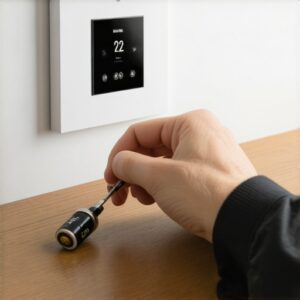
The first thing I check isn’t the ‘gas’ (refrigerant); it’s the thermostat wiring. Most heat pumps—especially brands like Rheem or Ruud—energize the reversing valve in heating mode, while almost everyone else (Trane, Carrier, Goodman) energizes it in cooling mode. This is the ‘O’ vs. ‘B’ terminal logic. If you recently swapped your thermostat and now the unit won’t switch, you likely have a programming error. If the ‘O’ terminal isn’t sending 24 volts out to the unit, that reversing valve is never going to shift. It’s like trying to drive a car without putting it in gear. I’ve seen many a ‘Sales Tech’ quote a whole new mini-split system when the only issue was a loose orange wire at the subbase. Don’t let them ‘sparky’ your wallet for a simple wiring fix.
Step 2: The Solenoid Coil – The Magnetic Muscle
If the brain is sending the signal, but the valve won’t move, we look at the solenoid. This is a small electromagnetic coil that sits on top of the reversing valve. When it gets 24 volts, it creates a magnetic field that pulls a tiny pilot valve inside. This pilot valve redirects the high-pressure discharge gas to push the main slide. If that coil is burnt out—which you can smell, it has that distinct acrid, ozone-like scent of fried electronics—the valve stays put. You can test this with a screwdriver; if it’s energized, it’ll be magnetic. If it’s dead, a $50 part saves you from a $10,000 AC installation.
Step 3: Mechanical Seizure and Pressure Differentials
Now we get into the heavy lifting. The reversing valve operates on pressure. It needs a certain ‘delta’ or difference in pressure to slide that internal piston. If your system is low on refrigerant (the ‘gas’), there might not be enough ‘oomph’ to push the valve over. This is where those scammers tell you that you need to ‘top off the Freon.’ Listen to me: a heat pump is a sealed system. If it’s low, it has a leak. Period. Finding that leak is part of a real heating service, not just dumping more juice into a leaking sieve. If the valve is mechanically stuck, sometimes we can ‘tap’ it with a rubber mallet while the unit is running to break it loose, but that’s a temporary fix. A stuck valve usually means it’s time for a major repair or to evaluate the age of the unit.
“A heat pump system shall be sized to satisfy the cooling load as determined by Manual J, but a faulty reversing mechanism can render even the most precise calculations moot.” – ACCA Manual J Standards
The Climate Context: Why Humidity Makes it Worse
If you’re in a high-humidity zone, a heat pump stuck in heat mode is a recipe for mold. When the system runs in heat mode, it’s not pulling moisture out; it’s potentially flash-evaporating any standing water in the drain pan back into the ducts. This is why proper maintenance and a solid AC installation matter. You need a tech who knows how to use ‘Pookie’ (mastic) to seal those duct leaks so you aren’t pulling attic air into the mix. If your unit is oversized, it’ll short cycle, never reaching the steady-state pressures needed to ensure that reversing valve operates reliably over its 15-year lifespan.
Mini-Splits and the Electronic Expansion Valve (EEV)
For those of you with a mini-split, the diagnosis is even more surgical. These systems use Electronic Expansion Valves and sophisticated boards to manage the refrigerant flow. If a mini-split won’t switch modes, it’s often a communication error between the heads and the condenser. This isn’t a job for a ‘tin knocker’ who only knows how to hang ductwork; you need a tech who understands DC voltage and thermistor resistance charts. A furnace repair guy might be lost here; you need a heat pump specialist.
The Verdict: Repair or Replace?
When I’m standing over a unit with a dead reversing valve, I look at the ‘Suction Line.’ If it’s not ‘beer can cold’ and the compressor is screaming like a banshee with a failing bearing, I have to be honest with the homeowner. Replacing a reversing valve is a ‘surgical’ repair. It requires recovering all the refrigerant, cutting the four copper lines with a torch (without burning the internal teflon seals), and vacuuming the system down to 500 microns. It’s labor-intensive. If your unit is over 12 years old and uses R-410A, you’re looking at a repair bill that’s 40% of a new AC installation. With the 2025 refrigerant transition looming and R-410A prices spiking, that $2,500 repair starts to look like a bad investment. But if it’s just a capacitor or a solenoid? Fix it and run it till the wheels fall off. That’s the difference between an honest tech and a salesman in a clean uniform. Always check the physics before you check the financing options.