The Ghost in the Machine: Why Your Commercial Utility Bill Is Lying to You
I followed a ‘Sales Tech’ last February who quoted a local warehouse manager $45,000 for a total rooftop replacement. The kid told him the furnace repair was impossible because the heat exchanger was ‘vaporized.’ I climbed up that rusted ladder in a sleet storm, pulled the burner assembly, and found exactly what I expected: a bird’s nest blocking the flue and a tripped high-limit switch. It was a $200 service call, not a $45,000 capital expense. That’s the industry today—parts changers looking for commissions instead of technicians looking for physics. When we talk about a commercial HVAC energy audit, we aren’t just looking at stickers and serial numbers; we are looking at the thermodynamic efficiency of a system that is likely fighting against itself every second it’s running.
The Thermodynamics of a Leak: Why Horsepower Doesn’t Equal Comfort
Most commercial owners think if they throw enough tonnage at a building, it’ll stay cool. Wrong. I’ve seen 20-ton units struggle to maintain 75 degrees because the AC installation was handled by a tin knocker who didn’t understand static pressure. If your ductwork is undersized, that blower motor is working against a wall of air. This is what we call high external static pressure. It’s like trying to exhale through a cocktail straw while sprinting. Your energy consumption skyrockets because the motor is pulling peak amps just to move a fraction of the required CFM (Cubic Feet per Minute).
“The most expensive equipment in the world cannot overcome a bad duct system.” – Industry Axiom
In our climate, especially during those brutal northern winters, heating service becomes a matter of survival for your bottom line. We look at the AFUE (Annual Fuel Utilization Efficiency). If you’re running an old 80% furnace, 20 cents of every dollar you spend is literally going out the chimney. In a commercial setting, that’s thousands of dollars a year wasted on heating the sky. We audit the heat exchanger for hairline fractures and secondary coil blockage. If that secondary coil is plugged with bypass dust, your heat transfer coefficient drops, and your ‘gas’ consumption goes through the roof.
[IMAGE_PLACEHOLDER]
The 2025 Regulatory Cliff: R-410A is Dead
If you’re still clinging to R-410A systems, you’re sitting on a ticking financial bomb. As of 2025, the EPA is pushing the industry toward A2L refrigerants like R-454B. These are ‘mildly flammable,’ which means the new equipment requires leak sensors and specialized mitigation boards. When I audit a commercial site, I’m looking at your ‘juice’ (refrigerant) levels. A system that is low on charge isn’t just ‘old’—it’s a sealed system, which means you have a leak. Topping it off is a crime against the environment and your wallet. A low charge causes the compressor to run hot, thinning the oil and leading to an acidic burnout that smells like a dumpster fire at a chemical plant. That’s when the AC installation costs truly become unavoidable.
The Commercial Audit Checklist: The Forensic Breakdown
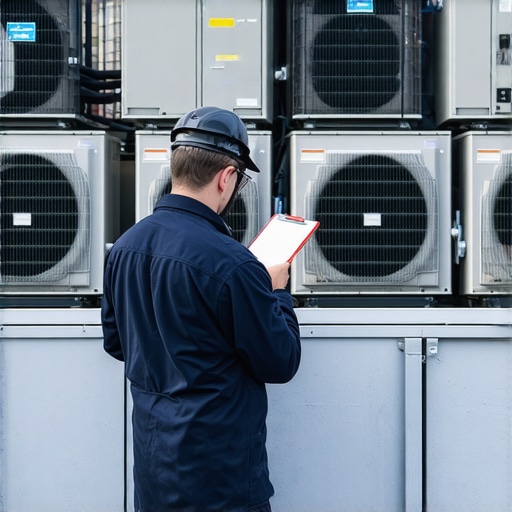
1. The Delta-T Check: We measure the temperature drop across the evaporator coil. If we don’t see a 16-22 degree difference, we have a problem with heat transfer or airflow. 2. The Amp Draw: We check the ‘Sparky’s’ work. If a motor is rated for 15 amps and it’s pulling 14.8, it’s screaming for help. 3. The Envelope Integrity: You can’t cool what you can’t seal. We look for ‘Pookie’ (mastic) failures at the plenum. If you’re conditioning the attic or the mechanical room, you’re burning cash. 4. Mini-Split Efficiency: For server rooms or isolated offices, a mini-split is often the scalpel where a rooftop unit is a sledgehammer. We audit whether these units are being utilized to offset the main load.
“Ventilation must be provided in all spaces intended for human occupancy to maintain acceptable indoor air quality.” – ASHRAE Standard 62.1
The Airflow Manifesto: Physics Over Magic
I’ve been on rooftops for 30 years, and I’ll tell you this: comfort is physics. If your furnace repair guy doesn’t pull out a manometer to check your gas pressure and static drop, fire him. A real audit looks at the latent heat—the humidity. In the summer, if your unit is oversized, it ‘short cycles.’ It gets the air cold fast but leaves the moisture behind. You end up with a ‘cold swamp’—70 degrees but 70% humidity. That’s how mold starts, and that’s how energy bills explode because the occupants keep cranking the thermostat down trying to feel ‘dry.’ Stop looking for a ‘deal’ and start looking for a technician who knows how to read a psychrometric chart. Your commercial energy audit isn’t a suggestion; it’s a diagnostic of your business’s circulatory system. If the air isn’t moving right, the money is moving out.