The Sticky Reality of Modern Comfort
I’ve spent three decades belly-crawling through blown-in insulation and dragging my gauges across sun-baked shingles, and if there is one thing that gets my blood boiling faster than a locked rotor, it’s the way we talk about mini-splits. People think these sleek wall-hangers are magic. They think you just slap one on the drywall, drill a hole for the line-set, and suddenly you’re living in a laboratory-grade environment. But lately, my phone won’t stop ringing with the same complaint: ‘My mini-split is blowing cold air, but I feel like I’m living in a Georgia swamp.’
You see, most ‘Sales Techs’—those guys who show up in a clean polo shirt and spend more time looking at your credit score than your static pressure—don’t understand the fundamental physics of the latent heat. They want to sell you a 24,000 BTU monster for a 400-square-foot bedroom because they think ‘bigger is better.’ It’s not. In fact, in the world of high humidity, an oversized unit is your worst enemy. I followed one of these ‘comfort advisors’ last Tuesday. He’d quoted a homeowner a full AC installation replacement because their three-year-old mini-split ‘wasn’t keeping up.’ I walked in, saw the unit short-cycling every six minutes, and realized the evaporator coil never stayed cold long enough to reach the dew point. He wanted $8,000 for a new system; I charged $150 to adjust the fan speed and educate the client on why their ‘Dry Mode’ actually matters. It’s not a mechanical failure; it’s a failure of physics.
“The most expensive equipment in the world cannot overcome a bad duct system—or an improperly sized evaporator coil.” – Industry Axiom
Thermodynamic Zoom: Sensible vs. Latent Heat
To understand why your mini-split is failing you in the humidity, you have to understand the difference between sensible heat (the temperature you see on the thermostat) and latent heat (the energy trapped in water vapor). When your mini-split is running, the evaporator coil—that’s the part inside the wall-head—has two jobs. First, it has to lower the air temperature. Second, it has to drop that temperature below the dew point so the water in the air condenses onto the fins and runs out the drain line. This is where the heating service and cooling logic of an inverter compressor gets tricky.
In high-humidity zones like the South, the latent load can be 30% or more of the total cooling requirement. If your unit is too big, it performs ‘sensible cooling’ so fast that the thermostat is satisfied in ten minutes. The unit shuts down (or ramps down to its lowest hertz), and the moisture stays in the air. You’re left with a room that is 68 degrees but 75% relative humidity. We call that a ‘cold swamp.’ You’re shivering, but your skin feels clammy. This is why properly calculating the load—not just guessing based on square footage—is the hallmark of a real tech, not a ‘Sparky’ moonlighting in HVAC.
The Static Pressure Trap and the ‘Tin Knocker’s’ Revenge
Even if the sizing is right, airflow is king. I’ve seen ‘Tin Knockers’ (duct guys) and installers get lazy with the line-set penetrations. If you don’t seal the hole behind that mini-split head with enough ‘Pookie’ (mastic) or high-quality foam, you’re literally sucking unconditioned, humid air from the wall cavity directly over the return air sensor. The unit thinks the room is hotter and more humid than it is, leading to erratic compressor behavior.
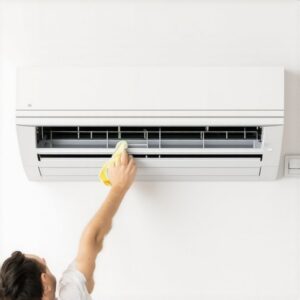
Then there’s the blower wheel. Unlike a traditional furnace repair where you have a massive squirrel cage blower, a mini-split uses a long, thin cross-flow fan. These things are delicate. If you haven’t had a deep clean in two years, a microscopic layer of organic growth (yeah, I mean mold) on those blades kills your CFM (Cubic Feet per Minute). When the airflow drops, the coil gets too cold and can actually ice up, or the unit’s logic board gets confused and starts ‘hunting’ for the right speed. You can’t move heat if you can’t move air.
“Designers shall use the procedures outlined in Manual J to ensure equipment capacity matches the sensible and latent loads of the space.” – ACCA Standard 5
Why Your Mini-Split Struggles in the Humidity
Mini-splits are often sold on their SEER ratings, but SEER is a measure of efficiency, not necessarily dehumidification ‘muscle.’ In a high-humidity environment, you need the evaporator coil to stay ‘Beer Can Cold’ for as long as possible. If the unit is constantly ramping its inverter down because it thinks it’s finished its job, that water on the coil just evaporates back into the room the moment the fan stops.
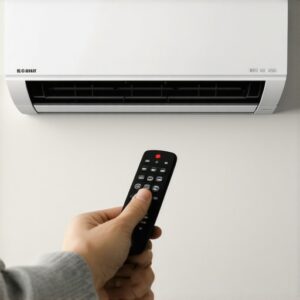
This is why I often tell clients to stop using the ‘Auto’ fan setting. In ‘Auto,’ the unit tries to be as quiet and efficient as possible, which often means lower fan speeds and less air-to-coil contact time. By locking the fan into a medium speed and using the ‘Dry Mode’—which is specifically programmed to prioritize moisture removal by slowing the fan and keeping the coil temperature just above freezing—you can finally beat the humidity. It’s not about the ‘Juice’ (refrigerant) levels; it’s about the dwell time of the air on the aluminum fins.
The Verdict: Physics Over Salesmanship
If your mini-split is struggling, don’t let some guy in a shiny van tell you that you need a whole new AC installation or a ‘recharge.’ Refrigerant is a sealed system; if it’s low, you have a leak, and if you have a leak, you need a repair, not a ‘top-off.’ But 9 times out of 10, the issue is either a filthy blower wheel, an oversized unit, or a misunderstanding of how to use the inverter technology to manage latent heat. Comfort is a science. It’s about managing the phase change of water as much as it is about moving molecules of air. If your tech doesn’t know what a psychrometric chart is, send him packing and find someone who’s spent enough time in the ‘trenches’ to know the difference between a cooling call and a physics problem.