The Stench of Failure: Why Your High-Tech Air Handler Smells Like a Locker Room
I’ve spent thirty years crawling through blown-in insulation and balancing on grease-slicked restaurant rooftops, and if there is one thing I’ve learned, it’s that physics doesn’t care about your comfort. When a homeowner calls me complaining that their expensive mini-split smells like a jug of white vinegar or a middle-school gym bag, they usually expect a quick spray-and-go. But the truth is buried in the fins. That sour, acidic stench isn’t just an annoyance; it’s the byproduct of a biological civil war happening inside your evaporator coil. You see, these units are marvels of engineering, but they are also perfect petri dishes. Unlike a traditional furnace repair where we’re dealing with combustion gases and heat exchangers, a mini-split is a moisture-wrangling beast that thrives on latent heat removal. When that process goes sideways, the ‘juice’—that’s R-410A or R-32 for the greenhorns—is the least of your worries.
The $12,000 ‘New Unit’ Hustle: A Narrative of Greed
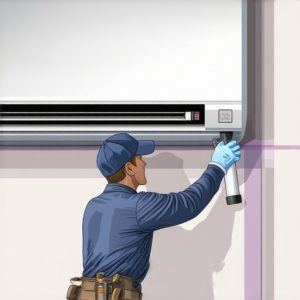
Last August, during a humid stretch that had the suction line sweating like a marathon runner, I followed a ‘Sales Tech’ from one of those big-box franchises to a house in the suburbs. The homeowner, a retired teacher, was told her three-year-old system was ‘internally compromised’ and needed a full AC installation to the tune of twelve grand. Why? Because it smelled like old socks. I walked in, popped the plastic shroud, and shone my light on the blower wheel. It wasn’t ‘compromised’; it was furred over with a thick, gray carpet of organic growth. The sales guy hadn’t even pulled the filters. He just smelled the ‘Dirty Sock Syndrome’ and saw a commission. I spent two hours doing a proper deep-clean, cleared the sludge from the 1/4-inch drain line, and saved her $11,800. That’s the difference between an ‘Airflow Architect’ and a parts-changer. Most ‘bad units’ are just neglected machines gasping for air through a layer of skin cells and dust.
Thermodynamic Zooming: The Physics of the Funk
To understand the smell, you have to understand the dew point. Your mini-split’s evaporator coil is designed to drop below the ambient dew point to pull latent heat (humidity) out of the air. This moisture condenses on the fins and is supposed to slide down into a plastic tray and out the drain. However, mini-splits have incredibly tight fin spacing—much tighter than your standard A-coil in a traditional heating service setup. This density is great for efficiency but terrible for hygiene. When the unit ‘short cycles’—meaning it’s oversized for the room—it cools the air so fast that the coil never stays wet long enough to wash away the particulates. Instead, the dust and proteins from your indoor air get trapped in a damp, sticky film. Bacteria and fungi move in, and as they feast, they off-gas. The ‘vinegar’ smell is often the result of acetic acid-producing bacteria, while the ‘socks’ are pure fungal bliss.
“The most expensive equipment in the world cannot overcome a bad duct system, and even ductless systems are slaves to the laws of static pressure and biological accumulation.” – Industry Axiom
The Climate Context: The Cold Swamp Effect
In humid zones like the Gulf Coast or the Atlantic South, we deal with a phenomenon I call the ‘Cold Swamp.’ If your installer didn’t perform a proper Manual J load calculation, your unit is likely too big. An oversized unit hits the thermostat setpoint in ten minutes, shuts off, and leaves the air at 72 degrees but 70% humidity. That’s when the mold starts to party on your blower wheel. You don’t need more ‘gas’ or a bigger compressor; you need a system that can run long enough to actually dehumidify the space. This is where variable-speed inverters shine, but only if they are configured correctly. If the installer just slapped it on the wall and didn’t adjust the fan curve, you’re basically living in a refrigerated marsh.
The Forensic Diagnosis: Tracking the Odor
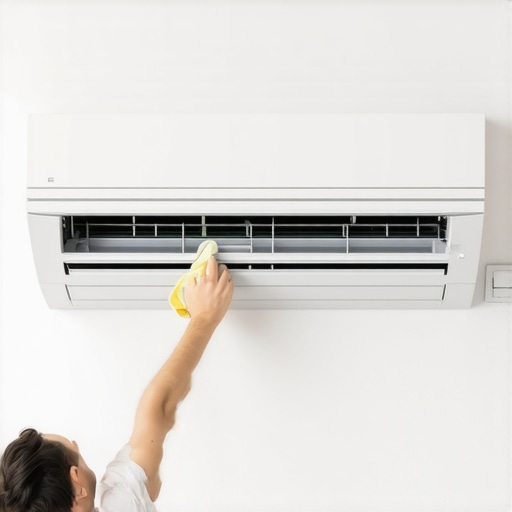
When I’m on a heating service call or a cooling troubleshoot, I look at three things: the coil, the pan, and the wheel. If the smell is sharp and acidic (vinegar), I’m looking for chemical reactions or specific bacterial strains. If it’s musty (socks), it’s mold. Here is the reality: you cannot fix this with a ‘scented’ spray. You have to mechanically remove the biofilm. This means pulling the housing, bagging the unit, and using a pressurized coil cleaner that can penetrate through those dense fins. We’re talking about ‘Beer can cold’ physics here; if the air can’t touch the metal because of a layer of slime, the heat exchange fails, and your efficiency goes into the gutter.
“Ventilation systems shall be designed to prevent the accumulation of moisture and the growth of microorganisms on all internal surfaces.” – ASHRAE Standard 62.1
Why ‘Pookie’ and Tape Won’t Save You
I’ve seen ‘Tin Knockers’ try to seal up mini-split penetrations with ‘Pookie’ (mastic) and silver tape, thinking they’re stopping the smell from coming from the wall cavity. While sealing the hole is important to prevent ‘Sparky’ from having to fix a shorted wire due to condensation, it won’t stop the internal growth. The smell is coming from the inside of the room’s air being recycled through a dirty filter. You need to ensure the condensate line has a proper pitch. If that water sits in the pan for even a day, it turns into a science project. I always tell clients: ‘If you wouldn’t leave a damp towel in a dark closet for a week, don’t leave your mini-split without a dry-out cycle.’
The Long-Term Solution: Beyond the Spray
To keep the funk away, you need to use the ‘Fan Only’ mode or the ‘Dry’ mode regularly. Most modern units have a setting that keeps the fan running for 10-20 minutes after the cooling cycle ends to dry the coil. If yours doesn’t, do it manually. Also, stop buying the cheap 99-cent ‘perfume’ filters. They just add a layer of oil to the coil that traps more dust. If you’re at the point where you’re considering a new AC installation because the smell is unbearable, call a veteran who knows how to tear the unit down to the chassis. A real deep clean is 10% chemicals and 90% labor. It’s not magic; it’s maintenance. Your furnace repair guy might know his way around a gas valve, but a mini-split is a different breed of cat that requires a surgeon’s touch and a chemist’s nose.