The Ghost in the Bedroom Wall: Why Your Mini-Split Is Talking to You
You’re laying there, the house is finally quiet, and just as you’re drifting off into a deep sleep, you hear it. Snap. Click. Pop. It sounds like a tiny woodpecker is trying to breach your drywall, or maybe a poltergeist has taken up residence in your indoor air handler. You’ve spent thousands on this high-efficiency HVAC installation, and now it’s keeping you awake. Before you call a furnace repair company that doesn’t know a thermistor from a toaster, or worse, one of those ‘Sales Techs’ who will try to sell you a whole new AC installation because they can’t diagnose a paper bag, let’s talk about what’s actually happening inside that plastic box. As a tech who’s spent thirty years crawling through blown-in insulation and sweating through my shirt on 130-degree rooftops, I can tell you: that noise isn’t magic, and it isn’t a broken unit. It’s physics. And physics doesn’t care about your sleep schedule.
The Physics Lesson: Why My Mentor Screamed at Me in 1994
My old mentor, a man who smelled exclusively of pipe tobacco and refrigeration oil, used to scream at me until he was purple in the face: ‘You can’t cool what you can’t touch!’ He was talking about airflow, but the lesson goes deeper into the very molecular structure of the equipment we install. This brings us to the core of your clicking problem. When your mini-split is running, it’s not just moving air; it’s moving heat. In the HVAC world, we deal with two types of heat: sensible heat (the stuff you feel on your skin) and latent heat (the moisture in the air). When that evaporator coil inside your wall unit drops to 40 degrees Fahrenheit to pull the juice through the system and drop the room’s dew point, everything inside that unit—the copper, the aluminum fins, and especially the high-density polymer casing—undergoes a radical temperature shift. This is where the clicking starts.
The Forensic Diagnosis: The Case of the Expanding Plastic
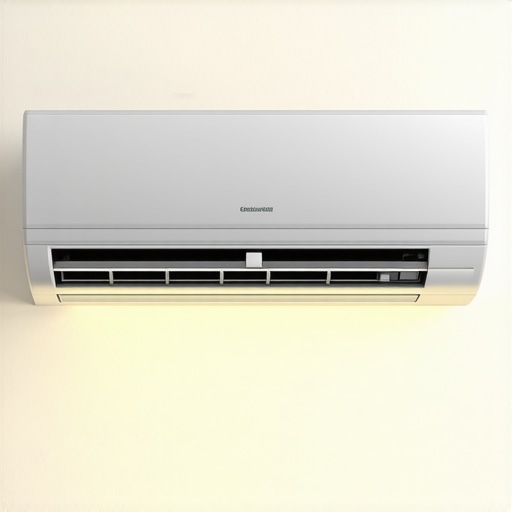
The majority of ‘weird clicking noises’ at night are the result of thermal expansion and contraction. Most mini-split chassis are made of plastic. Plastic, by its very nature, has a high coefficient of linear thermal expansion. When the unit is off, the plastic is at room temperature (say, 72°F). When the ‘gas’ (refrigerant) starts flowing and that coil hits 40°F, the air blowing across it is cold. The plastic casing begins to contract. But here’s the rub: it’s not contracting at the same rate as the metal frame it’s screwed into. The ‘click’ you hear is the plastic housing rubbing against the metal backplate or the mounting clips as it physically moves. It’s a mechanical ‘stiction’—static friction.
“The most expensive equipment in the world cannot overcome a bad duct system, and the finest engineering cannot bypass the laws of thermodynamics regarding material expansion.” – Industry Axiom
This is especially common at night because the unit is likely ‘hunting’ for a setpoint. During the day, it might run constantly, keeping the plastic at a steady, cold temperature. But at night, when the heat load drops, the inverter compressor slows down, the coil warms up slightly, and the plastic expands. Then the unit ramps back up, and the plastic contracts. It’s a literal breathing cycle of the machine.
The Electronic Expansion Valve (EEV) and the ‘Hunting’ Noise
If the clicking is more rhythmic, like a rapid-fire tapping, you’re likely hearing the Electronic Expansion Valve (EEV). Unlike a standard heating service call for a furnace where you have a simple gas valve, a mini-split uses a stepper motor to control the flow of refrigerant. This valve is the brain of the system, modulating the juice to ensure you’re getting exactly the right amount of cooling without wasting energy. At night, when the load is low, the EEV might be ‘hunting’ for the perfect position. It’s a tiny motor clicking through its steps. If your technician didn’t properly insulate the lineset where it enters the back of the unit, or if they used cheap Pookie (mastic) that’s hardened and cracked, those vibrations can be amplified through the wall. I’ve seen ‘Tin Knockers’ try to install these units like they’re hanging a bathroom fan, and it never ends well. If the unit isn’t perfectly level, or if the backplate is bowed because the Sparky put the junction box in a weird spot, the internal tension on the casing makes every expansion ‘click’ sound like a gunshot.
The Humidity Factor: Latent Heat and the Drain Pan
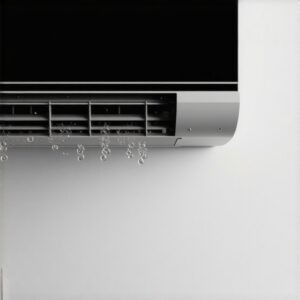
In humid climates, we have to talk about the ‘slurp’ and ‘click.’ As the unit removes latent heat, it turns that humidity into liquid water (condensate). This water drips into a plastic tray. If the unit wasn’t pitched correctly during the AC installation, that water doesn’t drain immediately. It sits there, and as the unit cycles, the temperature of that water changes, causing the drain pan to flex. If you have a condensate pump installed (those little white boxes often tucked inside the casing), they are notorious for clicking and vibrating at night. I always tell homeowners: if you can gravity-drain, do it. Relying on a mechanical pump for a bedroom unit is a recipe for a midnight wake-up call.
“Proper condensate management is vital to indoor air quality and equipment longevity; stagnant water is the enemy of the technician and the occupant alike.” – ASHRAE Standard 62.2
How to Fix the Click (Without a $15,000 Quote)
If a heating service guy tells you that you need a new system because your mini-split is clicking, show him the door. Here is how a real tech fixes it. First, we check the mounting. Often, just loosening the screws on the wall-mounted plate by a quarter turn allows the metal to breathe without binding the plastic. Second, we look at the contact points. I’ve spent many a night (and many rolls of felt tape) lining the edges where the plastic cover meets the chassis. A little bit of friction-reducing material acts like a lubricant for the expansion cycle. Third, we check the ‘juice.’ If the system is low on refrigerant, the coil can actually start to flash-freeze, causing a much louder cracking sound as ice forms and then breaks away. This is why a proper vacuum—pulled down to 500 microns and held—is essential during the initial AC installation. If your tech didn’t use a micron gauge, they didn’t do their job.
[image_placeholder]
The Verdict: Is It Dying?
Ninety percent of the time, the clicking is a ‘comfort’ issue, not a ‘mechanical failure’ issue. It’s the result of high-efficiency machines doing high-efficiency things in a world made of materials that don’t like to stay the same size. However, if the clicking is accompanied by a sour, acidic smell (a compressor burnout in the making) or a screeching sound (a failing indoor blower motor bearing), then you need a pro. But for the standard night-time ‘tick,’ it’s usually just the house and the unit settling into their thermodynamic rhythm. Don’t let a ‘Sales Tech’ turn a need for some felt tape and a leveling level into a five-figure invoice. Real HVAC work is about understanding the physics of the air, the properties of the gas, and the reality of how materials behave in the field. Your mini-split isn’t haunted; it’s just busy moving heat so you can sleep in a cold room. Respect the process, and maybe put a little nylon spacer behind the mounting bracket. Your ears will thank you.