The Paradox of the Summer Glacier
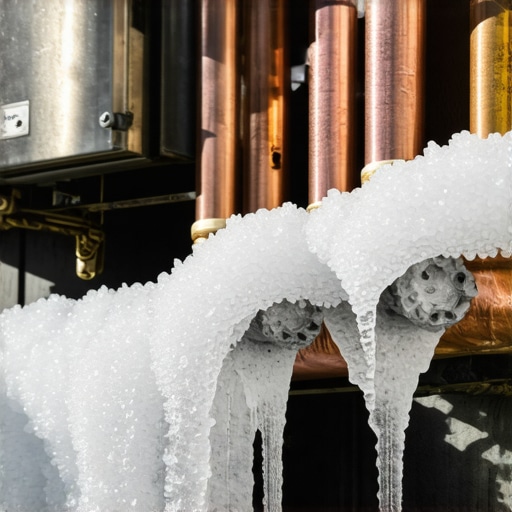
It is 98 degrees in the shade with 85% humidity, the kind of afternoon where the air feels like a wet wool blanket. You walk over to your outdoor unit and see something that defies logic: a thick, white crust of ice wrapping around the copper suction line. You are standing in a furnace, yet your air conditioner is trying to be an Igloo cooler. Most homeowners think this means the unit is ‘cooling too hard.’ As a technician who has spent three decades dragging gauges through humid crawlspaces, I can tell you that ice is not a sign of power; it is a scream for help from a system that is literally suffocating. Whether you are dealing with a standard split system or a modern mini-split, physics does not care about your comfort. It only cares about the pressure-temperature relationship.
The Sales Tech Deception: A Forensic Case Study
Last August, I followed behind a ‘Comfort Advisor’—that is the industry’s fancy term for a salesman in a polo shirt who doesn’t own a set of manifold gauges. He had visited a retired firefighter’s home and quoted him $14,500 for a full AC installation because the evaporator coil was ‘frozen solid and likely breached.’ He told the guy the ‘compressor was grounded’ because it wouldn’t start. Of course it wouldn’t start; the thermal overload had tripped because the poor thing was trying to compress liquid refrigerant instead of vapor. I walked into the mechanical room, pulled out a filter that looked like it had been used to brush a Golden Retriever, and spent an hour thawing the coil with a heat gun. The ‘broken’ system just needed a $15 filter and a shot of nitrogen to clear the condensate line. This is why I tell people: airflow is the lifeblood of thermodynamics. If you do not respect the physics of the heating service and cooling cycle, you will be exploited by someone looking for a commission.
“The most expensive equipment in the world cannot overcome a bad duct system.” – Industry Axiom
Thermodynamic Zooming: How a Coil Becomes an Ice Cube
To understand why your lines are freezing, we have to look at the evaporator coil. Inside those copper fins, the refrigerant (the ‘juice’ or ‘gas’) undergoes a phase change. It enters the coil as a low-pressure, cold liquid-vapor mix. As the warm, humid return air from your house is blown across these fins, the refrigerant absorbs the sensible heat (the temperature you see on the thermostat) and the latent heat (the moisture in the air). In a humid climate like the Gulf Coast or the Atlantic seaboard, the AC’s primary job is actually dehumidification. When the refrigerant absorbs this heat, it boils and turns into a vapor. This vapor then travels down the suction line—which should be ‘beer can cold’ and sweating, not frozen—back to the compressor. If the airflow is restricted, there isn’t enough heat to boil the refrigerant. The saturation temperature of that refrigerant drops below the freezing point (32°F). The moisture it pulled from your humid air hits those sub-freezing fins and turns instantly to ice. Once a thin layer of ice forms, it acts as an insulator, blocking even more heat exchange, and the icing accelerates until you have a solid block of HVAC permafrost.
The Three Culprits of the Freeze
When I arrive for a furnace repair or an AC diagnostic and see ice, I check three things in this specific order. First: Airflow. This is the king of all problems. If your ‘tin knocker’ (duct guy) undersized the return air vents, or if you used one of those high-MERV ‘allergy’ filters that are as thick as a brick, the blower motor cannot pull enough air across the coil. The lack of heat exchange causes the ‘juice’ to stay too cold. Second: Low Refrigerant. It seems counter-intuitive, but being low on gas causes freezing. When the pressure in the system drops, the boiling point of the refrigerant also drops. A system designed to boil at 40°F might start boiling at 25°F if it’s low on charge. Third: Mechanical failure. A failing blower motor or a stuck Expansion Valve (TXV) can also kill the cycle. If you see a ‘Sparky’ (electrician) or a tech trying to add refrigerant without checking the static pressure of your ducts first, throw them off your property.
“Equipment shall be sized according to the heating and cooling loads calculated using ACCA Manual J.” – ANSI/ACCA Standard 5
The Humid Climate Trap: Latent Heat Overload
In high-humidity zones, we deal with the ‘Cold Swamp’ syndrome. If your unit is oversized—a common mistake by lazy contractors—it cools the air so fast that it satisfies the thermostat before it has a chance to remove the humidity. The air feels 72 degrees but 70% humidity. Homeowners then crank the temp down to 65 to try and feel comfortable. This forces the system to run longer under high latent load conditions. Eventually, the condensate drain gets overwhelmed, or the coil temperature stays too low for too long, leading to a freeze-up. This is where variable speed compressors shine; they ramp down to keep the coil cold enough to dehumidify without dropping below the dew point into the freezing zone. Using Pookie (mastic) to seal your ductwork ensures that you are cooling your living room and not your unconditioned attic, which reduces the load on the system and prevents the compressor from ‘slugging’—a death sentence where liquid refrigerant makes it back to the compressor pistons.