The Gurgle of Doom and the Silent Shutdown
It usually happens at 9:00 PM on a Tuesday in July, right when the humidity in the Georgia air is thick enough to chew. You notice the house feels like a damp cave. You check the thermostat; the display is blank, or it says ‘Cool On’ but the air coming out of the vents is as still as a tomb. You climb into the attic, and there it is: the secondary pan is full of rusty, lukewarm water, and the safety float switch has done its job by cutting the low-voltage circuit to your condenser. Your AC is dead, not because the compressor fried, but because a $2 piece of PVC pipe is choked with what we in the trade call ‘slime.’ It’s a mix of dust, skin cells, and biological growth that thrives in the dark, wet environment of your air handler. If you don’t know what you’re doing, this is the moment a ‘Sales Tech’—those guys who wear clean white shirts and carry iPads instead of pipe wrenches—will tell you that your evaporator coil is ‘pitted’ and you need a full $12,000 AC installation. I’ve seen it a hundred times.
“The removal of latent heat through condensation is a fundamental requirement of air conditioning; however, failure to manage the resulting liquid effluent leads to catastrophic structural damage and indoor air quality degradation.” – ASHRAE Standard 62.1
The Sales Tech Scam: A Forensic Tale
I remember following a ‘comfort consultant’ out to a ranch-style home in Savannah last summer. The homeowner was a retired schoolteacher, shaking like a leaf because the previous tech told her that her mini-split was ‘leaking internal juices’ and she needed a total system overhaul. I walked up to the unit, saw the drain line was bone dry on the outside, and the internal pan was overflowing. I grabbed my wet-vac, spent ten minutes at the termination point, and sucked out a three-inch ‘slug’ of algae that looked like a wet bratwurst. Total cost of parts? Zero. The previous guy wanted to hit his monthly quota by selling a unit she didn’t need. That’s why I’m writing this. You need to know the anatomy of your drain system so you don’t get taken for a ride during a routine heating service or cooling check.
Thermodynamic Zooming: Why Water Happens
To understand the clog, you have to understand the physics. Your evaporator coil isn’t just ‘making things cold.’ It’s a heat exchanger performing a phase change. As the warm, humid return air passes over the fins—which should be ‘beer can cold’—the air drops below its dew point. This turns the water vapor (latent heat) into liquid droplets. On a typical 3-ton system in a humid climate, your AC can pull 10 to 20 gallons of water out of the air every single day. That water is supposed to gravity-feed through the 3/4 inch PVC line. But because that water is distilled and slightly acidic, it’s the perfect breeding ground for ‘zoogloea’—a bacterial slime. If your furnace repair guy didn’t check the pitch of that pipe during the winter, that standing water just sits there, growing its own ecosystem until the line is a solid plug.
The Anatomy of the Drainage System
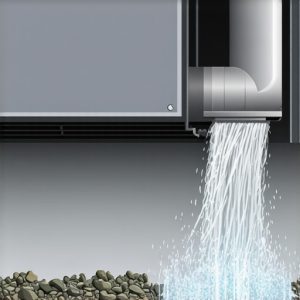
Before you grab the vac, look at the ‘Anatomy of the Flow.’ You have the primary drain pan located directly under the evaporator coil inside the plenum. This feeds into the primary drain line. Most systems also have a secondary port. If the primary clogs, the water backs up into a secondary emergency pan or triggers a ‘Puck’ switch. In a proper AC installation, there should be a trap—a U-shaped bend in the pipe. This trap is there because the blower motor is often pulling a vacuum on the cabinet. Without a trap, the ‘juice’ (air pressure) prevents the water from draining, causing it to spray off the coil like a monsoon. If you see water dripping from the eaves of your house, that’s usually your secondary line screaming for help.
“Condensate disposal piping shall be trapped and shall be installed to maintain a minimum horizontal slope in the direction of discharge of not less than 1/8 unit vertical in 12 units horizontal.” – ACCA Manual S
How to Clear the Line with a Wet-Vac: Step-by-Step
1. Identify the Termination Point: Find where the PVC pipe exits your house. It’s usually near the outdoor condenser unit. 2. The Seal is Everything: You can’t just hold the wet-vac hose near the pipe. You need a tight seal. I use a wet rag or even some ‘Pookie’ (mastic) to bridge the gap between the 1.5-inch vac hose and the 3/4-inch PVC. 3. The Suction Phase: Turn on the wet-vac. Let it run for at least 2 to 3 minutes. You’ll hear a change in pitch when the ‘slug’ finally breaks loose. 4. The Flush: Go back to the air handler. Locate the T-vent (the open pipe sticking up). Pour a gallon of warm water mixed with a cup of distilled white vinegar down the line. If it disappears instantly, you’ve won the war against physics. Avoid bleach; it can react with the plastic and the coil’s copper over time, leading to a premature furnace repair or coil replacement.
The Math of Maintenance
Let’s talk numbers. A decent wet-vac costs $60 at a big-box store. A bottle of vinegar is $3. A service call for an ’emergency AC installation‘ or repair can run you $200 just to show up, and if they find a ‘clog,’ a shady tech will try to upsell you on a $500 UV light system or a $300 ‘chemical flush.’ By doing this yourself twice a year, you are essentially paying yourself $150 an hour. More importantly, you’re preventing water from rotting out your floor joists or ceiling drywall. If you have a mini-split, the process is even more critical because those tiny 1/2-inch drain lines clog if you even look at them wrong. Don’t be the homeowner who ignores the ‘slurp’ sound coming from the wall.
When to Call a Professional (A Real One)
If you’ve sucked the line clear and the water still isn’t flowing, you might have a ‘double trap’ issue—where the pipe has sagged somewhere in the crawlspace, creating a secondary trap that air-locks the system. This is a job for a real ‘Tin Knocker’ or lead tech, not a salesman. They’ll need to cut the PVC, re-pitch it, and secure it with straps. Remember, airflow is king. If your ductwork is restricted, your coil will get too cold, freeze the condensate into ice, and then when it thaws, it will overwhelm the drain pan regardless of how clear the line is. Comfort isn’t magic; it’s a balance of pressure, temperature, and moisture. Master the drain, and you master the summer.