The Sound of a Dying System: When Physics Goes Reverse
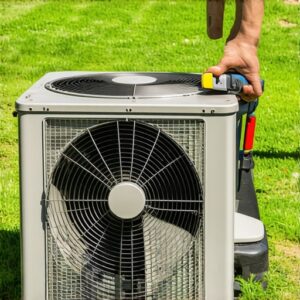
You’re standing in your backyard, the July sun is beating down with the intensity of a welding torch, and you notice something haunting. Your AC condenser—the big metal box that’s supposed to be your best friend—is making a low, guttural hum. You look through the top grate, expecting to feel a blast of hot air hitting your face, but instead, you feel a vacuum. The fan is spinning, but it’s spinning backward. It’s a sight that makes most homeowners panic, and rightfully so. In thirty years of crawling through spider-infested crawlspaces and baking on black-top roofs, I’ve seen this ‘Poltergeist’ effect more times than I can count. It isn’t ghosts, and it isn’t ‘reversed polarity’ in the way some hack ‘Sales Tech’ will try to tell you to sell a $15,000 unit. It’s a failure of fundamental electrical physics.
The Narrative Matrix: The Case of the ‘Backward’ Scam
I remember following a tech out to a job in the peak of a heatwave. This kid—let’s call him ‘Shifty’—had quoted a local baker a full AC installation because, according to his clipboard, the ‘magnetic orientation of the compressor had flipped.’ I walked up to that unit, heard the compressor struggling like a marathon runner with a collapsed lung, and watched the fan blade lazily spinning the wrong way. I didn’t need a manifold gauge set to know what happened. I pulled the service disconnect, discharged a bulging, rusted dual-run capacitor that looked like a soda can about to burst, and replaced it. Total cost for the part? Less than a steak dinner. Five minutes later, that fan was drawing air across the coils, the ‘juice’ was flowing correctly, and the baker was back in business. That’s the difference between a technician and a salesman.
“The most expensive equipment in the world cannot overcome a bad duct system or a technician who doesn’t understand basic electrical induction.” – Industry Axiom
The Forensic Anatomy: How an Induction Motor Loses Its Way
To understand why your fan is spinning backward, you have to understand the ‘Permanent Split Capacitor’ (PSC) motor. This isn’t a simple ‘on/off’ lightbulb. This motor relies on two separate windings: the start winding and the run winding. Because we use single-phase power in most residential settings, the motor doesn’t naturally know which way to turn. It needs a ‘push’ to create a phase shift in the magnetic field. This is the job of the capacitor. The capacitor stores energy and releases it to the start winding, creating a simulated second phase that tells the motor, ‘Hey, spin clockwise.’
When that capacitor dies—usually because the 115°F ambient heat in a dry climate has cooked the dielectric oil inside—the motor loses its sense of direction. If a stiff breeze catches the fan blade and starts it spinning counter-clockwise right as the contactor pulls in, the motor will simply keep running in that direction. It has no ‘brain’ to correct itself. It just follows the path of least resistance. This is why you might see it spin correctly one day and backward the next; it’s all down to which way the wind was blowing when the thermostat called for cooling.
Thermodynamic Zooming: Why Direction Matters
You might think, ‘It’s still moving air, so what’s the big deal?’ Here is where we get into the nitty-gritty of heat transfer. Your AC doesn’t ‘create’ cold; it removes heat. The evaporator coil inside your house absorbs sensible heat and latent heat (humidity) until the refrigerant reaches its dew point. That heat is then pumped outside to the condenser. The condenser fan is designed to pull air *through* the aluminum fins of the coil and blast it out the top. This is ‘Heat Rejection.’
When the fan spins backward, it sucks air down from the top and tries to push it out through the sides. This is incredibly inefficient. The air being pulled in is often the hot air that was just exhausted, leading to a ‘recirculation’ effect. This causes the head pressure to skyrocket. When the head pressure goes up, the compressor has to work twice as hard to compress the refrigerant ‘gas.’ Pretty soon, the compressor’s internal thermal overload will trip, or worse, the acidic/sour smell of a burnout will start wafting through your vents. At that point, you aren’t looking at a simple repair; you’re looking at a full furnace repair or a complete system overhaul.
The Climate Factor: High Head Pressure and the Monsoon Effect
In the Southwest, where the air is as dry as a desert bone, we deal with ‘Sensible Heat.’ The heat is intense, and it cooks electrical components. A capacitor in Arizona might only last three to five years before it gives up the ghost. If you’re in a humid region, the ‘Latent Heat’ load is the enemy. An oversized unit—another trick used by Sales Techs—will ‘short cycle,’ turning on and off so fast that the fan motor never reaches its thermal equilibrium. This constant slamming of the contactor is what leads to motor failure and capacitor degradation. If your system was part of a poor AC installation where the ‘Tin Knocker’ didn’t size the return air drops correctly, the static pressure will be so high that your fan motor is fighting a war every time it starts.
“Standard practice requires that the outdoor unit be located such that the condenser airflow is not restricted and that the heated discharge air does not recirculate.” – ACCA Manual S
The Decision: Repair vs. Replace
If you catch your fan spinning backward, turn the system off immediately at the thermostat. Every minute it runs like that, you are shortening the life of your compressor. If the unit is under ten years old, a simple capacitor replacement or a new fan motor is a no-brainer. However, if your unit is still running on the old R-22 ‘gas’ (which is now worth its weight in gold), you might be looking at the ‘Regulatory Cliff.’ With the 2025 transition to A2L refrigerants like R-454B, the cost of parts for older 410A systems is going to climb. If your motor is seized and the coil is leaking ‘pookie’ (mastic) and oil, it might be time to look into a mini-split or a high-efficiency heat pump.
The HVAC Veteran’s Maintenance Checklist
- Wash Your Coils: A dirty coil increases head pressure. Use a garden hose (not a pressure washer!) to clean the ‘cottonwood’ and dust out of the fins.
- Listen for the Screech: If you hear a metal-on-metal scream, your fan motor bearings are shot. No amount of ‘juice’ will fix a mechanical seizure.
- Check the ‘Sparky’ Work: Ensure your wiring isn’t frayed. A loose wire on the capacitor can cause the same ‘backward’ symptoms as a dead part.
- Don’t Ignore the Mini-Split: If you have one room that’s always a ‘hot box,’ stop trying to fix it with a window unit. A properly installed mini-split is the surgeon’s scalpel of HVAC.
Comfort isn’t magic; it’s physics. When your fan starts acting like it’s in a different timezone, it’s a cry for help from a system that’s fighting the laws of thermodynamics. Get a real technician out there—someone who knows the difference between a suction line and a liquid line—and get your airflow back where it belongs.