The Forensic Diagnosis: Tracking the Biological Funk in Your Airflow
The silence of a mini-split is usually its greatest selling point, but when that silence is accompanied by a pungent, vinegar-like stench that reminds you of a high school locker room in August, the luxury is gone. You aren’t smelling a gas leak, and you aren’t smelling a dead rodent—at least not usually. You are experiencing what we in the trade call Dirty Sock Syndrome (DSS). It is a biological phenomenon that has nothing to do with how clean you keep your house and everything to do with the physics of the evaporator coil. I’ve spent thirty years crawling through damp crawlspaces and balancing static pressure, and I can tell you that the ‘Sales Techs’ will try to sell you a whole new AC installation for this. They’ll tell you the coil is ‘rotting.’ They’re lying. They just want the commission. I followed a guy last month who quoted a young family in a coastal town $11,000 for a full system replacement because of this smell. I walked in, pulled the blower wheel, showed them the biofilm, and fixed it with a $40 gallon of alkaline coil cleaner and some elbow grease. Here is the forensic breakdown of why your high-tech inverter is failing the sniff test.
The Narrative: The Savannah Scam and the Petri Dish Blower
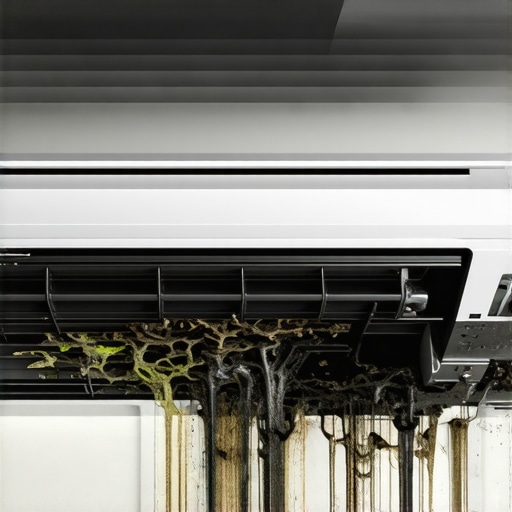
I remember a call out in Savannah, Georgia—humidity so thick you could wear it. A homeowner had a three-year-old high-efficiency mini-split that was making his living room smell like a gym bag. A ‘Sparky’ turned HVAC guy had already been there and told him the ‘juice’ (refrigerant) was leaking and reacting with the aluminum. Pure nonsense. Refrigerant is a sealed system; if it’s leaking, the unit won’t cool. I took one look at the indoor head unit and knew the heating service history was nonexistent. When I popped the cover, the blower wheel was caked in a greyish-black sludge. The moisture from the humidity was mixing with household dust and skin cells, creating a perfect laboratory for Alcaligenes and Pseudomonas bacteria. This isn’t a mechanical failure; it’s a failure of the thermodynamic rinse cycle. My old mentor used to scream, ‘You can’t cool what you can’t touch!’ If that air can’t touch the bare aluminum of the coil because of a layer of bacteria, you aren’t just losing efficiency—you’re breathing in a biology project.
“The most expensive equipment in the world cannot overcome a bad duct system—or a contaminated thermal exchange surface.” – Industry Axiom (Derived from ACCA Manual D Principles)
Thermodynamic Zooming: The Physics of the Funk
To understand the smell, you have to understand the latent heat removal process. Your mini-split’s evaporator coil is designed to drop well below the dew point of the room air. As the blower pulls warm, humid air over the fins, the air temperature drops (sensible cooling), and the water vapor turns into liquid (latent cooling). In a perfect world, this water runs down the fins, into the condensate tray, and out the drain line. However, mini-splits use very tightly spaced aluminum fins to achieve high SEER ratings. When the unit ‘short cycles’ or when the variable speed compressor ramps down to a low frequency, the coil doesn’t always get ‘washed’ by enough condensate. The moisture sits there. It gets stagnant. The dust that makes it past those flimsy mesh filters provides the food. The bacteria then produce VOCs (Volatile Organic Compounds) as metabolic byproducts. That is the ‘dirty sock’ smell. It’s the smell of bacterial off-gassing happening exactly where your air is supposed to be purified.
The Climate Factor: Why the Humid South is Ground Zero
If you live in a place like Houston or Charleston, you are in the high-load latent heat zone. In these regions, a mini-split is often oversized for the sensible load but struggles with the latent load. When the room reaches the setpoint temperature, the compressor slows down, but the fan keeps spinning. This is where the disaster happens. The fan blows air across a wet, stagnant coil that isn’t cold enough anymore to dehumidify, but is wet enough to grow mold. The moisture is effectively re-evaporated back into the room along with the bacterial stench. This is why mini-split maintenance is more critical than a standard furnace repair. You aren’t just dealing with a heat exchanger; you are dealing with a localized climate creator that can become a swamp if the suction line isn’t maintaining that ‘beer can cold’ temperature long enough to flush the coil.
“Ventilation systems shall be designed to prevent the accumulation of stagnant water and microbial growth in all air handling components.” – ASHRAE Standard 62.1
The Solution: Beyond the ‘Scam Tune-Up’
Don’t let a tech tell you that you need a ‘UV Light’ as the primary fix. A UV light in a mini-split is like putting a band-aid on a gunshot wound—it only kills what it hits with light, and it can’t hit the back of a blower wheel. You need a deep chemical flush. First, we use a non-acidic, self-rinsing foam on the evaporator. Then, we pull the blower wheel—the ‘tin knocker’s’ worst nightmare—and pressure wash the organic ‘gunk’ off the blades. Finally, we check the ‘Pookie’ (mastic) around the line set penetrations. If warm, humid air is leaking into the back of the unit from the hole in the wall, it creates a constant ‘dew point’ collision right behind the unit, fueling the mold growth. Proper AC installation requires that hole to be packed tight with thumb gum or foam to prevent this ‘ghost’ humidity from feeding the Dirty Sock Syndrome. If you want to prevent it, run your unit in ‘Dry Mode’ for 30 minutes a week, which forces the coil to stay freezing cold and flush itself with condensate, effectively giving the system a bath.