The Telltale Signs of a Failing Expansion Valve: A Diagnostic Deep Dive
The sound of a failing HVAC system isn’t always a bang or a screech; sometimes, it is the eerie, rhythmic ‘hunting’ of a compressor trying to find its balance while the Thermostatic Expansion Valve (TXV) chokes the life out of the cycle. I’ve spent thirty years crawling through humid crawlspaces and baking on asphalt roofs, and if there is one thing I’ve learned, it’s that the ‘Sales Techs’—those guys who trade their manifold gauges for a polished clipboard the second things get complicated—will always try to sell you a full AC installation when all you really have is a metering disaster.
The Narrative Matrix: The Case of the ‘Burned’ Compressor
Last August, I followed a tech from one of those ‘yellow van’ companies into a home where an elderly couple was sitting in 84-degree stagnant air. The previous guy had quoted them $14,000 for a complete system replacement, claiming the ‘gas’ was gone and the compressor was internally damaged. He’d even shown them a picture of a burnt terminal that probably came from his own truck. I hooked up my gauges and saw the suction pressure bouncing like a basketball. The suction line wasn’t ‘beer can cold’; it was lukewarm. I checked the liquid line—plenty of subcooling. The ‘Juice’ was there, but it wasn’t getting into the evaporator. I pulled the sensing bulb off the suction line, dropped it in a cup of ice water, and watched the pressures stay exactly the same. The TXV was stuck shut. A $300 part and two hours of labor saved them a fortune. That’s the difference between a mechanic and a salesman.
Thermodynamic Zooming: How the TXV Controls the Storm
To understand a bad expansion valve, you have to understand the physics of the evaporator coil. The TXV is the gatekeeper. Its job is to maintain a specific superheat by metering the liquid refrigerant into the coil. When that liquid hits the lower pressure of the evaporator, it flashes into a vapor. This phase change is where the magic happens—it’s where we remove latent heat. If the unit is in a humid climate like the Southeast, the evaporator must drop below the dew point of the indoor air. If the TXV isn’t opening wide enough, the coil starves. The temperature drops too low, the condensate freezes, and suddenly you have a block of ice where your airflow should be. Conversely, if it’s stuck open, you’re ‘slugging’ the compressor with liquid refrigerant, which is the fastest way to turn a $2,000 heart into a boat anchor.
“The most expensive equipment in the world cannot overcome a bad duct system or a poorly calibrated metering device.” – Industry Axiom
[IMAGE_PLACEHOLDER]
The Forensic Diagnosis: Blueprint of a Failure
1. The Frost Pattern Paradox
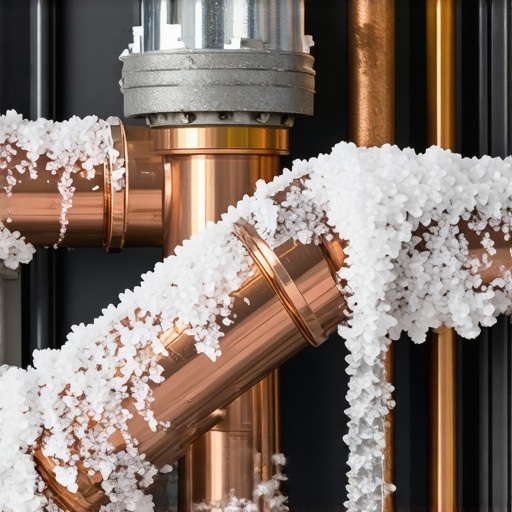
If you see frost on the mini-split indoor head or the traditional evaporator coil, don’t immediately assume you need a furnace repair or more refrigerant. A starving TXV creates a massive pressure drop right at the inlet. This causes the temperature to plummet locally, freezing the humidity out of the air instantly. If you see frost starting right after the expansion valve but the rest of the coil is bone dry, the valve is likely restricted. This is often caused by ‘oil logging’ or debris from a poor heating service where a Tin Knocker didn’t use nitrogen while brazing.
2. The ‘Hunting’ Compressor
A TXV has a diaphragm, a spring, and a sensing bulb. These three forces fight for control. When the valve is failing, it ‘hunts.’ You’ll hear the compressor load change every thirty seconds as the valve opens too wide, realizes its mistake, and slams shut. This oscillation ruins your AC installation efficiency and leads to premature mechanical failure. It’s like trying to drive a car by flooring the gas and then slamming the brakes repeatedly.
3. High Superheat and High Head Pressure
In a humid environment, a bad TXV will cause the superheat to skyrocket. Superheat is the temperature rise of the gas after it has fully evaporated. If the gas is too hot when it hits the compressor, it can’t cool the motor windings. This is why we see ‘thermal overload’ trips. If you’re calling for heating service in the shoulder season and the heat pump won’t stay running, check the valve—it’s the heart of the pressure differential.
“Refrigerant flow must be modulated to ensure that the evaporator surface temperature remains consistently below the entering air dew point for effective dehumidification.” – ASHRAE Standard 15
The Physics of Climate: Why Humidity Changes Everything
In the South, the enemy isn’t just the heat; it’s the latent heat. A TXV that is ‘lazy’ won’t allow the coil to stay cold enough to pull the water out of the air. You’ll find your thermostat says 72 degrees, but you’re sweating through your shirt because the relative humidity is 70%. This is often misdiagnosed as an oversized unit, but if the subcooling is correct and the superheat is high, that brass valve is the culprit. Don’t let a Sparky or a general handyman tell you to just ‘add a pound of gas.’ Adding refrigerant to a restricted TXV will only skyrocket your head pressure and blow a seal.
The Math: Repair vs. Replace
Replacing a TXV is a surgical procedure. It requires recovering the refrigerant, cutting out the old valve (without burning the nearby Pookie or insulation), brazing in the new one while flowing nitrogen, and pulling a vacuum down to 500 microns. If your system is over 12 years old and uses R-22, a bad TXV is usually the signal to look at a new AC installation. But if it’s a modern R-410A system, don’t let them upsell you a whole new mini-split when a surgical strike on the metering device will get you another decade of comfort. Physics doesn’t lie, even if salesmen do.