I remember my old mentor, a guy who had been brazing copper since the R-12 days and had more silver solder in his lungs than blood, once grabbed me by the collar as a gale-force wind whipped across a coastal job site. He pointed at a mini-split condenser that was shimmying like a cheap washing machine on a plywood roof. “Kid,” he grunted, “you can’t cool what you can’t keep on the wall. That unit is a sail, and the wall is the mast. If the mast snaps, you are just a tin knocker looking for a new career.” He was right. People think AC installation is just about connecting the juice and walking away, but in high-wind regions, it is a structural engineering project disguised as a heating service call. If you live in a hurricane zone or the wind-swept plains, your outdoor unit is a target. When 100 mph gusts hit that cabinet, it is not just air; it is literal tons of pressure trying to rip the suction line out of the wall. If that happens, the gas escapes, the compressor burns up, and you are looking at a repair bill that makes a furnace repair look like pocket change.
The Thermodynamic Zoom: Why Wind is the Enemy of Physics
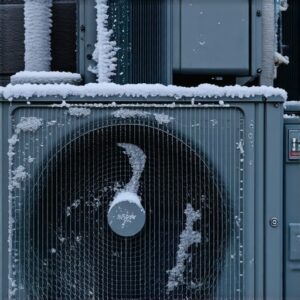
In a standard cycle, your mini-split relies on the fan to pull air across the aluminum fins of the condenser coil. This air removes the heat that the refrigerant carried out from your living room. We call this sensible heat transfer. However, when high winds hit, they create a phenomenon I call “Fan Fight.” If a 60 mph gust blows directly into the fan outlet, it stalls the motor. The head pressure inside the system skyrockets because the heat has nowhere to go. The sparky might tell you it is an electrical issue, but it is pure physics. The compressor starts pulling massive amperage to fight that pressure, the internal thermal overload trips, and suddenly you are calling for emergency service. [IMAGE_PLACEHOLDER] To prevent this, we do not just bolt the unit down; we have to consider the orientation and the structural integrity of the mounting surface. If you are mounting on a wall, you are betting the safety of a $4,000 inverter-driven machine on the shear strength of a few lag bolts. I have seen AC installation jobs where the tech used plastic anchors in old brick. One tropical storm later, the unit was dangling by the copper lines like a dead pendulum, screaming as the juice hissed into the atmosphere.
“Equipment shall be anchored to resist wind forces in accordance with the building code. Mechanical systems and equipment shall be stayed and braced to resist wind and seismic forces.” – ACCA Manual J Standards
Blueprint for Stability: Wall Mounts vs. Ground Pads
If you are in a high-wind area, the choice between a wall-mounted bracket and a ground-level concrete pad is the difference between sleeping during a storm and staring at the ceiling in terror. A wall mount is convenient, but it turns the entire side of your house into a sounding board. Every vibration from the compressor is transmitted through the studs. In a storm, the wind tries to peel that bracket right off the siding. If you must go with a wall mount, use heavy-gauge stainless steel brackets. Forget the powder-coated junk that rusts out in three years. Use 3/8-inch stainless steel wedge anchors if you are going into concrete or 4-inch lag bolts into solid framing. Do not ever trust just the sheathing. On the ground, you want a hurricane pad—a heavy, steel-reinforced concrete slab that weighs at least 150 pounds. We then use galvanized steel straps or “tie-downs” that wrap over the feet of the unit and are bolted into the concrete. This ensures that even if the wind tries to lift the cabinet, it is fighting the weight of the earth itself.
The Vulnerability of the Lineset
The most overlooked part of securing a mini-split is the lineset. That copper is soft. If the condenser moves even half an inch in a windstorm, it creates a stress fracture. Most techs just wrap some tape around it and call it a day. I use pookie (mastic) and a rigid lineset cover (slim duct). The cover acts as an exoskeleton. It protects the insulation from being shredded by flying debris and adds a layer of structural rigidity. When the wind howls, that lineset cover keeps the copper from whipping back and forth. If that copper snaps, you are not just losing gas; you are inviting moisture into a system that uses POE oil, which is hygroscopic. It sucks up water like a sponge, turns into acid, and eats the compressor from the inside out. That is a death sentence for any mini-split.
“The most expensive equipment in the world cannot overcome a bad structural installation or a compromised refrigerant circuit.” – Industry Axiom
The Maintenance Reality
Every time I do a heating service check in the fall, I wrench on those anchor bolts. Vibration is a slow killer. It loosens nuts and backs out screws. If I find a unit that has any play in it, I know the next windstorm will finish the job. For those in the Southwest or coastal regions, salt and sand are also factors. Sand acts like sandpaper at 50 mph, stripping the protective coating off the fins. Wind baffles are the secret weapon here. A wind baffle is a metal hood that sits over the fan discharge. It allows the air to escape but prevents the wind from blowing directly into the blades. It is a simple fix that saves thousands in compressor wear. Whether you are doing a new AC installation or just trying to keep an old unit alive, remember: the wind doesn’t care about your SEER rating. It only cares about gravity and shear force.