The Airflow Manifesto: Why Your Master Suite is a Thermodynamic Nightmare
You have a master suite that feels like a kiln while the rest of the house is an icebox. You have probably been told you need a bigger central AC, but that is a lie sold by a “Sales Tech” looking for a commission on a 5-ton paperweight. In the trenches of residential air conditioning, we know that comfort is not about brute force; it is about the surgical application of physics. My old mentor, a guy who could smell a burnt contactor from the driveway and had the scars of a thousand attic crawls, used to bark at me: ‘You can’t cool what you can’t touch!’ This was his way of saying that if the air molecules are not physically passing over that evaporator coil, they are just stagnant energy traps. In a master bedroom, this problem is amplified by high-end finishes, heavy drapes, and the sheer volume of sensible heat generated by occupants and electronics.
“The most expensive equipment in the world cannot overcome a bad duct system.” – Industry Axiom
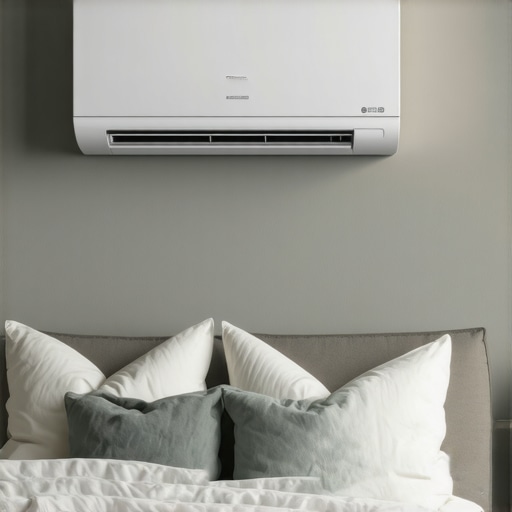
When we talk about AC installation in a ductless format, specifically a mini-split, we are bypassing the limitations of traditional tin-knocking. But a mini-split is only as good as its placement. If you slap that head unit in a corner where the air just bounces off a wardrobe, you are creating a short-cycling disaster. The unit’s onboard thermistor will see its own cold air, think the room is satisfied, and shut down the compressor before it has even touched the latent heat (the humidity) in the far corner of the room. This is how you end up with a room that is technically 72 degrees but feels like a damp cave. [IMAGE_PLACEHOLDER]
Thermodynamic Zooming: The Evaporator’s Secret Life
To understand placement, you have to understand the boiling point of the gas (refrigerant) inside that suction line. Inside that wall-mounted unit, R-410A is screaming through the copper at a temperature that needs to be below the dew point of the room. As the warm air from your bedroom is pulled in, the evaporator coil strips away the sensible heat (temperature) and the latent heat (moisture). This moisture turns into condensate, which is why we need a heating service professional to ensure that the drain line is pitched correctly or that the lift pump isn’t going to fail and dump water on your $5,000 headboard.
The Coanda Effect and the ‘Ghost Breath’ Problem
The biggest mistake in mini-split placement is putting the unit directly over the bed. It seems logical—you want the cold air on you. But you don’t. You want the air to circulate. In the HVAC world, we use the Coanda effect—the tendency of a fluid jet to stay attached to a convex surface. By placing the unit on a long, unobstructed wall, the air can ‘throw’ across the ceiling, mixing with the warmer air at the top of the room and slowly descending in a gentle, uniform curtain. If it’s right over your head, you get ‘ghost breath’—that annoying, direct draft that dries out your sinuses while the rest of the room stays muggy. This is where furnace repair guys often fail when they switch to ductless; they forget that without ducts, the room is the plenum.
Climate Context: Dealing with the Latent Load
In a humid climate, the mini-split is a dehumidification machine first and a cooler second. If you oversize the unit for the master bedroom—say, putting an 18,000 BTU unit where a 9,000 BTU unit belongs—the compressor will reach the setpoint so fast that it never runs long enough to pull moisture out of the air. You’ll have 68-degree air with 70% humidity. That is how mold starts. A proper AC installation requires a Manual J calculation for that specific room, taking into account the R-value of your walls and the U-factor of those big master bedroom windows. We want long run times at low speeds. That is the beauty of inverter technology; it’s like a cruise control for your comfort, rather than the old-school ‘all or nothing’ approach of a standard furnace repair or central air setup.
“Design conditions shall be based on the 1% or 2.5% hourly outdoor temperature recorded by the nearest weather station.” – ACCA Manual J
The ‘Pookie’ and the ‘Sparky’: The Installation Reality
Don’t let a tin knocker tell you that the electrical is ‘easy.’ You need a dedicated circuit. If a ‘Sparky’ (electrician) hasn’t run a 240v line to your outdoor condenser, you aren’t getting the efficiency you paid for. And when the lineset goes through the wall, we use ‘Pookie’ (mastic) or high-grade sealants to ensure that we aren’t creating a thermal bridge. I’ve seen brand-new installations fail because a tech left a 2-inch hole in the brick, allowing hot, humid air to be sucked directly into the back of the unit. That creates a perpetual loop of condensation that rots the drywall. Whether you’re looking for heating service in the winter or a summer cooling solution, the integrity of the envelope is paramount.
The 2025 Refrigerant Cliff: Why Placement Matters Now
We are currently facing the R-410A phase-out, moving toward A2L refrigerants like R-454B. These are ‘mildly flammable.’ While they are perfectly safe when handled by a pro, placement becomes even more critical because these units will soon feature leak detection sensors. If you tuck a unit into a dead-air space with no circulation, a tiny, insignificant leak could trigger a sensor and shut down your whole system. Proper AC installation in 2025 and beyond means ensuring the unit is in a space where air can move freely, preventing any theoretical gas buildup. This isn’t just about comfort anymore; it’s about staying ahead of the regulatory curve.