The Sound of a $4,000 Mistake
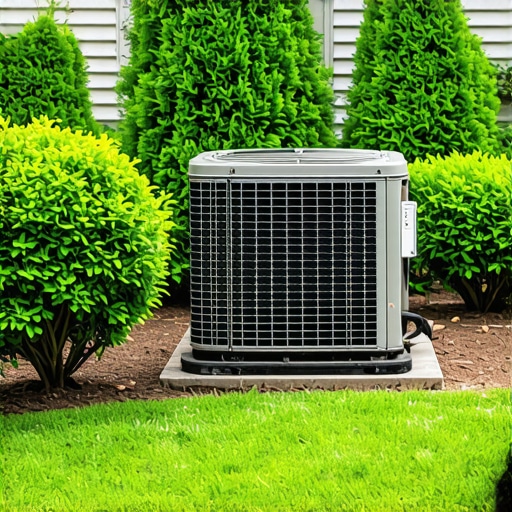
The sound isn’t a bang. It isn’t even a pop. It is a low, rhythmic thrum-thrum-thrum that vibrates through the copper line set, travels up the wall, and resonates in your floorboards like a heartbeat with an arrhythmia. That is the sound of a compressor struggling against high head pressure. It is the sound of a mechanical heart trying to pump liquid refrigerant—the ‘gas’ or ‘juice’ as we call it—through a system that can’t shed its heat. I’ve spent thirty years in this trade, crawling through crawlspaces and baking on 130-degree rooftops, and I can tell you that most compressor deaths are preventable homicides. The killer? A lack of respect for the 3-foot rule. My old mentor, a man who smelled permanently of solder flux and burnt ozone, used to scream at me, ‘You can’t cool what you can’t touch!’ He was talking about the air. If the condenser coil can’t ‘touch’ fresh, cool air because you’ve wrapped it in a decorative privacy hedge, you are effectively suffocating your system.
“Equipment shall be installed in accordance with the manufacturer’s instructions and the requirements of this code. Airflow shall not be obstructed by structures, vegetation, or other equipment.” – ACCA Manual J / Local Mechanical Code Reference
In the Southwest, where the ambient temperature hits 115°F before lunch, the physics of heat rejection are unforgiving. Your AC installation isn’t just a box; it’s a heat exchanger. The compressor’s job is to take low-pressure vapor and squeeze it into high-pressure, high-temperature vapor. This heat must be rejected into the outside air. When you plant a juniper bush eighteen inches away from that coil, you create a micro-climate of stagnant, superheated air. The fan tries to pull air through the fins, but it ends up recycling the same hot exhaust it just blew out the top. This is the ‘Monsoon Effect’ of heat—re-circulating thermal energy until the internal thermal overload switch finally gives up, or worse, the motor windings melt into a sour-smelling sludge known as an acidic burnout.
Thermodynamic Zooming: Why Sensible Heat is Your Enemy
Let’s talk about sensible heat versus latent heat. Inside your home, your evaporator coil is dropping below the dew point to remove latent heat (humidity). But outside, at the condenser, we are dealing with sensible heat rejection. As the refrigerant enters the condenser coil, it is significantly hotter than the outside air. The temperature difference (TD) is what drives the heat out. If the air surrounding the unit is 120°F because your bushes are blocking the breeze, the TD narrows. This forces the compressor to work at much higher head pressures to force that heat out. Higher pressure equals higher amperage draw. Higher amperage equals heat in the windings. It’s a death spiral. I’ve seen homeowners try to hide their ‘ugly’ units with fancy lattice work and thick shrubs, only to call me for an emergency heating service or AC repair when the system trips the breaker. You aren’t just saving the compressor by giving it 3 feet of clearance; you’re saving the capacitor and the contactor, too. High heat dries out the electrolyte in those capacitors until they swell up and pop like a cheap firework.
“Proper clearance around outdoor heat rejection equipment is critical to maintain the designed Energy Efficiency Ratio (EER) and prevent premature component degradation.” – ASHRAE Standard 15-2022
The Anatomy of a Forensic Diagnosis
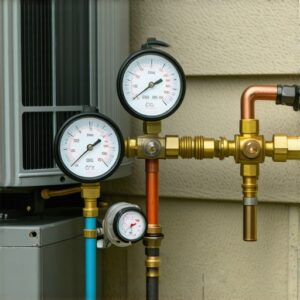
When I roll up to a house where the AC has quit, I look at the landscaping before I even touch my manifold gauges. If I see ‘Pookie’ (mastic) smeared on a leaking duct but the outdoor unit is buried in bougainvillea, I know exactly what I’m going to find. I open the electrical panel and look at the contactor. If the points are pitted and charred, it’s been ‘chattering’ due to high heat or low voltage. I check the suction line—it should be ‘beer can cold.’ If it’s lukewarm and the discharge line is hot enough to brand cattle, that compressor is screaming for mercy. Many ‘Sales Techs’ will look at a 10-year-old unit in this state and immediately quote a $15,000 AC installation for a new 16-SEER system. They won’t mention that the new unit will die just as fast if those bushes aren’t trimmed. A real tech, a tin knocker who knows his physics, will tell you to grab the hedge trimmers before you grab your wallet. Sometimes, all that’s needed is a $200 capacitor and a hard start kit to kick that compressor back to life, provided the windings haven’t grounded out yet.
The 2025 Regulatory Cliff and Mini-Split Considerations
We are entering a strange era with the transition to A2L refrigerants like R-454B. These ‘mildly flammable’ gases are replacing R-410A, and they are even more sensitive to pressure and temperature. If you think the 3-foot rule was important for your old furnace repair and AC combo, it’s a matter of life and death for the new systems. The sensors in these new units will lockout the system if they detect the kind of heat-soak caused by poor airflow. This applies to a mini-split just as much as a 5-ton central unit. Those small, horizontal-discharge mini-split condensers are often tucked away in narrow side-yards. If you don’t have at least 24 to 36 inches of clearance in front of that fan, you are essentially throwing your money into a furnace. The efficiency drops, the inverter board overheats, and ‘Sparky’ the electrician will be back to replace the fried components every season.
Math of the Machine: Repair vs. Replace
Is it worth it to save a unit that’s been baking in a bush for five years? Here is the math. A compressor replacement out of warranty can run you $2,500 to $4,000 depending on the tonnage and the gas. A full AC installation starts at $8,000 and goes up. If your unit is under 10 years old and the compressor isn’t grounded, trim the bushes, wash the coils with a low-pressure hose (never a power washer, you’ll fold the fins like paper), and install a hard start kit. If the compressor has suffered an acid burnout, you have to replace the whole thing—liquid line drier, suction filter, and all. At that point, the ‘Sales Tech’ might actually be right, but for the wrong reasons. Physics doesn’t care about your curb appeal. It cares about CFM (cubic feet per minute) and delta-T. Give your unit 3 feet of breathing room, or start a savings account for its replacement. Comfort isn’t magic; it’s just moving heat from where you don’t want it to where you don’t care about it. Don’t let a $50 shrub kill a $10,000 machine. “