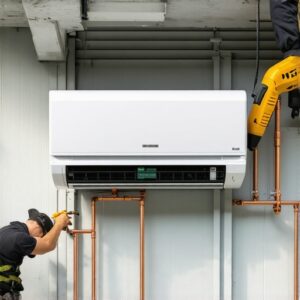
The Diagnostic Ghost: Why Your Mini-Split Isn’t Moving Heat
I remember my old mentor, a man who had more copper dust in his lungs than blood, used to scream at me every time I reached for a manifold gauge set without checking the filters first. ‘You can’t cool what you can’t touch!’ he’d roar, pointing at a matted, gray evaporator coil. This is why airflow matters more than horsepower. He wasn’t just being a cranky old salt; he was teaching me the fundamental physics of the heat pump. A ductless mini-split is a masterclass in engineering, but when the juice—that’s refrigerant to you civilians—starts to leak, the whole thermodynamic ballet falls apart. Most homeowners think a recharge is like putting gas in a car. It isn’t. If you’re low on gas, you have a hole in the bucket. Period.
The Anatomy of Heat Transfer: Thermodynamic Zooming
To understand why your unit is failing, you have to look at the evaporator coil. In cooling mode, the refrigerant enters that indoor coil as a low-pressure, cold liquid. As the indoor fan blows warm house air over those fins, the refrigerant absorbs the heat. It undergoes a phase change, boiling from a liquid into a vapor. This is where the magic happens—latent heat removal. If the system is low on refrigerant, the pressure drops. When the pressure drops, the boiling point of the juice drops too far. Instead of a steady 40-degree coil that sweats and dehumidifies, you get a 20-degree coil that flashes into ice. The humidity in your air hits that coil and freezes instantly. Now, instead of an air conditioner, you have a block of ice acting as an insulator, and your compressor is screaming for mercy.
“The most expensive equipment in the world cannot overcome a bad duct system or a fundamental lack of proper charge volume.” – Industry Axiom (ACCA Manual S)
The Signs of a Starving System
How do you know? First, listen. A healthy mini-split should be almost silent. If you hear a persistent hissing or a gurgling sound coming from the indoor unit, that’s often the sound of the juice struggling to move through the lines. It’s called ‘slugging’ or ‘throttling’ at the Electronic Expansion Valve (EEV). Second, look at the flare nuts on the outdoor condenser. If you see ice forming on the small liquid line (the high-pressure side), that’s a dead giveaway. In the North, during a bitter winter, a low charge is even more catastrophic. Your heat pump depends on that refrigerant to pull heat out of the freezing outdoor air. If the charge is low, the unit will stay in ‘Defrost Mode’ for hours, trying to melt ice that shouldn’t be there while you shiver inside.
The Inverter Struggle: Why Diagnostics Are Tricky
Modern mini-splits use inverter-driven compressors. Unlike your old-school ‘Sparky’ special that was either 100% on or 100% off, an inverter ramps up and down. This makes diagnosing a low charge difficult for a rookie ‘Sales Tech.’ They’ll see the low pressure and immediately try to dump more gas in. But wait. If the EEV is wide open trying to compensate for a dirty coil, the pressures will look identical to a low charge. You have to measure the subcooling and superheat accurately, or you’re just guessing. You can’t just ‘top it off.’ These units use R-410A, which is a blend. If it leaks, the gases that make it up leak at different rates (fractionation). You often have to pull the whole charge, find the leak with a nitrogen trace, fix the ‘Tin Knocker’s’ bad flare joint, and then weigh the juice back in to the tenth of an ounce.
“Safety standards require that refrigerant concentrations in occupied spaces do not exceed specific thresholds to prevent asphyxiation in the event of a catastrophic leak.” – ASHRAE Standard 15
The Forensic Verdict: Repair vs. Replace
If your system is five years old and the juice is low, it’s almost always a bad flare connection. I’ve seen hundreds of them where the installer didn’t use a torque wrench. They just cranked it until it ‘felt right.’ Over time, the vibration of the compressor loosens that copper-to-brass connection. We find it, we re-flare it using a bit of specialized sealant (not that sloppy Pookie some guys use on ducts), and we pull a vacuum. If that vacuum doesn’t hit 500 microns and stay there, we still have a leak. This isn’t a 20-minute job. If a tech shows up without a vacuum pump and a digital scale, kick them off your property. They aren’t doing a heating service; they’re doing a robbery. For a unit that is 12-15 years old, however, once the internal evaporator coil starts leaking (pitting corrosion), you’re looking at an AC installation rather than a repair. The cost of the juice alone, which has skyrocketed due to EPA phase-outs, makes a full replacement more logical than chasing leaks in a rotting coil.