The sound of a failing compressor isn’t always a bang; sometimes it’s a rhythmic, metallic throb that vibrates through the copper lines and into the floorjoists of a home. When I pull up to a driveway in the middle of a 110°F July heatwave in the Mojave, I don’t look at the thermostat first. I look at the ground. If that 400-pound condenser is leaning like the Tower of Pisa because the desert soil shifted during the last monsoon, I already know why the bearings are screaming. My old mentor, a grizzled tech who had been hauling vacuum pumps since the days of R-12, used to scream at me, “You can’t cool what you can’t touch, and you can’t pump what isn’t level!” He believed that airflow was the king of the castle, but gravity was the law of the land. This is why airflow matters more than horsepower, and why a tilted pad is a death sentence for your AC installation.
“The outdoor unit shall be set level on a concrete slab or other approved material.” – ACCA Manual S (Residential Equipment Selection)
In the Southwest, we deal with sensible heat that cooks capacitors and a “Monsoon Effect” that turns dry dust into shifting mud. When that condenser pad tilts, it isn’t just an aesthetic issue. It’s a thermodynamic catastrophe. Inside that compressor, the POE (Polyolester) oil sits in the sump. When the unit is level, that oil lubricates the scroll plates evenly. Tilt that unit more than a few degrees, and you’re starving one side of the scroll. The friction increases, the heat rises, and the “juice”—that’s refrigerant to you civilians—starts to carry acidic byproduct through the suction line. You’ll know it when you smell it: a sour, metallic stench that tells every experienced tech the compressor is toast. This is where a $15,000 furnace repair or full heating service starts—with a $50 pad that wasn’t leveled properly.
The Forensic Diagnosis: Why Gravity Kills Compressors
Before you go renting a backhoe, you need to understand the mechanical anatomy of what’s happening. The compressor is the heart of the system. It pumps the gas, creating the high-pressure differential needed for the refrigerant to move heat from the evaporator coil (where it removes latent heat, or humidity) to the condenser coil. If the unit isn’t level, the vibration isn’t absorbed by the rubber grommets; instead, it’s transferred into the copper brazed joints. Eventually, those joints fatigue and crack. Now you’ve got a leak, and the next thing you know, some “Sales Tech” is trying to sell you a whole new mini-split because they’re too lazy to find the leak. They’ll tell you it’s a “sealed system” while they’re actually just looking for a commission.
“Support for the condenser must be provided to prevent the unit from tipping or sagging, which can lead to oil trapping in the refrigeration lines.” – ASHRAE Standard 15-2019
The math of the situation is brutal. A proper leveling job costs you a few hours and maybe twenty bucks in gravel. A compressor replacement? You’re looking at $2,500 to $4,500 depending on the SEER2 rating and the tonnage. If the unit is old, you’re better off pulling the plug and doing a full AC installation. But if that unit has life left, we fix the foundation. We don’t need heavy machinery; we need physics.
The Lever and the Lift: Leveling Without a Backhoe
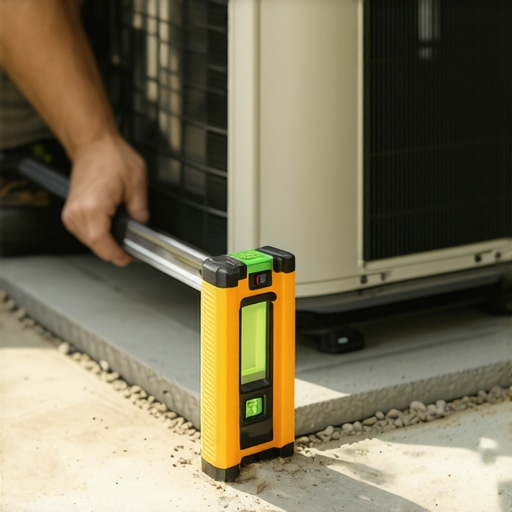
To level a pad without a “Tin Knocker” or a heavy equipment operator, you need a heavy-duty pry bar and a few bags of crushed stone or pea gravel. First, you have to be careful of the “Sparky’s” work—the electrician who ran the liquid-tight whip. If you lift that unit too fast, you’ll yank the wires right out of the disconnect. I’ve seen it happen. I’ve also seen guys kink the suction line, which is “beer can cold” when running correctly, but brittle as a dry twig when it’s under stress. You want to slide the pry bar under the low side of the pad. Slowly, and I mean slowly, lift the edge. While you hold it up, your partner (or your stack of bricks) slides the gravel underneath. You aren’t just looking for level; you’re looking for compaction. If the soil underneath is loose, the first rain will just wash your hard work away.
Thermodynamic Zooming: The Oil Return Issue
Let’s talk about the suction line. In a dry climate like Phoenix or Vegas, we aren’t fighting the swamp-house feel of Florida, but we are fighting high head pressure. If the condenser is tilted toward the house, the oil can actually start to pool in the low spots of the refrigerant lines. This prevents the oil from returning to the compressor. Without that oil, the internal components of the compressor begin to gall. The heat from the 115°F ambient air can’t be dissipated because the refrigerant flow is restricted by the oil slugs. You’ll hear the contactor click, the fan might spin, but the compressor will just hum and then trip on its internal thermal overload. That’s the sound of money leaving your bank account.
Materials for a Permanent Fix
If the pad is cracked, gravel won’t save you. You’ll need a new composite pad. Most residential AC installations use these now because they don’t crack like concrete. If you’re leveling an existing pad, use plastic shims or “Pookie” (mastic) to seal any gaps where rodents might crawl under the unit. Mice love the warmth of a transformer in the winter, and they’ll chew through your low-voltage wiring faster than you can say “no cooling.” When you’re done, check the static pressure of the system if you can. A level unit is a quiet unit. If you’ve leveled it and it still sounds like a bag of rocks in a dryer, the damage is already done, and you’re looking at a mechanical failure of the internal valves.
The Scam Tune-Up vs. Real Maintenance
A lot of companies will offer a “$49 Tune-Up” just to get a foot in the door. They won’t look at your pad. They won’t check your airflow. They’ll just hook up their gauges (and likely introduce moisture into your system) and tell you that you’re low on gas. If a system is low on gas, it has a leak. Period. It’s a sealed system. A real technician will check the level of your unit, wash the desert dust off your coils to drop the head pressure, and ensure your capacitors aren’t bulging. Leveling the pad is part of that preventive maintenance. It’s the difference between a unit that lasts 8 years and one that lasts 22.