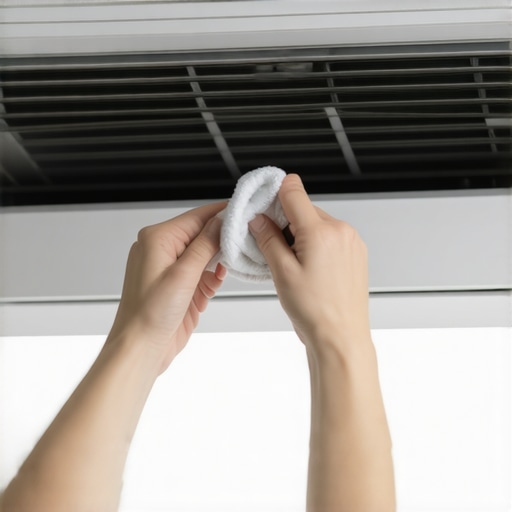
The Pungent Reality of Dirty Sock Syndrome
You walk into your home after a long day, expecting a crisp breeze of conditioned air, but instead, you are hit with a scent that smells like a middle school locker room. It is that sour, vinegar-like, funky odor commonly known in the trade as ‘Dirty Sock Syndrome’ (DSS). Most homeowners think their dog had an accident or there is a forgotten sandwich under the couch. But as someone who has spent three decades crawling through spider-infested crawlspaces and baking on black shingle roofs, I can tell you exactly where that stench is coming from: your evaporator coil. This isn’t just a nuisance; it is a failure of physics and maintenance.
The Mentor’s Mantra: Airflow is Everything
My old mentor, a man who could diagnose a bad compressor just by putting his ear to the suction line, used to scream at me, ‘You can’t cool what you can’t touch!’ I remember one sweltering afternoon in a cramped mechanical room where he pointed at a slime-covered coil. He explained that if the air cannot physically contact the aluminum fins because of a layer of organic ‘pookie’ and biofilm, the thermodynamic exchange fails. This is the heart of the problem. Your AC installation might have been top-tier, but if you aren’t managing the moisture on that coil, you’re just breeding a science experiment. The ‘Dirty Sock’ smell is the result of bacteria and mold colonies feeding on the dust and moisture trapped in the microscopic grooves of your indoor coil.
“The design of the condensate disposal system is critical to prevent moisture accumulation and microbial growth.” – ASHRAE Standard 62.1
The Thermodynamic Zoom: Why It Smells Sour
To understand the fix, you have to understand the ‘gas’ (refrigerant). In a humid climate, your AC is a giant dehumidifier. When the cold refrigerant flows through the evaporator coil, the surface temperature drops below the dew point of the ambient air. This causes water to condense on the fins. In a perfect world, this water slides down into the primary drain pan and out of the house. However, if your system is oversized—a classic mistake by a ‘Sales Tech’ looking for a commission—the unit ‘short cycles.’ It cools the room so fast that it doesn’t run long enough to wash the coil with condensate. Instead, the coil stays damp, the ‘tin knocker’ who did the ductwork didn’t provide enough return air, and you get stagnant moisture. That moisture reacts with the dust that slipped past your cheap filter, and the bacteria start a feast, producing that acidic, sour off-gassing.
The Forensic Diagnosis: Mini-Splits vs. Central Air
If you have a mini-split, you are even more susceptible. These units have tightly packed fins and blowers that are magnets for biofilm. If you haven’t had a proper heating service or AC tune-up, the blower wheel inside that wall unit probably looks like a petri dish. For central systems, the issue often hides in the transition between the furnace repair you had last winter and the cooling cycle today. When the furnace runs, it dries out the organic material; when the AC kicks back on, the moisture ‘re-activates’ the smell. It is a vicious cycle of rot.
“Airflow across the indoor coil must be maintained at 350 to 450 CFM per ton to ensure proper latent heat removal.” – ACCA Manual S
The Solution: More Than a ‘Quick Spray’
Don’t let a ‘Sales Tech’ tell you that you need a whole new $15,000 system because of a smell. Here is the veteran’s path to a fresh house: First, we need to clean the coil with a non-acidic, pH-neutral cleaner. If the growth is heavy, the coil must be pulled and cleaned—a job for a real technician, not a ‘Sparky’ or a DIYer. Second, look into UV-C germicidal lights. These are installed over the coil to blast the DNA of the bacteria, preventing them from colonizing. Third, consider a specialized coating for the coil that prevents moisture from sticking. Finally, check your static pressure. If your ducts are too small, your airflow is too slow, and your coil stays wet too long. Physics doesn’t lie, and no amount of scented spray will fix a thermodynamic failure. Professional AC installation includes verifying that the drainage is pitched correctly so water doesn’t sit in the pan like a stagnant pond. If you keep smelling that sour sock, it is time to stop masking the scent and start fixing the airflow.