The Sound of a Wet Carpet and the Smell of Neglect
There is a specific sound that makes an experienced HVAC tech’s skin crawl. It’s not the screech of a seized bearing or the hum of a grounded compressor—it’s the rhythmic drip, drip, drip of water hitting a hardwood floor at 2 AM. When a mini-split starts leaking, homeowners panic. They see water pouring out of a thousand-dollar wall unit and think the sky is falling. Usually, some ‘Sales Tech’ in a starched shirt will show up, look at it for three minutes, and tell you the evaporator coil is porous and you need a $15,000 AC installation. That’s a lie. Most of the time, you’re just dealing with a biology project gone wrong in your drain line.
My old mentor used to scream at me until he was purple in the face: ‘You can’t cool what you can’t touch!’ He was talking about airflow, but the same logic applies to moisture. If your unit can’t get rid of the water it pulls out of the air, the whole thermodynamic cycle becomes a mess. This isn’t just about a puddle; it’s about the physics of latent heat. In high-humidity zones like the Gulf Coast or the humid East, your mini-split isn’t just a cooler; it’s a massive dehumidifier. When that heating service or cooling cycle kicks in, the coil drops below the dew point, and moisture clings to the fins. That water has to go somewhere, and if the 1-inch plastic pipe is choked with ‘slime,’ it’s coming into your living room.
“Condensate disposal systems shall be provided for equipment and appliances that produce condensate in order to prevent damage to the structure.” – International Mechanical Code (IMC)
The Physics of the ‘Gunk’: Why Drains Clog
To understand the ‘Wet-Vac Trick,’ you have to understand what you’re sucking out. When we talk about furnace repair or AC maintenance, we often focus on the mechanicals, but the drain line is a biological battlefield. In a mini-split, the drain pan is shallow—dangerously shallow. Because these units use a ‘gravity-fed’ or small ‘condensate pump’ system, there is very little pressure to push obstructions out. Dust, skin cells, and pet dander bypass the filters (which you probably haven’t cleaned in months) and mix with the water on the coil. This creates a nutrient-rich slurry that grows Zoogloea—a thick, snot-like bacterial slime. Eventually, this slime forms a plug. Suddenly, the ‘Beer can cold’ suction line is sweating, the pan is overflowing, and your wall is bubbling.
The Forensic Diagnosis: Is it a Leak or a Clog?
Before you go grabbing tools, you need to verify the crime scene. If the water is dripping from the back of the unit against the wall, your ‘Tin Knocker’ might have messed up the pitch of the pipe during the initial install. If the water is spitting out of the blower wheel like a fountain, your coil is likely freezing up due to low ‘gas’ (refrigerant) or a dead motor. But if the water is slowly overflowing from the front or bottom of the primary plastic casing, you’ve got a clog. This is where the wet-vac becomes your best friend. It’s a $0 fix that saves you a $300 service call from a guy who’s just going to do exactly what I’m about to tell you.
The Wet-Vac Trick: A Step-by-Step Tactical Manual
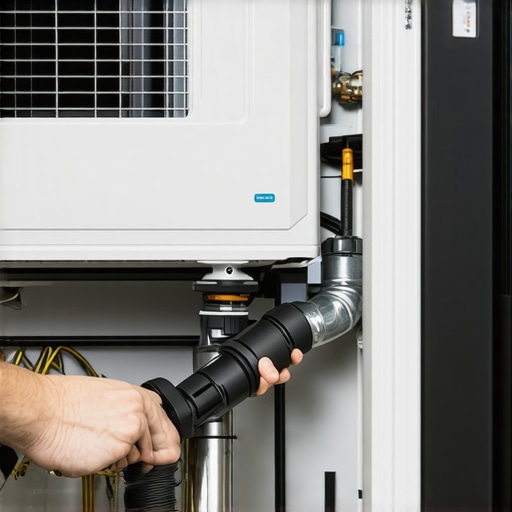
First, shut off the ‘Sparky’s’ work—kill the power at the disconnect or the breaker. Don’t be the person who gets a 240V reminder while playing in a puddle. Step 1: Locate the Termination Point. Find where that PVC or flexible drain line exits your house. It’s usually sticking out near the outdoor condenser. Step 2: The Seal is Everything. You can’t just hold a vacuum nozzle up to the pipe; physics requires a pressure differential. Use a rag, or better yet, some ‘Pookie’ (mastic sealant) or a specialized rubber adapter to create an airtight seal between the wet-vac hose and the drain line. Step 3: The Extraction. Turn on the vacuum. Let it run for at least 30 to 60 seconds. You aren’t just looking for water; you’re looking for that ‘snot plug.’ When you hear the vacuum motor change pitch, you’ve hit the gold mine. Step 4: The Flush. Go back inside, pop the front cover of the mini-split, and carefully pour a cup of warm water into the internal drain pan. If it disappears instantly, you’ve won.
“A system that cannot properly manage its latent load is not a cooling system; it’s a mold factory.” – Industry Axiom
The Humidity Factor: Why Your Climate is Killing Your Drain
If you live in a place where the air feels like a warm wet blanket, your mini-split is working double duty. In these humid climates, the ‘Latent Heat’ load—the energy required to turn water vapor into liquid—is often higher than the ‘Sensible Heat’ load (the actual temperature). If your unit is oversized, it will ‘Short Cycle.’ This means it cools the room so fast that it doesn’t run long enough to properly drain the pan. The water sits there, stagnant, getting warm and growing that nasty slime. This is why proper AC installation sizing matters more than the brand on the box. A 2-ton unit in a 1-ton room is a recipe for a flooded house and a moldy soul.
Beyond the Vacuum: Long-Term Maintenance
Once you’ve cleared the line, don’t just walk away. You need to treat the ‘water’ so the slime doesn’t return. While I’m usually against chemical shortcuts, a dedicated condensate pan tablet can help. Do NOT use bleach; it can crack the plastic pans and eat through the glue in the fittings over time. If you’re really serious about heating service and cooling longevity, check the ‘pitch.’ A drain line should have a 1/4 inch of drop for every foot of run. If it’s sagging in the middle, gravity is working against you, and no amount of vacuuming will fix a structural flaw in the plumbing. Sometimes you have to get the ‘Tin Knocker’ back out to re-hang the line properly.
When to Put the Tools Down
I get it—you want to save money. But if you’ve vacuumed the line and water is still pouring out, or if you see ice forming on the copper lines, the wet-vac isn’t the answer. You might have a failed condensate pump or a refrigerant leak. A leak isn’t just a ‘top-off’ job. Refrigerant is a ‘sealed system’—if it’s low, there’s a hole. If you find yourself calling for furnace repair or AC ‘juice’ every summer, you’re being scammed. A real tech finds the leak, fixes the flare, and pulls a vacuum down to 500 microns. Anything less is just a band-aid on a gunshot wound. Comfort is about physics, not magic. Respect the drain, clean your filters, and keep your ‘Pookie’ handy.