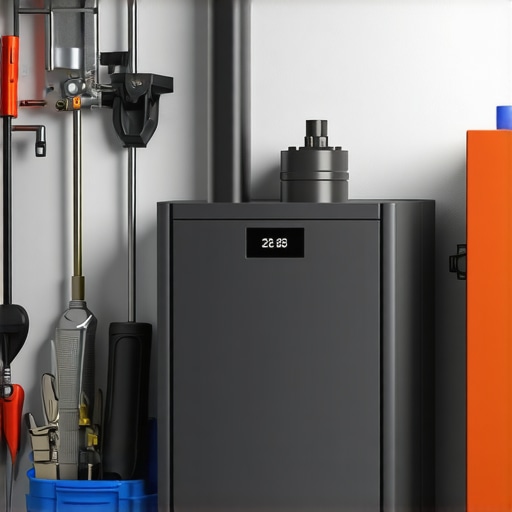
The Anatomy of a Cold House: Why Your High-Tech Furnace is Failing the Forensic Test
I remember my old mentor, a grizzled veteran who smelled like burnt ozone and stale coffee, shouting at me over the roar of a 100,000 BTU beast in a cramped basement: ‘Kid, you can’t heat what you can’t touch!’ He was hitting the side of a return air drop with a wrench for emphasis. At the time, I thought he was just being cranky, but thirty years of crawling through fiberglass-filled attics has proven him right. Most homeowners think a furnace is just a box that makes fire. It is actually a complex thermodynamic exchange engine, and if your 2026 model is leaving you in a parka inside your own living room, the problem usually isn’t the flame—it is the physics. We are entering an era where heating service is becoming more about data and less about ‘turning a screw.’ If you are seeing underperformance in a modern high-efficiency system, you are likely a victim of one of five technical failures that the ‘Sales Techs’ won’t tell you about because they are too busy trying to sell you a whole new AC installation when all you need is a furnace repair and a lesson in static pressure.
“The most expensive equipment in the world cannot overcome a bad duct system.” – Industry Axiom
1. The Static Pressure Paradox: Your Ductwork is Suffocating the Heat
In the trade, we call the tin knocker the most underrated person on the job site. Why? Because you can buy a 98% AFUE furnace, but if your ductwork was sized for a low-efficiency unit from 1985, you have a mismatch that will kill your blower motor. Modern furnaces use ECM (Electronically Commutated Motors) that try to maintain a constant airflow. If your return air ducts are too small, the motor ramps up its RPMs to compensate for the resistance. This increases ‘static pressure.’ Imagine trying to breathe through a cocktail straw while running a marathon; that is what your furnace is doing. High static pressure causes the limit switch to trip because the heat exchanger isn’t getting enough air to strip the heat away. The furnace shuts down to prevent a meltdown, and you get ‘the chill.’ You don’t need a new unit; you need a technician who knows how to use a manometer, not just a screwdriver.
2. The Condensate Trap: The Silent Killer of High-Efficiency Heat
If you are in a Northern climate like Chicago or the Northeast, your furnace is likely a condensing model. This means it has a secondary heat exchanger. As the flue gases cool, they reach the ‘dew point’—the temperature where water vapor turns back into liquid. This latent heat release is how we get those 96% and higher efficiency ratings. However, that acidic ‘juice’ or condensate has to go somewhere. If the drain line is clogged or the ‘Pookie’ (mastic) was applied sloppily during the furnace repair, the water backs up into the secondary heat exchanger. The furnace’s pressure switch senses this blockage and kills the ignition. You’ll hear the inducer motor spinning—that high-pitched whine—but the burner never kicks in. It’s a forensic diagnosis: if there is water where it shouldn’t be, the fire stays out.
3. The 2026 A2L Transition and Sensor Sensitivity
We are currently in the middle of a massive regulatory shift. While 2026 furnaces are primarily gas-fired, many are now part of ‘dual-fuel’ systems involving a mini-split or a high-efficiency heat pump. The new A2L refrigerants (like R-454B) are ‘mildly flammable,’ which has led to a surge in sensor technology inside the cabinetry. These sensors are incredibly sensitive. If they detect even a trace of refrigerant ‘gas’ from a micro-leak in the evaporator coil (often installed right on top of your furnace), the entire system will lockout as a safety precaution. This is the ‘Regulatory Cliff.’ We are seeing systems that are ‘too smart for their own good,’ where a minor component failure in the cooling side creates a total shutdown of the heating side. This isn’t a mechanical failure; it’s a software-mandated safety freeze.
“Design of the duct system shall be based on the actual pressure drop of the equipment selected.” – ACCA Manual D
4. Flame Rectification: The Microamp Struggle
The sparky (electrician) might tell you the power is fine, but furnace logic boards are finicky about flame rectification. The flame sensor is a simple metal rod that sits in the fire. Through a process called ‘thermionic emission,’ the furnace sends an AC current to the rod, and the flame itself conducts a tiny DC signal (measured in microamps) back to the board. If that rod is dirty—covered in a thin layer of silica or carbon—the board won’t see the signal. It ‘thinks’ the furnace hasn’t lit and shuts off the gas to prevent an explosion. This is a classic ‘forensic’ repair. I’ve seen homeowners quoted $4,000 for a new board when all they needed was a 30-second cleaning with a piece of Scotch-Brite. If your furnace starts and then dies after three seconds, your ‘physics’ is working, but your ‘sensing’ is failing.
5. The Oversizing Myth: Short-Cycling and Cold Spots
The biggest scam in AC installation and heating is the ‘bigger is better’ mentality. A ‘Sales Tech’ looks at your house and says, ‘You need a 100k BTU unit,’ without doing a Manual J load calculation. An oversized furnace will blast your home with hot air, hit the thermostat setpoint in five minutes, and shut off. This is called ‘short-cycling.’ Because the air isn’t moving long enough, it never reaches the back bedrooms. The air near the floor stays cold because you haven’t achieved ‘stratification.’ You want long, slow run cycles that keep the air mixing. A furnace that is too big is like a car that only has two speeds: stopped and 100 MPH. It’s uncomfortable, it’s hard on the equipment, and it’s why you are shivering even though the thermostat says it’s 72 degrees. Real comfort is about airflow architecture, not just raw horsepower.
Repair vs. Replace: The Forensic Conclusion
Before you commit to a $10,000 replacement, look at the anatomy of the failure. Is the heat exchanger cracked? That’s a death sentence—carbon monoxide isn’t a joke. Is the inducer motor screeching like a banshee? That’s a $600 fix. But if your 2026 furnace is simply ‘underperforming,’ the culprit is almost always the environment it was forced into. Check your filters, look for ‘Pookie’ blocking your secondary drains, and make sure your tin knocker didn’t leave a damper closed in the attic. Physics doesn’t lie, even if a sales brochure does.
This article really hit home for me, especially the part about static pressure and duct sizing. I had a similar issue last winter where our furnace kept shutting down, and it turned out to be small return ducts causing high static pressure. After having a technician measure the pressure with a manometer, he found the ductwork was mismatched for our high-efficiency furnace. It’s such a common oversight but makes a world of difference in performance. The point about the condensate trap resonated with me too—clogged drains are a silent killer I’ve seen many homeowners overlook, leading to incomplete combustion or system shutdowns. Have any of you experienced problems with micro-leaks in refrigerant lines affecting heating? I’m curious about how others have tackled these dual-fuel system challenges, especially with the new A2L refrigerants and sensors becoming more sensitive. Overall, knowledge about these nuances can save a lot of money and frustration before jumping to full replacements.