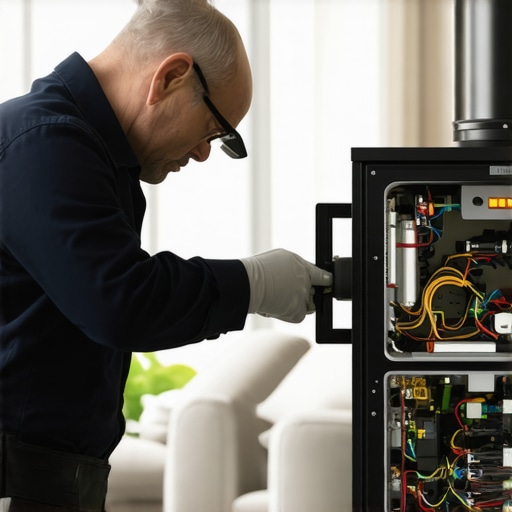
The Sound of a Dying Inducer and the Smell of a Sales Pitch
The sound of a failing furnace isn’t just a rattle; it’s a rhythmic, metallic chirp that tells me a bearing in the inducer motor is about to give up the ghost. I was standing in a crawlspace in South Bend last November, my knees sinking into the damp earth, listening to that exact sound. A young couple had called me for a second opinion after a ‘Comfort Consultant’ from a big-box HVAC outfit told them their five-year-old furnace was a ‘lethal hazard’ that needed immediate replacement. The quote? Fourteen thousand dollars for a basic 80% AFUE unit. I pulled the panel, checked the heat exchanger with my scope—not a crack in sight. The culprit was a $150 inducer motor and a clogged condensate trap. That ‘Sales Tech’ wasn’t looking at the physics; he was looking at his commission check. This is the reality of the industry today, and if you think prices are high now, wait until 2026 hits you like a frozen pipe in January.
The Great Refrigerant Pivot: Why 2026 is the Financial Cliff
You might wonder why a furnace repair discussion involves refrigerants. In the world of modern residential HVAC, your heating and cooling systems are often tethered. Whether you’re running a dual-fuel heat pump or a traditional split system, the industry is currently undergoing the most violent regulatory shift since the phase-out of R-22. By 2026, the ‘gas’ we’ve used for two decades—R-410A—will be a legacy product. We are moving to A2L refrigerants like R-454B and R-32. These are ‘mildly flammable.’ That means your new AC installation or heat pump isn’t just a box of coils anymore; it’s a piece of equipment that requires leak sensors, specialized ‘spark-proof’ contactors, and mitigation boards. The manufacturing cost alone has surged, and those costs are being passed directly to your basement.
“The design and installation of the duct system are the most critical factors in the performance and longevity of the HVAC system.” – ACCA Manual D
When you call for heating service in 2026, you aren’t just paying for the technician’s time; you’re paying for the specialized recovery equipment and the liability insurance required to handle these new atmospheric pressures and flammability ratings. If your current tech doesn’t understand the difference between sensible heat and latent heat removal, they’re going to overcharge your system, sky-rocket your head pressure, and blow your compressor before the first frost.
Thermodynamic Zooming: The Secondary Heat Exchanger Crisis
Let’s talk about the ‘guts.’ A high-efficiency furnace (90% AFUE and above) uses two heat exchangers. The primary one takes the brunt of the flame—the sensible heat. The secondary heat exchanger is where the real magic (and the real headache) happens. This is where the combustion gases cool down so much they reach their dew point. This phase change—turning gas into liquid—releases latent heat, which gives you that extra efficiency. But here’s the rub: that liquid is acidic. It’s a chemical cocktail that eats through inferior metals. If your furnace repair tech doesn’t check the PH of your condensate or ensure the ‘Pookie’ (mastic) on your transition is airtight, that secondary exchanger will clog with ‘white flakes’ (aluminum oxide), and your furnace will trip its limit switch every twenty minutes. By 2026, the materials required to withstand this corrosion are becoming scarcer, doubling the price of the components.
The Airflow Manifesto: Why Horsepower is a Lie
I’ve seen ‘Tin Knockers’ slap a five-ton blower on a duct system designed for three tons, thinking more ‘juice’ equals more comfort. It’s a lie. Airflow is king. If your ducts are too small, the static pressure rises, the motor works harder, and your ‘Sparky’ will be out to replace a fried control board every three years. This is why a mini-split is often a better surgical strike for that one cold bedroom than trying to force more air through a choked-down trunk line. A mini-split allows for zone-specific thermodynamic control without the massive parasitic loss of uninsulated ducts in a freezing attic.
“Equipment shall be sized according to the heating and cooling loads calculated by Manual J.” – International Residential Code, Section M1401.3
If your contractor doesn’t pull out a laptop to run a Load Calc and instead just looks at the ‘tonnage’ on your old unit, kick them off your property. They are guessing with your money. An oversized furnace ‘short cycles’—it heats the air so fast the thermostat shuts off before the actual mass of your home (the walls, the furniture) reaches temperature. You end up with ‘stratification,’ where your head is hot and your feet are freezing. That thermal cycling also fatigues the metal in your heat exchanger, leading to the cracks that actually *do* leak carbon monoxide.
The 2026 Survival Guide
If your system is over 12 years old, you are sitting on a ticking financial clock. The transition to A2L refrigerants and the stricter AFUE requirements coming in the next 24 months mean that a heating service call today for a minor fix might be the last ‘cheap’ repair you ever see. Don’t let a ‘Sales Tech’ scare you into a unit you don’t need, but don’t ignore the physics of a failing bearing either. Listen for the screech, smell for the ‘sour’ scent of an electrical short, and always, always check your static pressure. Comfort isn’t a setting on a Nest thermostat; it’s a result of proper air-to-fuel ratios and a duct system that can actually breathe. If you treat your HVAC system like a ‘set it and forget it’ appliance, 2026 is going to be a very expensive year for your bank account.