The Sound of a Dying Giant: Why Gauges Are Your Last Resort
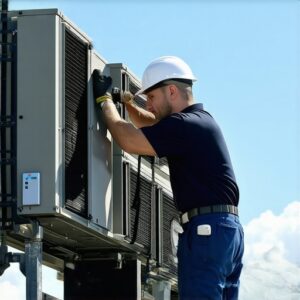
I remember standing on the edge of a three-story shopping mall roof in Scottsdale, the ambient temperature hitting 114°F, watching a kid barely out of trade school trying to hook up his gauges to a 50-ton rooftop unit. He was sweating through his uniform, shaking, and about to commit the cardinal sin of commercial AC installation: he was going to ‘top it off’ because the suction line didn’t feel ‘beer can cold.’ I stopped him before he could crack the manifold. This kid followed a ‘Sales Tech’ mentor who’d been quoting a local facility manager $22,000 for a total system replacement, claiming the compressor was shot. I pulled the service panels, looked at the evaporator, and saw a 3-inch thick wall of dust and grease from the food court below. His ‘low juice’ diagnosis was actually a total lack of airflow. Once we cleaned those coils, the pressures normalized. He was ready to kill a perfectly good compressor with liquid slugging because he didn’t understand the thermodynamic physics of a commercial circuit.
The Thermodynamic Zoom: Latent Heat vs. Sensible Reality
In a commercial setting, we aren’t just ‘cooling air.’ We are moving massive amounts of thermal energy. When you’re dealing with heating service or cooling cycles on this scale, you have to understand the psychrometric chart. In the Southwest, we fight sensible heat—the kind that cooks capacitors and turns Pookie (mastic) into brittle crackers. If your commercial unit is short on juice, the evaporator coil doesn’t just get ‘less cold.’ The refrigerant that remains flashes off too early. Because the pressure is low, the boiling point drops, and the coil might actually freeze over, acting as an insulator and stopping all heat transfer. This is why furnace repair and AC diagnostics are two sides of the same coin: it’s all about the exchange. You can’t cool what you can’t touch. If the air can’t penetrate the fins, the refrigerant stays cold, returns to the compressor as a liquid, and ‘clack-clack-clack’—there goes your $5,000 Scroll compressor.
“The most expensive equipment in the world cannot overcome a bad duct system.” – Industry Axiom
The Safety Checklist: Respecting the High Head Pressure
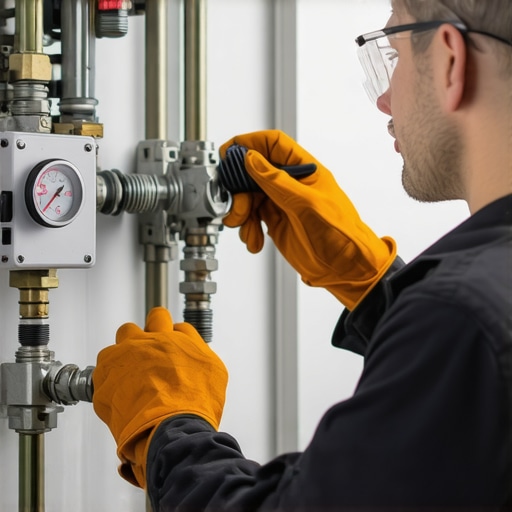
Commercial systems aren’t your residential mini-split. We are talking about hundreds of pounds of refrigerant under high pressure. If you don’t follow the Sparky (electrician) rules for Lockout/Tagout (LOTO), you’re asking for a bad day. Step 1: The Sensory Inspection. Before you ever touch a schrader valve, smell the air. If it smells acidic or sour, you’ve got a compressor burnout. That oil will eat through your gloves and your skin. Step 2: Check Static Pressure. If your Tin Knocker (duct guy) messed up the return, your refrigerant levels will look wrong even if they are perfect. You need to verify that the blowers are moving the CFMs required by the ACCA Manual N. Step 3: Temperature Drop. Check the delta-T across the coil. If you aren’t seeing a 18-22 degree drop, then—and only then—do you reach for the gauges. Step 4: Connect with Care. Always use low-loss fittings. In a commercial system, losing even a few ounces can change the subcooling on a critical process chiller.
“Refrigeration systems shall be designed and constructed to safely contain the refrigerant under all operating conditions.” – ASHRAE Standard 15
Decoding the P-T Chart: Subcooling is the King
For any system with a Thermostatic Expansion Valve (TXV), which is almost every commercial rig, checking ‘suction pressure’ alone is for amateurs. You must measure Subcooling. Subcooling is the temperature of the liquid refrigerant below its saturation point as it leaves the condenser. If the subcooling is too low, you have a starving evaporator. If it’s too high, you’re backing up liquid in the condenser, which skyrockets your head pressure and kills your SEER rating. In the Southwest, high head pressure is our greatest enemy. When the sun is beating down on those rooftop units, the condenser has to work ten times harder to reject heat into 120°F air. If the coils are even slightly ‘fuzzy,’ the pressure will hit the high-limit switch and the unit will trip. This isn’t a ‘broken’ unit; it’s a unit that’s screaming for a garden hose and a brush. Don’t be the tech who sells a new system when the old one just needs a bath.
The Future of the Juice: R-454B and the A2L Transition
We are entering the ‘Regulatory Cliff.’ By 2025, R-410A is being phased out for A2L refrigerants like R-454B. These are ‘mildly flammable.’ If you’re checking levels on a new commercial install, you can’t just vent a ‘puff’ to clear your lines anymore—not that you ever should have, per EPA 608. These systems require leak sensors and specialized recovery equipment. If you’re a property manager, don’t let a tech talk you into a ‘cheap’ R-22 retrofit or a ‘drop-in’ without changing the seals. It’ll leak out faster than you can bank the check. Real AC installation and maintenance means understanding that the chemistry of the system is just as vital as the mechanics. When we do a heating service on a commercial gas-pack, we check the heat exchanger for cracks because carbon monoxide is the silent killer, but in the summer, the silent killer is high discharge temperatures that turn your oil into sludge and toast your bearings. Keep your coils clean, keep your filters fresh, and stop trusting any tech who doesn’t use a digital scale when they’re charging a system.