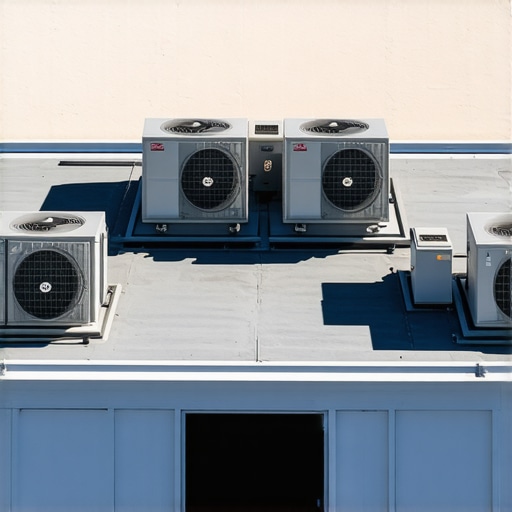
You can hear a dying rooftop unit (RTU) from the parking lot long before you see the service lights on the thermostat. It is a specific, rhythmic thrum—the sound of a scroll compressor slugging liquid because some ‘sales tech’ overcharged it with juice last July. I have spent thirty years on these scorched-earth TPO roofs, and if there is one thing I have learned, it is that a retail space is only as profitable as its airflow. Most retail managers treat their RTUs like a toaster; they expect it to work until it doesn’t. But up here, in the 115°F heat of a desert afternoon, physics does not care about your quarterly budget. My old mentor, a man who could sniff out a refrigerant leak from three aisles away, used to scream at me, ‘You can’t cool what you can’t touch!’ He was talking about surface area and static pressure. If that evaporator coil is plugged with ten years of parking lot dust, or if your return air is choked by a poorly designed duct drop, that 10-ton unit is just an oversized space heater. We are digging into the gut-level reality of AC installation, furnace repair, and why the heating service you ignored last winter is about to cost you a fortune in the 2025 refrigerant transition.
The Thermodynamic Zoom: Why Heat Removal Is a Battle, Not a Process
In a retail environment, we aren’t just fighting the sun; we are fighting the ‘sensible heat’ from every light bulb, refrigerator case, and warm body that walks through the door. But the real enemy in the Southwest is the head pressure. When the ambient temperature hits 110°F, the temperature on that white roof is closer to 135°F. Your condenser fan motor is screaming, trying to shove heat from a 150°F refrigerant line into 135°F air. The Delta-T is paper-thin. This is where thermodynamic zooming matters. Inside that copper tubing, the refrigerant is undergoing a phase change. If your coils are caked in ‘cottonwood’ or grease from a nearby restaurant vent, that gas never fully condenses back into a liquid. You end up feeding your TXV (Thermal Expansion Valve) a frothy mix of bubbles instead of a solid column of liquid. The result? The compressor works twice as hard for half the cooling, the windings start to cook, and eventually, you get that sour, acidic smell of a burnout. It’s the smell of a $12,000 mistake. Proper AC installation isn’t just about crane-lifting a box onto a curb; it’s about ensuring the subcooling is dialed in precisely to handle these high-ambient spikes.
“The most expensive equipment in the world cannot overcome a bad duct system. Static pressure is the silent killer of efficiency in 90% of commercial retail installations.” – Industry Axiom
The 2025 Regulatory Cliff: R-410A Is Dying
If you think retail maintenance is expensive now, wait until the A2L transition hits full stride. We are moving away from R-410A toward mildly flammable refrigerants like R-454B. This isn’t just a ‘gas’ swap. The new units require leak sensors and specialized spark-proof contactors. If you are limping an old R-22 or an early R-410A unit along with ‘stop-leak’ and prayers, you are walking toward a financial cliff. When that compressor finally seizes, you won’t just be looking at a simple furnace repair or a standard swap-out. You’ll be looking at a complete system overhaul because the new ‘juice’ isn’t compatible with your old evaporator coils. A ‘tin knocker’ can’t just patch the old curb; the weight and footprints of these new high-efficiency units are changing. Retailers who wait until the unit dies in a mid-August heatwave will face lead times and price tags that would make a CFO weep. This is why I tell my clients that the best time for AC installation was three years ago, and the second-best time is today, before the 2025 mandates sent equipment costs into the stratosphere.
The Airflow Manifesto: Beyond the Filter Change
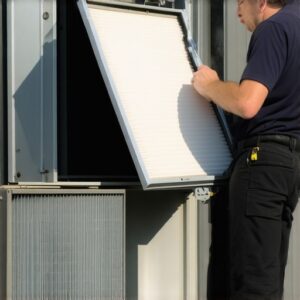
I’ve seen ‘sparkies’ wire up a 3-phase RTU in reverse, and I’ve seen ‘sales techs’ tell a shop owner they need a new system when the belt was just slipping. But the most common crime in retail HVAC is the neglect of static pressure. Most retail spaces have been remodeled three times, with walls moved and vents covered, but the RTU remains the same. When you increase the resistance to airflow, the blower motor has to ramp up, consuming more amps and generating more heat. Eventually, it burns out. Or worse, the lack of airflow across the heat exchanger during a heating service call leads to a cracked heat exchanger. In a retail setting, a cracked heat exchanger isn’t just a furnace repair; it’s a liability nightmare involving carbon monoxide and customer safety. We use ‘Pookie’—that thick, gray mastic—to seal every joint because even a small leak in the supply plenum means you’re cooling the space between the drop ceiling and the roof instead of your customers. If you want efficiency, you stop looking at the SEER rating and start looking at the manometer. If your static pressure is over 0.5 inches of water column, you are throwing money into the wind.
“Maintenance of HVAC systems should be based on actual condition and performance, not just a calendar date, to ensure the health and safety of the building occupants.” – ASHRAE Standard 180
The Mini-Split Myth in Retail
Lately, I see more retail owners asking about a mini-split for their back offices or server rooms. They think it’s a ‘game-changer’ (a word I hate). While a mini-split is great for targeted cooling, it’s not a substitute for the heavy lifting of an RTU. A mini-split doesn’t provide the fresh air intake required by code for high-occupancy retail. If you rely solely on them, your air gets stale, the CO2 levels rise, and your customers get ‘shopping fatigue’—which is just a fancy way of saying they feel lightheaded because your building isn’t breathing. My job is to look at the whole building as a lung. The RTU is the diaphragm. If the economizer dampers are rusted shut—which they usually are because nobody greases the linkages—you’re missing out on ‘free cooling’ when the desert air drops to 60°F at night. That’s not just bad maintenance; it’s a failure of basic physics.
Conclusion: The Sound of a System Done Right
A well-maintained retail unit shouldn’t scream. It should hum. The suction line should be ‘beer can cold,’ sweat dripping off the insulation, showing that the latent heat is being pulled out effectively. The discharge air should be a crisp 55 degrees, regardless of how hard the sun is beating down on the curb. Don’t listen to the tech who only wants to talk about ‘replacement’ the second he sees a dirty flame sensor. But also, don’t be the owner who thinks a $20 filter once a year counts as a maintenance program. Your RTU is a high-performance machine operating in a hostile environment. Treat it like one, or get ready to spend your Christmas bonus on a crane rental and a 400-pound cylinder of R-454B. Comfort isn’t magic; it’s just the result of a tech who knows how to read a gauge and a building that knows how to breathe.