The 3 AM Ghost: When Your Heat Pump Goes Cold
It is 3:00 AM, the outside temperature has cratered to 18 degrees, and you wake up because the soft hum of your mini-split has turned into a rhythmic, mechanical groan followed by a blast of lukewarm air. You aren’t imagining it. Your high-efficiency heat pump just quit on the job, and it’s not because it’s broken—it’s because it’s fighting a war against physics that it’s currently losing. I’ve spent three decades dragging manifolds through crawlspaces and debugging inverter boards that have more computing power than the Apollo 11 lunar module, and I can tell you this: 90% of midnight heating failures in ductless systems come down to a fundamental misunderstanding of the refrigeration cycle.
“The most expensive equipment in the world cannot overcome a bad duct system, but a mini-split without proper thermal management is just an expensive fan.” – Industry Axiom
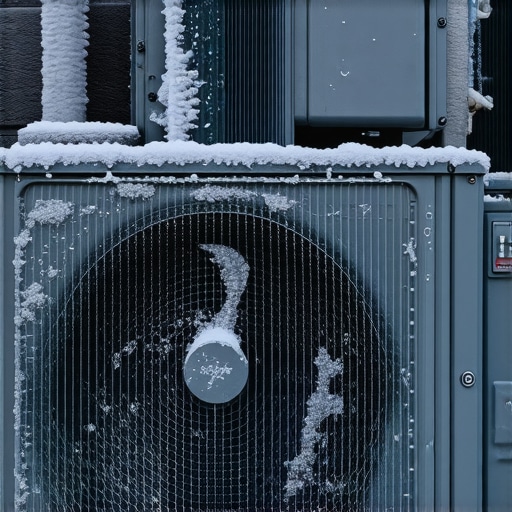
My old mentor, a grizzly veteran who could smell a burnt contactor from the driveway, used to scream at me, “You can’t cool what you can’t touch, and you can’t heat what you can’t find!” He was talking about the second law of thermodynamics. Heat doesn’t just appear; we move it. In the winter, your mini-split is literally trying to find ‘warmth’ in the freezing outdoor air to pump inside. When that outdoor coil gets colder than the dew point, frost starts to build. If that frost isn’t managed, the unit chokes.
The Defrost Cycle: The Necessary Evil
When you notice your mini-split losing heat in the dead of night, you are likely witnessing the ‘Defrost Cycle.’ To pull heat from 20-degree air, your outdoor unit’s coil has to be even colder—often well below zero. Moisture in the air hits that freezing aluminum and turns to ice instantly. Eventually, the ice blocks the airflow. To fix this, the unit reverses itself. It sends the hot ‘juice’ (refrigerant) back outside to melt the ice. During this time, the indoor head shuts its louvers or blows cool air to prevent slugging the compressor. This isn’t a call for furnace repair; it’s the machine breathing. However, if your unit stays in defrost for forty minutes, you’ve got a sensor or a charge issue.
The Myth of ‘Topping Off the Gas’
I followed a guy last week who told a homeowner they needed to ‘top off the Freon’ every winter. That’s a load of garbage. HVAC systems are sealed. If you are low on ‘gas,’ you have a leak, likely at a flare nut that some tin knocker or cut-rate installer didn’t torque down to spec. When the pressure drops, the boiling point of the refrigerant shifts. You end up with flash gas in the liquid line, and your heating capacity vanishes exactly when the load is highest. A proper heating service involves checking the subcooling and superheat, not just staring at a manifold and guessing. If your installer didn’t use a micron gauge during the AC installation phase to ensure a vacuum below 500 microns, moisture is currently turning into ice inside your EEV (Electronic Expansion Valve), causing it to ‘hunt’ and lose temperature control at night.
Static Pressure and the Airflow Manifesto
People love mini-splits because they don’t have ducts, but that doesn’t mean airflow isn’t king. I’ve seen homeowners ‘hide’ their indoor heads behind decorative valances or crown molding. This creates a short-circuit of air. The unit sucks in the warm air it just produced, thinks the room is 75 degrees, and ramps down the inverter while you’re shivering on the couch. This is where thermodynamic zooming comes in: the thermistor on the return air side is sensitive. If the velocity of the air isn’t sufficient to throw the heat across the room, the ‘sensible heat’ stays near the ceiling while the ‘latent heat’ (the stuff that makes you feel cold) stays at your feet.
“Design conditions for heating shall be based on the 99% dry-bulb temperature for the location.” – ACCA Manual J
The Inverter Struggle: Sensible vs. Latent Heat
In a cold climate like the Northeast, a mini-split has to work twice as hard to manage the sensible heat load. When the sun goes down, the house loses heat through the building envelope faster. If your unit is undersized—perhaps because someone skipped a Manual J load calculation during AC installation—it will run at 100% capacity (high hertz) until the compressor starts to overheat. At that point, the onboard logic will ‘clamp’ the frequency to protect the hardware. You get heat, but it’s weak heat. It’s the mechanical equivalent of a runner hitting the wall at mile 20.
When to Call for Professional Heating Service
If your louvers are dripping water, if the outdoor unit sounds like a jet engine trying to take off, or if you see a ‘P0’ error code, you aren’t in a defrost cycle; you have a component failure. Most often, it’s a failed thermistor or a Sparky-related power surge that fried a communication wire. Don’t let a sales-hungry tech talk you into a $12,000 replacement because of a $150 sensor. Demand a resistance test on the sensors and a pressure test on the lineset. Real HVAC work isn’t about swapping boxes; it’s about mastering the phase change of matter under pressure. Your comfort depends on a machine’s ability to manipulate physics, and when physics wins, you stay cold.