The Sound of a Failing Comfort System? Not Quite.
You’re lying in bed, the house is finally quiet, and then you hear it: a rhythmic, sharp click-click-tick coming from that expensive ductless head on the wall. To a homeowner, it sounds like a gear stripping or an electrical arc. To an old-school tin knocker like me, it sounds like physics doing exactly what physics does. I’ve spent thirty years dragging my tool bag through crawlspaces and balancing on ice-covered parapets, and if there is one thing I’ve learned, it’s that your mini-split isn’t haunted—it’s just struggling with its own skin. When you call for a heating service or an AC installation, most companies send a ‘Sales Tech’ who couldn’t tell a micron gauge from a meat thermometer. They’ll tell you the ‘flux capacitor’ is shot and you need a whole new system. They’re full of it. Most clicking is a result of material science, not mechanical failure.
The Mentor’s Lesson: You Can’t Cool What You Can’t Touch
My old mentor, a guy we called ‘Iron Lung’ because he could smell a refrigerant leak from across a parking lot, used to scream at me, ‘You can’t cool what you can’t touch!’ He wasn’t just talking about the AC installation of the evaporator coils; he was talking about the thermal transfer between the copper, the aluminum fins, and the plastic chassis. He taught me that every material in that indoor head—from the ABS plastic of the shroud to the copper ‘gas’ lines—has a different expansion coefficient. When that unit kicks on and drops the temperature of the coil below the dew point to strip out latent heat, the metal shrinks instantly. The plastic, however, takes its time. That friction between the shrinking metal and the stubborn plastic is where your clicking lives. It’s called ‘stiction,’ and it’s been the bane of my existence since the first inverter-driven units hit the market.
“The most expensive equipment in the world cannot overcome a bad duct system, nor can it bypass the fundamental laws of thermal expansion.” – Industry Axiom
The Forensic Diagnosis: The Plastic Creep
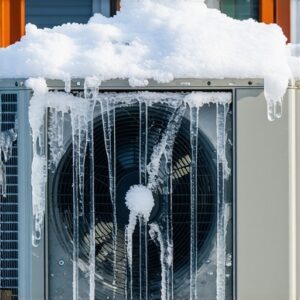
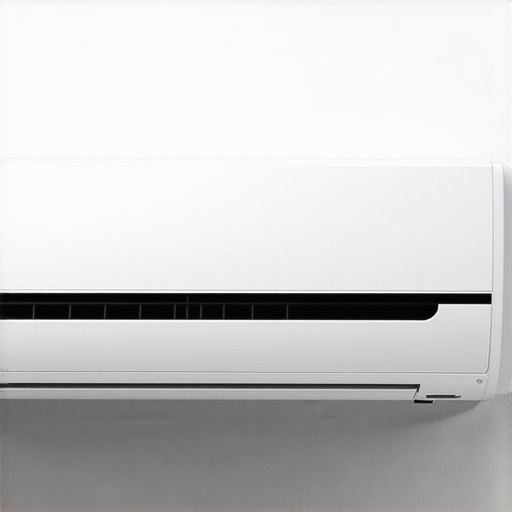
Let’s look at the mechanical anatomy of your mini-split. Inside that sleek white box is a coil that is getting hammered with 40°F refrigerant (the ‘juice’) when you’re in cooling mode. In the winter, during a furnace repair or when the heat pump is cranking, that coil might hit 110°F. In the North, where the polar vortex turns your outdoor unit into an ice cube, the system has to enter ‘Defrost Mode.’ This is the ‘Forensic Diagnosis’ of the click. During defrost, the unit suddenly reverses the flow of refrigerant to melt ice off the outdoor coil. The indoor fan stops, and the temperature of the indoor coil plummeting or skyrocketing creates a massive thermal shock. The plastic housing expands or contracts against the wall bracket. If your installer—likely some ‘Sparky’ moonlighting as an HVAC guy—tightened the mounting screws too hard, the plastic has nowhere to go. It buckles, it rubs, and it clicks.
Thermodynamic Zooming: Latent Heat and the Dew Point
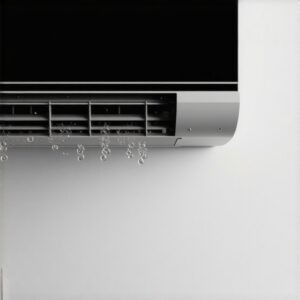
To understand the click, you have to understand the psychrometrics of the air in your room. When we perform an AC installation, we aren’t ‘adding cold’; we are removing heat. As the evaporator coil temperature drops, it crosses the dew point. This causes water vapor to condense into liquid on the fins. This liquid then drips into a plastic drain pan. If that drain pan is misaligned or the ‘Pookie’ (mastic) used to seal the penetrations is pulling at the chassis, the weight of the water combined with the temperature shift creates a physical shift in the unit’s center of gravity. You might hear a ‘thump’ followed by a ‘click.’ This is why airflow is king. If your filters are dirty, the coil gets too cold, the expansion is more violent, and the clicking gets louder. Heating service professionals often overlook this, focusing only on the BTU output rather than the static pressure and material stress.
“Designers shall account for the expansion and contraction of piping and components to prevent noise and structural damage.” – ASHRAE Standard 15
The Blower Wheel and the Screech
Not all clicks are thermal. If you hear a click that speeds up as the fan accelerates, you’re looking at a mechanical imbalance. These mini-split blower wheels are long, thin cylinders that look like squirrel cages. They are held in place by a single set screw on the motor shaft. Over time, vibration or dust accumulation (which turns into a heavy paste when mixed with condensate) can cause that wheel to wobble. That click-click-click is the edge of a plastic blade kissing the shroud. If you ignore this, you’ll eventually hear the screech of a bearing failing. This is common in furnace repair scenarios where a mini-split is used as a secondary heat source; it runs at high RPMs for months without a break, and the dust load becomes a wrecking ball for the motor’s balance.
The Regulatory Cliff: Why You Should Fix, Not Replace
We are currently facing the ‘Regulatory Cliff’ of 2025. The EPA is phasing out R-410A refrigerant in favor of A2L refrigerants like R-454B. These new gases are ‘mildly flammable,’ requiring new sensors and higher costs. If a ‘Sales Tech’ tries to sell you a new system because of a clicking noise, show them the door. A clicking mini-split usually just needs a ‘Deep Clean’ and some strategic lubrication. We use a specialty silicone grease on the contact points where the evaporator coil meets the plastic chassis. This allows the parts to slide past each other silently as they expand. It’s a $200 service versus an $8,000 replacement. Don’t let them ‘juice’ you for a new unit when yours just needs a little breathing room.
Conclusion: Comfort is Physics
At the end of the day, a mini-split is a precision instrument. It’s not a window shaker you bought at a big-box store. The clicking is a signal that the physics of the room—the humidity, the temperature delta, and the mounting tension—are out of sync. Whether you need furnace repair in the dead of a Chicago winter or a fresh AC installation in a humid coastal town, remember that airflow and expansion are the two gods of HVAC. If your tech doesn’t talk about ‘Static Pressure’ or ‘Expansion Coefficients,’ he’s just a guy with a manifold gauge. Get a pro who knows the difference between a mechanical failure and a thermodynamic reality. Your ears, and your wallet, will thank you.