The Physics of the Ceiling: Why Your Mini-Split is Lying to You
I remember my old mentor, a grizzled veteran we called ‘Gears’ because he could hear a chipped tooth in a blower motor from three rooms away, used to scream at me whenever I reached for a hammer without thinking. ‘You can’t cool what you can’t touch!’ he’d bark. He wasn’t talking about the physical unit; he was talking about the air. Airflow is the beginning and the end of this trade. If you don’t respect the way air moves, you’re just a glorified parts-changer. When it comes to AC installation, specifically ductless mini-splits, the most common sin isn’t a bad flare or a leak—it’s mounting the head unit so high that it chokes on its own supply.
“The most expensive equipment in the world cannot overcome a bad duct system—or in the case of ductless, a bad placement that ignores the laws of fluid dynamics.” – Industry Axiom
We see it all the time: a homeowner or a lazy tin knocker wants the unit tucked right against the ceiling so it stays ‘out of sight.’ Big mistake. You’re fighting the very physics that make the system work. To understand the best height, you have to understand Thermodynamic Zooming. The evaporator coil inside that plastic shroud is designed to drop below the dew point. As the warm, moist air from your room is pulled across those fins, the latent heat is removed—that’s the energy used to turn water vapor into liquid. If you mount that unit two inches from the ceiling, you are trapping a layer of stagnant, super-heated air right at the return-air sensor. The unit thinks the room is 90 degrees when it’s actually 72, causing the inverter to ramp up and waste ‘juice’ (refrigerant) for no reason.
The 7-Foot Sweet Spot: Why Elevation Matters
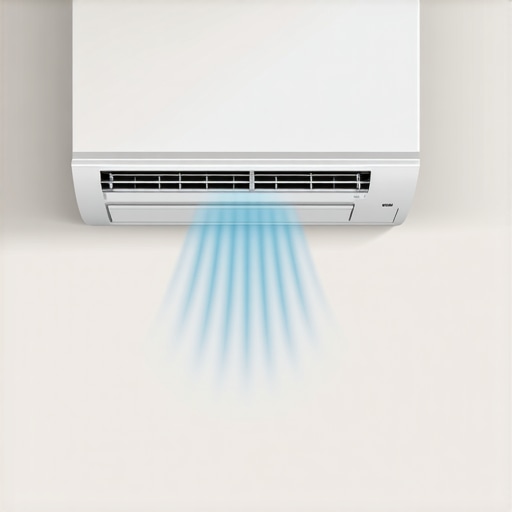
For most residential applications, the magic number is between 7 and 8 feet from the floor. Why? Because you need to leverage the Coanda effect—the tendency of a fluid jet to stay attached to a convex surface. When a mini-split is mounted at 7.5 feet, the cold, dense air can be thrown across the room, gradually sinking as it displaces the warmer air below. If you put it at 10 feet in a high-ceiling room, the cold air often ‘drops’ too fast, creating a cold zone directly under the unit while leaving the rest of the room as a humid swamp. This is especially true for mini-split setups in the Southeast, where latent heat (humidity) is the primary enemy. You need that air to circulate long enough to strip the moisture out, or you’ll end up with a house that feels like a cold locker in the middle of the Everglades.
The Breathing Room: Clearance is King
Every manufacturer has a spec sheet, but most ‘sales techs’ never read them. Most units require a minimum of 4 to 6 inches of clearance from the top of the unit to the ceiling. Why? Because that’s where the return air lives. A mini-split is a giant lung. If you put its ‘nose’ against the wall, it can’t breathe. When the return air is restricted, the static pressure increases, the fan motor works harder (shortening its life), and the coil temperature can drop so low that it starts to ice up. I’ve seen ‘ice balls’ the size of watermelons inside units because a sparky (electrician) or a DIYer thought it looked better ‘snug’ against the crown molding. Use your tape measure; your heating service bills will thank you when the unit isn’t fighting itself.
“Equipment capacity is a function of airflow; if the mass flow rate of air across the evaporator is diminished, the thermodynamic cycle is compromised.” – ASHRAE Standards
The Climate Logic: Sensible vs. Latent Heat
If you’re in a humid climate, the height is even more critical because of short-cycling. An oversized or poorly placed unit will satisfy the thermostat’s ‘sensible heat’ (temperature) requirement in five minutes, but it won’t run long enough to pull the ‘latent heat’ (humidity) out of the air. This results in the dreaded ‘Cold and Clammy’ syndrome. You want the unit mounted at a height where the internal sensor can get a true reading of the room’s average temperature, not just the heat trapped at the ceiling. If you’re dealing with a furnace repair or an old central air system that’s failing, and you’re switching to mini-splits, don’t let the installer just ‘slap it on the wall.’ Demand they check the stratification levels of the room first.
Installation Realities: The Suction Line and ‘Pookie’
When we do an AC installation, we aren’t just looking at the height for the air; we’re looking at the drainage. Gravity is your friend. If you mount the unit too high and don’t have a clear path for the condensate line to slope downward, you’re going to need a condensate pump. Those pumps are notorious for failing at 2 AM on a Sunday. By mounting at the 7-8 foot mark, you usually have enough wall space to create a proper pitch for the line set. And don’t get me started on the sealant. We use ‘Pookie’ (mastic) or high-grade silicone to seal that wall penetration. If you don’t, you’re just inviting humid air from the wall cavity to bypass the coil entirely, messing up your psychrometric calculations and leading to mold growth behind the unit.
Final Verdict for the Homeowner
If your installer tells you ‘it doesn’t matter’ where it goes, find a new installer. The best height is high enough to be out of the way, but low enough (usually 7 to 8 feet) to maintain a minimum 6-inch gap from the ceiling. This ensures the mini-split can breathe, the sensor can read accurately, and the air can properly mix. Anything else is just asking for a service call in three years when the compressor starts screaming like a banshee because it’s been slugging liquid refrigerant due to low airflow. Keep it cold, keep it dry, and for heaven’s sake, keep it clear of the ceiling.