The Ghost in the Machine: When “Off” Doesn’t Mean Off
You’ve done it. You’ve walked over to the thermostat, heard that satisfying click, and set the system to ‘Off.’ You expect silence. You expect the hum of the condenser to fade into the neighborhood background noise. But instead, you hear it—that low, rhythmic drone of the compressor outside, still hammering away. This isn’t a haunting; it’s a mechanical failure of the contactor, and it’s the kind of thing that burns out compressors and sends electric bills into the stratosphere. Most homeowners think they need a full AC installation when this happens, but a seasoned tech knows we’re likely looking at a twenty-dollar part that’s decided to weld itself into a permanent ‘on’ position.
The Savannah Sting: A Narrative of Pitting and Greed
I remember a call I took last August in Savannah. The humidity was thick enough to chew, and I was following a ‘Sales Tech’ from one of those big-box franchises that spends more on wraps for their vans than they do on diagnostic tools. He had quoted a retired schoolteacher $14,500 for a total system replacement, claiming her compressor was ‘locked’ and the ‘internal windings were grounded.’ When I pulled the service disconnect, the compressor stopped. When I put it back in, it started immediately, even with the low-voltage wires disconnected. I popped the cover on the side of the unit and there it was: a common field mouse had crawled behind the contactor, got fried, and the resulting arc had literally welded the silver-cadmium points together. The ‘Sales Tech’ didn’t even look. He just saw an old unit and reached for his commission-based iPad. I cleaned the terminals, replaced the contactor for a fraction of his quote, and she was back in business. That’s the difference between a parts-changer and a technician who understands the physics of the arc.
“The most expensive equipment in the world cannot overcome a bad duct system, nor can it survive the electrical abuse of a chattering contactor.” – Industry Axiom
The Anatomy of the Arc: How a Contactor Actually Works
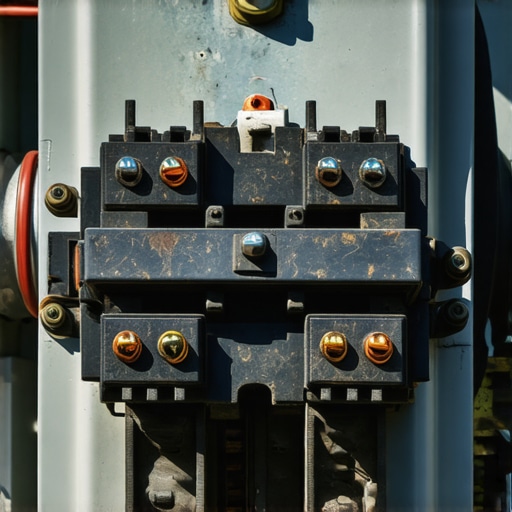
To understand why your unit is staying on, you have to understand the contactor. Think of it as the gatekeeper. It’s an electromagnetic switch. When your thermostat calls for cooling, it sends 24 volts to a coil. This coil creates a magnetic field that pulls down a metal bridge, closing the circuit and sending 240 volts of ‘juice’ to the compressor and the fan motor. The problem is that every time those points touch, a tiny spark—an arc—is created. Over years of thousands of cycles, this creates ‘pitting.’ Eventually, that arc gets hot enough to melt the metal slightly, and the two sides fuse together. Now, the gate is stuck open. The compressor keeps pumping gas, regardless of what the thermostat says. This is where Thermodynamic Zooming comes into play. Because the indoor blower fan is usually controlled by the furnace board, it might actually shut off. Now you have a compressor running with no indoor airflow. The evaporator coil drops far below the dew point, and because there’s no heat to exchange, the refrigerant stays in a liquid state. That liquid refrigerant starts ‘slugging’ back to the compressor. Compressors are designed to compress gas, not liquid. You try to compress a liquid, and you’ll snap a connecting rod faster than a dry twig.
The Southern Humidity Factor: Latent Heat and the Frozen Coil
In high-humidity zones like the Gulf Coast or the Carolinas, a stuck contactor is a recipe for a flooded house. We deal with massive amounts of latent heat—that’s the energy stored in the moisture in the air. When that contactor sticks and the coil freezes into a solid block of ice, that ice has to go somewhere when the unit finally dies or is shut off. I’ve seen drain pans overflow and ruin ceilings because a $30 part stayed closed too long. If you’re seeing ice on the suction line—that’s the big insulated copper pipe that should be ‘beer can cold’—you need to pull the disconnect immediately. Don’t wait for a heating service or a furnace repair tech to tell you your heat exchanger is fine; the damage is happening outside at the condenser. If you have a mini-split, the logic is different as they use solid-state relays or inverters, but for traditional split systems, the contactor is the most common point of mechanical-electrical failure.
“Standard 62.2 defines the roles of mechanical ventilation, but no regulation can protect a compressor from a welded contactor that bypasses all safety limits.” – ASHRAE Standards Reference
The Math: Repair ($150) vs. Replace ($10,000)
This is where the ‘Sparky’ (electrician) and the HVAC tech often butt heads. Is it worth fixing an 11-year-old R-410A system? If the coil is clean and the compressor sounds healthy—no screeching bearings or acidic ‘sour’ smells from the refrigerant—then yes, you replace the contactor. But you don’t just swap the part. You look for why it failed. Was the low voltage ‘chattering’ because of a bad thermostat wire? Was the Pookie (mastic) on the cabinet leaking air and allowing dust to coat the electrical components? If you just slap a part in without checking the static pressure and the ‘gas’ levels, you’re just a ‘Tin Knocker’ playing at being a tech. A real diagnostic involves checking the capacitors too. A weak capacitor makes the motor draw more amps, which puts more heat through those contactor points, accelerating the pitting process. It’s a holistic ecosystem, not a collection of random parts. If you find yourself needing constant AC installation quotes, it might be because your previous techs weren’t looking at the root cause of electrical wear.
The 2025 Regulatory Cliff and Your Decision
As we move toward the new A2L refrigerants, the cost of these components is going to climb. We are seeing a shift in the industry where even a simple heating service call is becoming a data-mining expedition for sales teams. If your AC is running while ‘off,’ check your contactor. Look for ants—they are attracted to the electromagnetic field and often get crushed between the points, causing a bridge that leads to failure. It’s a simple fix that saves your compressor’s life. Don’t let a ‘Sales Tech’ turn a minor electrical hiccup into a five-figure debt. Understanding the physics of your system is the only way to keep your home comfortable without being taken for a ride. Control the airflow, maintain the electrical contact, and respect the thermodynamics of the cycle.