The Sound of Wasted Money in the Service Bay
Walk into any multi-truck repair shop in the dead of February, and you’ll hear it: the roar of a high-efficiency furnace trying to heat the entire outdoors. You smell it, too—that faint scent of burning dust and scorched heat exchangers. Every time a 14-foot overhead door rolls up to let a Peterbilt in, thousands of dollars in BTUs vanish into the gray winter sky. Most shop owners think that’s just the cost of doing business. They listen to some ‘Sales Tech’ who tells them their 20-year-old units are ‘tired’ and quotes them $50,000 for a total AC installation and furnace overhaul. But here is the truth from someone who has spent thirty years with a manifold gauge in one hand and a thermal camera in the other: your equipment probably isn’t the problem. Your physics are.
The $15,000 Lie: A Tale from the Service Trenches
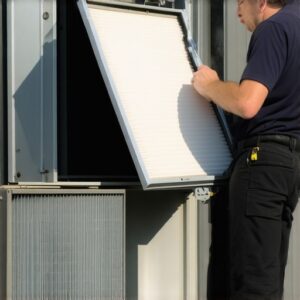
Last winter, I followed a technician—let’s call him a ‘Sales Professional’—to a fleet maintenance shop that had six trucks in the bays. The owner was frantic; his heating service bills had tripled, and the guys in the shop were still wearing parkas under their coveralls. The previous tech had spent ten minutes looking at the data plates and told the owner he needed four new 5-ton rooftop units (RTUs) because the current ones were ‘undersized for the cubic footage.’ I walked in, grabbed my monometer, and checked the static pressure. The blowers were screaming, trying to pull air through filters that looked like they had been used to scrub grease off a shop floor. I spent two hours cleaning the secondary heat exchangers and adjusting the gas pressure. The total parts cost? About $20 in cleaning solution and a few new filters. I caught that ‘Sales Tech’ trying to commission his way into a new boat while this shop owner was nearly ready to lay off a mechanic to pay the gas bill. You don’t always need a new unit; you need an expert furnace repair and a lesson in fluid dynamics.
“The most expensive equipment in the world cannot overcome a bad duct system.” – Industry Axiom
The Physics of the Shop: Why ‘Horsepower’ Fails
In a commercial shop environment, we aren’t just moving air; we are fighting the laws of thermal stratification. Heat is lazy. It wants to sit right under your corrugated metal roof, thirty feet above the heads of your mechanics. When you call for heating service, most guys just check the flame sensor and leave. A real tech looks at how that heat is distributed. If your supply registers are pointed straight down at a truck cab, the heat hits the metal, bounces, and rises. You are effectively heating the top of a Freightliner while your ‘Sparky’ or ‘Tin Knocker’ is freezing on the concrete floor. We use Thermodynamic Zooming to understand this: the air coming out of that furnace is roughly 120°F. By the time it mixes with the 40°F air near an open bay door, the sensible heat is lost. You need high-volume, low-speed (HVLS) fans to push that heat back down, or you are literally burning ‘juice’ for nothing.
The Mini-Split Solution for the Front Office
While the shop floor is a battleground of air exchange, the front office and the parts room are different animals. Running a massive 10-ton RTU just to keep the service writers comfortable is a classic mistake. This is where a mini-split system becomes a game-changer. By decoupling the office climate from the shop’s massive air volume, you stop short-cycling the main furnace. Short-cycling is the silent killer of compressors and heat exchangers. Every time those big contactors slam shut, it’s a spike in your demand charge on the electric bill. A mini-split allows you to maintain ‘beer can cold’ temps in the waiting room without trying to air-condition the entire garage when the AC installation in the main bay is overkill.
The 2025 Regulatory Cliff: R-454B and Your Future
If you are planning a major AC installation, you need to understand the ‘Gas’ change. We are moving away from R-410A to A2L refrigerants like R-454B. These are ‘mildly flammable.’ That means new units will have leak sensors and spark-proof contactors. If a ‘Sales Tech’ tries to dump old R-410A stock on you at a ‘discount,’ be careful. Parts for those units will skyrocket in price over the next decade. You want a system designed for the future, not a legacy ‘Pookie’ job held together with duct tape and hope.
“Design of ventilation systems for vehicle maintenance areas must account for the rapid exchange of air and the stratification of thermal loads.” – ASHRAE Standard 62.1
The Secret: Static Pressure and ‘Pookie’
The real secret to lower bills? It’s the Tin Knocker’s best friend: Mastic (we call it ‘Pookie’). Most commercial shop ducts leak 20% to 30% of their air before it ever hits the register. That’s air you paid to heat or cool that is now sitting in the ceiling joists. When we perform a furnace repair, we don’t just look at the burner; we look at the ‘Suction Line’ and the supply plenums. If your static pressure is too high because your ducts are too small or restricted, your blower motor is working double-time, drawing more amps and killing its bearings. It’s like trying to breathe through a cocktail straw while running a marathon. Seal your ducts, clean your coils, and stop letting the ‘Sales Techs’ tell you that a bigger box is the answer to a dirty system.