The Ghostly Glow: Why Your Furnace Flame Just Changed Colors
You probably don’t think about your furnace until the thermostat clicks and nothing happens, or until you smell something that reminds you of a burnt dusty attic. But if you’re the type to actually peer through that little observation window on your furnace cabinet, you’re looking for a crisp, steady blue cone of fire. If you see something that looks like a flickering campfire—lazy, dancing, and distinctly yellow or orange—you aren’t looking at ‘warmth.’ You’re looking at a chemical failure that could kill your family in their sleep. My old mentor, a guy who had been a tin knocker since the Eisenhower administration, used to grab me by the collar and scream, ‘You can’t heat what you can’t burn right!’ He wasn’t talking about the wood in a fireplace; he was talking about the stoichiometric ratio. If the physics of the combustion isn’t perfect, the furnace isn’t a heater anymore; it’s a carbon monoxide factory.
The Thermodynamic Reality of Combustion
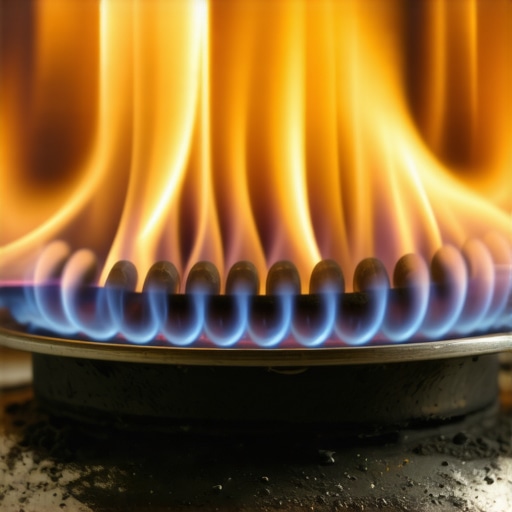
Let’s do some thermodynamic zooming. In a properly functioning gas furnace, methane (natural gas) or propane mixes with oxygen in a very specific ratio. When the igniter glows or the pilot sparks, that mixture should undergo complete combustion. The blue color is a signature of high-temperature, efficient energy release where the hydrocarbons are fully oxidized. When that flame turns yellow, it’s a sign of ‘incomplete combustion.’ This happens because the flame is ‘lazy’—it’s starved for oxygen or contaminated by dust, scale, or a failing burner assembly. That yellow tip is actually incandescent carbon particles—soot—that are glowing because they haven’t been burned off. While a furnace repair guy might just see a dirty burner, I see a system that is failing to manage its latent heat and is instead dumping toxic byproducts into your heat exchanger. [IMAGE_PLACEHOLDER]
“Carbon monoxide is a byproduct of incomplete combustion; any change in flame color from blue to yellow is a primary indicator of a hazardous condition.” – NFPA 54: National Fuel Gas Code
The Anatomy of a Failing Burner
When I go out for a heating service call in the dead of a Chicago winter, I’m not just looking for a broken part; I’m performing a mechanical autopsy. The furnace is a series of organs. The gas valve is the heart, the control board is the brain, and the burners are the lungs. If those burners are clogged with spider webs or rust (the ‘scum’ of the HVAC world), the air-to-gas mixture gets wonky. You’ll see the flame start to ‘waver.’ This is where the ‘Sales Techs’ start salivating. They’ll see a yellow flame and immediately tell a homeowner they need a $12,000 AC installation and furnace combo. But a real tech knows to check the manifold pressure and the inducer motor first. If the inducer (that small fan that draws the exhaust out) isn’t pulling hard enough, the flame doesn’t get enough oxygen. It’s like trying to breathe through a cocktail straw while running a marathon.
The Cracked Heat Exchanger: The Silent Killer
The biggest fear with a yellow flame isn’t just a lack of efficiency; it’s the ‘Flame Rollout.’ When the combustion is dirty, it creates soot. That soot coats the inside of the heat exchanger—the metal serpentine tubes that keep the fire away from the air you breathe. Soot acts as an insulator, making the metal get hotter than it was ever designed to be. Eventually, the metal stresses, expands, and cracks. Now, that yellow, carbon-monoxide-rich flame is being blown directly into your ductwork by the blower fan. This is why I tell people that a furnace repair isn’t something you ‘get around to’ next month. If you see yellow, you shut the gas off. Period. No exceptions. This isn’t a mini-split where a leak just means your juice (refrigerant) is gone; this is a life-safety issue.
“The heat exchanger must be inspected annually for cracks or breaches to ensure that combustion byproducts do not enter the conditioned air stream.” – ACCA Standard 4
Repair vs. Replace: The $5,000 Question
I’ve seen folks spend $800 on a new gas valve and inducer motor for a twenty-year-old furnace that belonged in a scrap yard. If your unit is over 15 years old and you’re seeing yellow flames despite a cleaning, you’re looking at a compromised heat exchanger. At that point, the math is simple. A new heat exchanger might cost you $2,000 in labor and parts, while a new 96% AFUE furnace might be $5,000. Why would you put a new transmission in a car with 300,000 miles and a rusted frame? When I’m sizing a new system, I’m looking at the static pressure of your tin (ductwork). If your old furnace was ‘cooking’ itself because the ducts were too small, a new one will do the exact same thing unless you fix the airflow. Airflow is king. Always was, always will be.
Don’t Fall for the ‘Sparky’ Fix
I’ve followed behind many a ‘Sparky’ (electrician) or a handyman who tried to fix a yellow flame by just vacuuming the outside of the furnace. That’s like trying to cure a lung infection by brushing your teeth. You have to pull the burner tray. You have to scrub the orifices. You have to check the flue vent for bird nests or ice buildup during a polar vortex. If you live in a cold climate, the high-efficiency PVC vents can often get blocked by ‘hoar frost,’ which chokes the furnace and turns those flames yellow. It’s a simple fix, but if you don’t know the physics, you’ll end up replaced a perfectly good control board for no reason.
Conclusion: Respect the Fire
At the end of the day, your furnace is a controlled explosion inside a box in your basement. Respect it. If those flames aren’t a sharp, surgical blue, you aren’t just losing money on your gas bill; you’re gambling with your health. Get a pro who knows how to use a combustion analyzer, not just a guy with a flashlight and a sales pitch. Maintenance is cheaper than a funeral, and it’s certainly cheaper than a 2 AM emergency heating service call on New Year’s Eve when the ambient temp is -10°F and every tin knocker in town is already booked solid.