The Anatomy of a Slow Death inside Your Air Handler
The house isn’t cooling quite right, the humidity is climbing, and you hear a faint, metallic hiss coming from your utility closet. As a technician who has spent more than three decades crawling through dusty joists and tracing refrigerant leaks, I can tell you that a leaking evaporator coil is one of the most frustrating failures an owner can face. It does not happen with a dramatic bang; it is a slow, agonizing bleed of your system’s lifeblood that robs you of comfort and runs up your electric bill before the compressor finally overheats and dies.
We are dealing with a thermodynamic battleground. The evaporator coil is where the actual heat transfer occurs. Liquid refrigerant, under high pressure, passes through an expansion valve and drops in pressure, becoming a cold liquid-vapor mix. As your indoor fan blows warm, humid return air across these aluminum or copper fins, the refrigerant absorbs that heat (sensible heat) and causes the moisture in the air to condense on the cold metal (latent heat). This water drains away, leaving you with cool, dry air. But when a microscopic pinhole forms in that copper tubing, the system loses its ability to change states efficiently.
The Sales Tech Scam: How I Saved a Homeowner from a $14,000 Mistake
Just last August, I followed a corporate “Sales Tech” who had visited a retired schoolteacher in our community. He had slapped his gauges on her system, saw a low suction pressure, and immediately quoted her $14,000 for a complete AC installation, claiming her compressor was completely shot and the system was a biohazard. I arrived for a second opinion. I pulled the front panel off her air handler, sniffed the air, and immediately smelled that telltale oily, chemical odor of escaped polyester (POE) lubricant mixed with a tiny bit of remaining gas. Her compressor was perfectly fine. Her evaporator coil had a tiny formicary corrosion leak at the copper bend. A simple coil replacement, a thorough system flush, and a proper vacuum pull saved her over $12,000. That ‘sales guy’ didn’t even own a leak detector; he just carried a iPad with financing brochures.
“The physical laws governing heat transfer do not care about your sales quotas. A system with restricted airflow or incorrect refrigerant charge will fail prematurely, regardless of brand.” – HVAC Operational Manual
The Physics of the Leaking Coil: Why the South Suffers Most
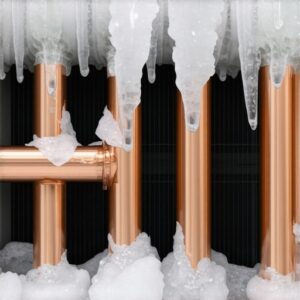
In hot, humid climates, a leaking evaporator coil is an absolute disaster. When your refrigerant, or “juice” as we old-timers call it, leaks out, the evaporating temperature inside the coil drops below the freezing point of water. Instead of dropping the indoor air below its dew point and draining the moisture out of the house, the condensate freezes solid on the fins. This creates a solid block of ice that completely chokes off your airflow.
Once that airflow is blocked, the system can no longer absorb heat. The compressor, which relies on cool returning refrigerant gas to keep its windings cool, begins to overheat. You will notice the air from your supply vents feels warm and sticky. The house turns into a muggy, miserable swamp because the system is short-cycling or running continuously without removing a single drop of latent moisture. If you let this go on too long, that liquid refrigerant slugging back to the compressor will wash out the oil and destroy the pistons or scrolls.
“The rate of vapor transmission through building materials is governed by vapor pressure differences. Without proper coil temperature maintenance, latent load control is entirely lost.” – ASHRAE Fundamentals Handbook
Four Critical Warning Signs of a Coil Leak
You do not need to wait for the system to stop blowing cold air entirely to know you have a leak. Here are the four primary warning signs you can spot yourself:
- The Sweet, Chemical Smell: Refrigerant oil has a distinct, chemically sweet, sometimes slightly acidic smell. If you open your closet or attic door where the air handler is located and get a whiff of this oily scent, your coil is likely weeping.
- The Hissing Sound: A microscopic hole under several hundred pounds of pressure can sound like a tiny, angry snake hidden behind the sheet metal. Listen closely to the coil cabinet while the unit is running.
- Ice Accumulation on the Suction Line: Go outside to your condenser. Look at the larger copper pipe covered in black foam insulation. If you see ice forming on the exposed brass valve or running up the line, your indoor coil is already freezing over due to low refrigerant. It should be “beer can cold,” wet with condensation, but never frozen.
- Unexplained Utility Spikes: Because a leaking system runs constantly to try and satisfy the thermostat, your power bill will skyrocket long before the house actually feels hot.
Properties like furnace repair and heating service are often called in when homeowners confuse a frozen air handler with a furnace blower failure. In reality, the heating service technician often finds a rusted-out evaporator coil that has leaked all its gas, leaving the blower running empty.
The Root Cause: Formicary Corrosion
Why do these modern coils leak so often? Older units from thirty years ago had thick copper walls that lasted decades. Modern coils use incredibly thin copper tubes to meet high SEER efficiency standards, or they are made entirely of aluminum. When household chemicals—like off-gassing paints, cleaning agents, cosmetics, or even building materials—mix with moisture on the cold coil, they form formic acid. This acid eats microscopic tunnels through the copper, creating what we call formicary corrosion. It looks like gray or black ash on the copper bends, accompanied by tiny oil spots where the lubricant has escaped along with the gas.
The Solution: Repair vs. Replace
Can you patch a leaking coil? In 99% of cases, the answer is no. Trying to braze a copper tube that has been eaten away by formicary corrosion is like trying to weld wet cardboard. The metal is too thin, and the corrosion is widespread. The only real solution is a full coil replacement or, if the system is more than ten years old and running on obsolete R-22 refrigerant, a completely new AC installation.
If you are looking at a newer system, a ductless mini-split might be a viable alternative. These systems utilize localized evaporator coils inside each room, eliminating the massive duct networks that often cause high static pressure. High static pressure makes your blower work harder, raising indoor humidity levels and forcing the coil to run colder, which accelerates the corrosive condensation cycle.
When hiring a contractor for an AC installation or a complex furnace repair, make sure they perform a true nitrogen pressure test and bubble test to prove where the leak is. Never let a technician simply “top off the gas” without finding and fixing the leak. That is not just bad service; venting refrigerant is a direct violation of EPA federal law.